
Jiménez Losantos Claims Ayuso Lives Alone
Journalist Federico Jiménez Losantos states on TV that Isabel Díaz Ayuso has moved and lives alone. No official confirmation exists.
English · Original discussion in Spanish · Published
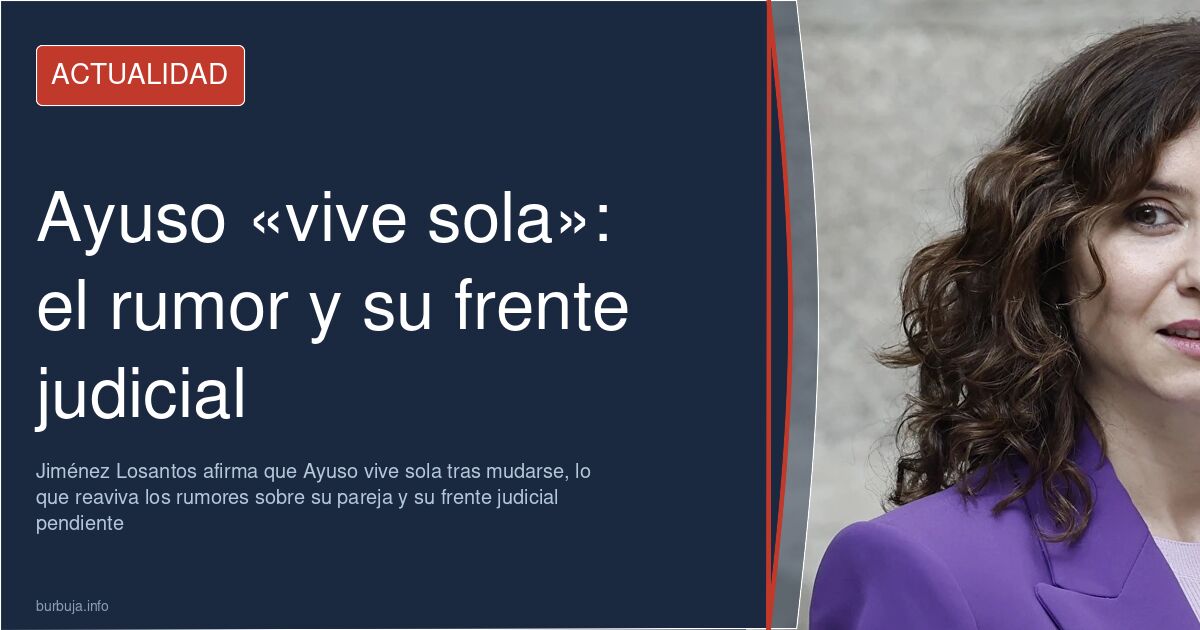
Jiménez Losantos Claims Ayuso Lives Alone
Isabel Díaz Ayuso lives alone. This claim does not come from an official statement or anonymous leak: it was raised by Federico Jiménez Losantos on Ana Rosa's program, backed by his long-standing direct line with the Madrid regional president and his track record of knowing private details before anyone else. For any other politician, this data would be anecdotal; here it acts as a thermometer: if her relationship with Alberto González Amador has broken down, his judicial calendar ceases to be a domestic matter and becomes a political management problem.
What It Means for Ayuso to Be Single
The question "Is Ayuso single?" has had an answer in Madrid's gossip circles for weeks, but the rumor only gained status as information after the journalist's intervention. Losantos is no ordinary commentator in this ecosystem: his alignment with the president is well-known, and previous insights into her circle have often been confirmed. Therefore, the move is not read as a simple change of address.
The material detail—a regional president now living alone—matters less than its political reading. Once the romantic relationship cools or breaks, the focus shifts away from González Amador: he is no longer the president's partner, but a private individual with open cases. There, the president gains distance, although she loses the narrative of personal stability that has served as a shield against attacks for months.
González Amador's Judicial Future Without Emotional Cover
The most circulating hypothesis is that the breakup anticipates an adverse judicial outcome for the couple. There is no sentence, no final resolution, no official confirmation of anything. The only verifiable fact is that, according to published reports, the relationship no longer exists as such. From there, each analyst makes their bet: some read the move as preventive shielding; others, as a simple consequence of long-standing deterioration.
What changes is the architecture of the narrative. While they were a couple, any judicial blow against González Amador splashed onto the president by osmosis. Without a partner, the blow remains in the private sphere of a third party. If this is indeed a maneuver, it is textbook.
The Profile Opposition Has Tried to Fit for Years
There is a line of analysis that has long been constructing a specific profile: woman near fifty, childless, with pets, several failed relationships, and renting housing. Each element has been used as a piece of a narrative aiming to dehumanize the president or, in the most cynical version, present her as someone without roots. It is an old framework, but it works in certain circles.
The problem with that framework is that it relies on data that do not withstand serious scrutiny. The Madrid president has three dogs, yes. She rents, also. And neither circumstance says anything about her management capacity. That the opposition and its media outlets insist on the personal profile reveals more about them than about her.
Ecosystem Reaction: From Gossip to Analysis
Public conversation on the topic has oscillated between easy jokes and political analysis. At one extreme, comments on her attractiveness, age, or marital status. At the other, readings on the judicial calendar, communication strategy, and wear of the official narrative. The mix is uncomfortable but accurately portrays the state of Spanish public debate: any issue involving a public figure becomes bar-talk material.
What is clear is that the move has triggered all alarms. If the president is single, her private life stops being an electoral asset and becomes a flank. In politics, flanks are exploited quickly.
The matter stays exactly where it was: no official confirmation, no sentence, no conclusion. Only a move, a well-connected journalist, and a question that still lacks an institutional answer.
Isabel Díaz Ayuso lives alone. This claim does not come from an official statement or anonymous leak: it was raised by Federico Jiménez Losantos on Ana Rosa's program, backed by his long-standing direct line with the Madrid regional president and his track record of knowing private details before anyone else. For any other politician, this data would be anecdotal; here it acts as a thermometer: if her relationship with Alberto González Amador has broken down, his judicial calendar ceases to be a domestic matter and becomes a political management problem.
What It Means for Ayuso to Be Single
The question "Is Ayuso single?" has had an answer in Madrid's gossip circles for weeks, but the rumor only gained status as information after the journalist's intervention. Losantos is no ordinary commentator in this ecosystem: his alignment with the president is well-known, and previous insights into her circle have often been confirmed. Therefore, the move is not read as a simple change of address.
The material detail—a regional president now living alone—matters less than its political reading. Once the romantic relationship cools or breaks, the focus shifts away from González Amador: he is no longer the president's partner, but a private individual with open cases. There, the president gains distance, although she loses the narrative of personal stability that has served as a shield against attacks for months.
González Amador's Judicial Future Without Emotional Cover
The most circulating hypothesis is that the breakup anticipates an adverse judicial outcome for the couple. There is no sentence, no final resolution, no official confirmation of anything. The only verifiable fact is that, according to published reports, the relationship no longer exists as such. From there, each analyst makes their bet: some read the move as preventive shielding; others, as a simple consequence of long-standing deterioration.
What changes is the architecture of the narrative. While they were a couple, any judicial blow against González Amador splashed onto the president by osmosis. Without a partner, the blow remains in the private sphere of a third party. If this is indeed a maneuver, it is textbook.
The Profile Opposition Has Tried to Fit for Years
There is a line of analysis that has long been constructing a specific profile: woman near fifty, childless, with pets, several failed relationships, and renting housing. Each element has been used as a piece of a narrative aiming to dehumanize the president or, in the most cynical version, present her as someone without roots. It is an old framework, but it works in certain circles.
The problem with that framework is that it relies on data that do not withstand serious scrutiny. The Madrid president has three dogs, yes. She rents, also. And neither circumstance says anything about her management capacity. That the opposition and its media outlets insist on the personal profile reveals more about them than about her.
Ecosystem Reaction: From Gossip to Analysis
Public conversation on the topic has oscillated between easy jokes and political analysis. At one extreme, comments on her attractiveness, age, or marital status. At the other, readings on the judicial calendar, communication strategy, and wear of the official narrative. The mix is uncomfortable but accurately portrays the state of Spanish public debate: any issue involving a public figure becomes bar-talk material.
What is clear is that the move has triggered all alarms. If the president is single, her private life stops being an electoral asset and becomes a flank. In politics, flanks are exploited quickly.
The matter stays exactly where it was: no official confirmation, no sentence, no conclusion. Only a move, a well-connected journalist, and a question that still lacks an institutional answer.
Also available in: Deutsch
Summary of a discussion on Burbuja.info - Foro de economía, actualidad y política., translated from Spanish and reviewed before publication. Read the full discussion (40 replies).
More summaries
-
Half of Spain's renters are now foreigners, forum claims
A forum post claims 5 million foreigners rent in Spain, while tourism accounts for only 10% of the market, sparking debate on housing shortages.
-
Bilbao man hospitalized after intervening in couple's argument
An 18-year-old with boxing training was arrested in Bilbao for severely injuring a 46-year-old who tried to mediate his domestic dispute.
-
Vox polls surge to 19%, seats double to 70
Polls show Vox reaching 18.8% and doubling seats to 70, bringing PP-Vox coalition close to absolute majority.
-
Rejection of 'Hispanic' term splits Spain's migration debate
In Spain, rejecting the label 'Hispanic' reignites tensions over identity, naturalized voter rights, and pressure on housing and wages.
-
Are Madrid voters foolish? Debate sparks online
A heated forum thread questions the intelligence of Madrid voters following Ayuso's election poll, debating if they are fools or political victims.
-
Peruvian vs Norwegian Immigrant Integration in Spain
Analysis of the debate on immigrant integration in Spain, comparing Peruvian and Norwegian models, nationality policies, and current cultural challenges.