
Heat decides how fast an EV battery degrades
An electric car parked at 100% charge in the garage can lose between 4% and 8% of capacity per year, versus 1-2% at medium charge, according to the debate.
English · Original discussion in Spanish · Published
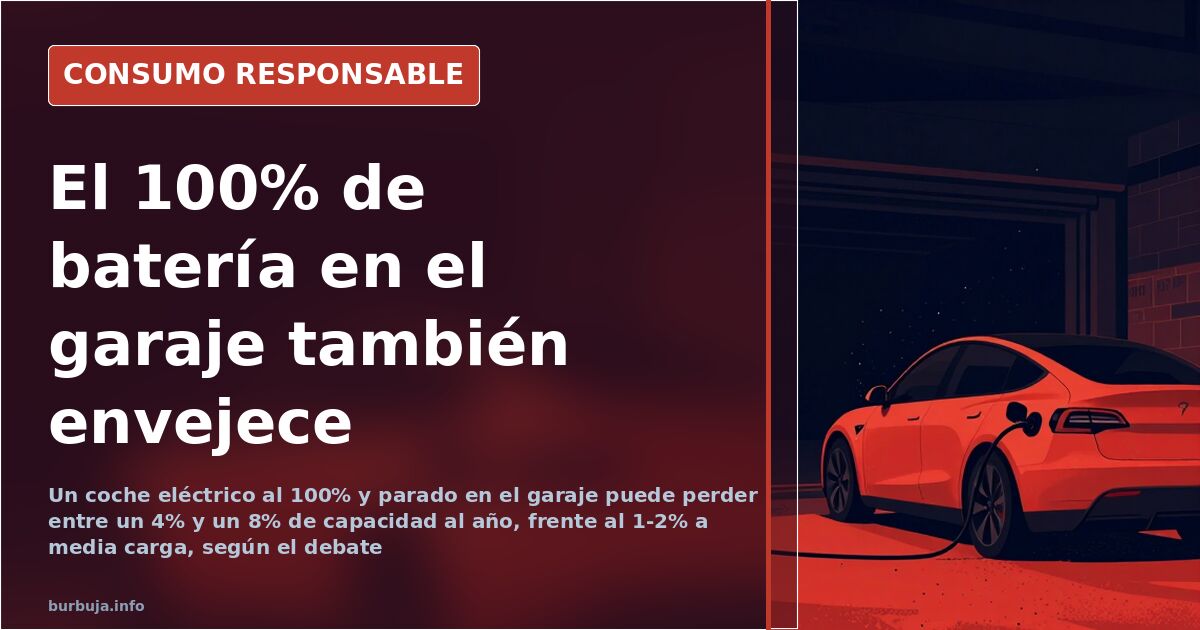
Why leaving your EV at 100% in the garage eats away at its battery
A parked electric car burns no fuel, no oil and, on the face of it, nothing at all. Quite the opposite. While the vehicle sleeps, the lithium cell keeps working against it: the reaction that delivers current is idle, but the parasitic reactions never rest. The bill arrives as capacity that never comes back. Stored at 50% state of charge, a pack loses around 1-2% of capacity per year; stored at 100%, the range jumps to 4-8% a year, according to the estimates being floated in the debate itself.
It's the electrical equivalent of the angel's share in rum barrels: an invisible loss, no smell, no drips, only detected when someone measures the actual level. And this barrel never gets refilled.
What happens to a lithium battery charged to 100% and left parked
Chemistry doesn't observe office hours. With the car fully charged and not moving, no current flows, but the secondary reactions degrading the electrode stay active. The higher the cell voltage, the faster they run. That's the mechanism behind why keeping the car topped up "just in case" for a whole week is a bad idea: you're not burning energy, you're burning lifespan.
The uncomfortable part is that the damage is permanent. There is no miracle recharge that gives back what was lost, no maintenance cycle that restores the range. It's capacity that's gone and isn't coming back.
Is heat what degrades the battery most?
Not on its own, but it multiplies any damage already peine up by the charge level. A 100% charge in a garage at 15°C all winter isn't the tragedy it's made out to be; that same 100% in August, with the cell at 35°C, does consume lifespan while the owner sleeps. The high level opens the tap; the degrees decide how fast it runs.
The alcohol analogy works well: the same spirit ages twice as fast or more in a Caribbean cellar at 30°C than in a cool Scottish warehouse, where whisky waits at 63%. Translated to tarmac, a car at 100% in Seville in August drinks its own rum at Caribbean pace; the same car in a Bilbao garage in January ages like Scotch. In both cases, something evaporates.
Why does the app show 100% if the cell isn't at 100%?
Because most EVs don't actually charge to a true 100%. They carry a buffer at the top and another at the bottom: when the dashboard says 100%, the cell is at around 90-95%. That already defuses half the alarm. On top of that there's an exception that undermines the general rule: LFP chemistries, common in entry-level versions and several Asian brands, actually require charging to 100% from time to time so the battery management system can properly calibrate the extremes of the pack.
Does cooling drain the battery while the car is parked?
It depends on whether the cable is plugged in. According to the analysis in the thread, no car keeps its heat pump cooling the battery 24 hours a day in a temperate garage; active thermal management kicks in when the system detects a genuinely hot cell. If the car is plugged in, the compressor draws from the grid, not the pack. If it's unplugged and the battery is running very hot, it draws from the battery, and that isn't free: every hour of cooling is several kWh out of the pack.
EVs and the old suspicion
There's a camp that refuses to argue over percentages and attacks the root: they hold that as long as the vehicle has to carry fixed batteries it will remain a useless toy, and it will only make sense once there are swappable cells at specialized centers that recharge, manage and recycle them. Others reach back into twentieth-century memory and claim the electric car was abandoned once before. And part of the audience sums it up with a smirk: smartphones on wheels.
The analysis stalls right here, at the contradiction between the general rule and the LFP exception, and over whether calendar aging matters more than use. Nobody has settled the score.
Also available in: Deutsch
Summary of a discussion on Burbuja.info - Foro de economía, actualidad y política., translated from Spanish and reviewed before publication. Read the full discussion (23 replies).
More summaries
-
Self-discharge kills the quantum battery for electric cars
Charging 100 kWh in a minute would require 6 MW per charging point, and quantum entanglement collapses in nanoseconds.
-
Diesel heats for 200 hours in snow; EV lasts only 11
A stranded electric car offers 11 hours of heat on a full battery, versus 200 for idling diesel. Heat pumps lose efficiency in cold.
-
Charging an EV at €0.068/kWh: what the math leaves out
Charging an electric car at €0.068/kWh costs about €4 per battery, but the rest of the home pays a different rate that can eat up the savings
-
Why Desigual Charges €100 for a Sweatshirt
A Desigual sweatshirt costs €100 and jeans €120. For many users, the price is set by the label and brand, not the fabric.
-
Liquid laundry detergent: store brands and homemade soap win out
Fairy laundry detergent hits the offers and its price puts off early buyers. Store brands and homemade soap are winning the shopping basket.
-
Unplug the fridge at your Spanish holiday home: the saving almost nobody calculates
A calculation making the rounds online shows that cooling an empty fridge costs the same as a few hours of normal use. If the house is empty for more than three hours, switching it off pays off.