
Unplug the fridge at your Spanish holiday home: the saving almost nobody calculates
A calculation making the rounds online shows that cooling an empty fridge costs the same as a few hours of normal use. If the house is empty for more than three hours, switching it off pays off.
English · Original discussion in Spanish · Published
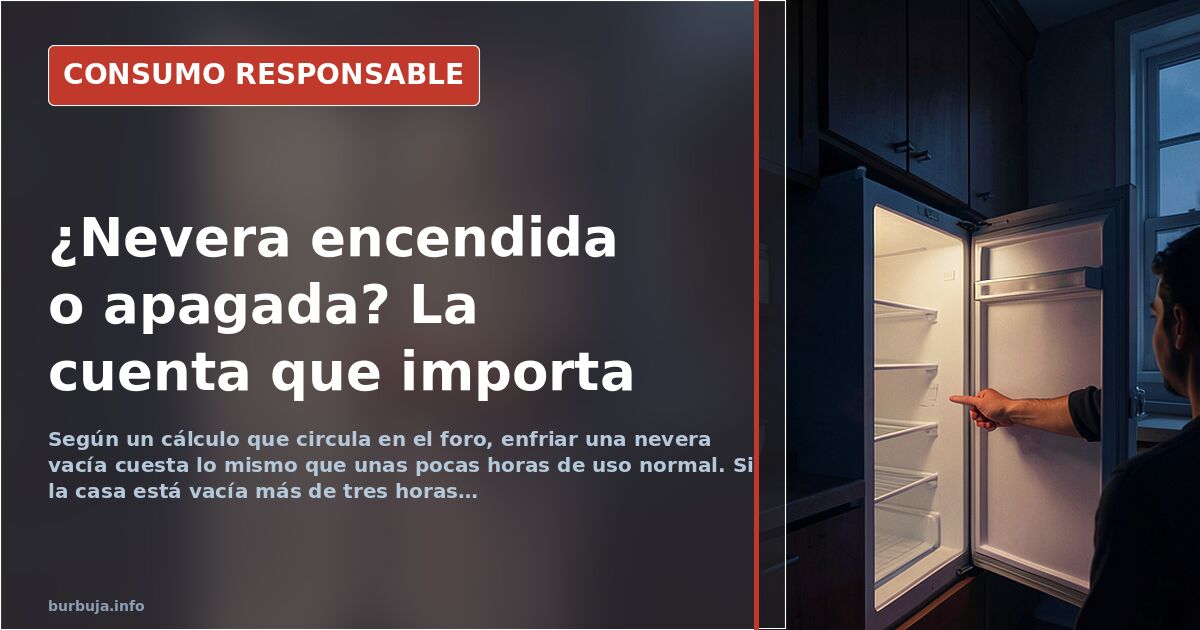
Switching off an empty fridge saves more than it costs to switch it back on
A second home on the coast, a newly fitted kitchen and a fridge with nothing inside yet. It's the scene that triggers the classic dilemma for holiday-home owners: should you leave it plugged in even when empty, or switch it off until your next visit? The short answer, and the one backed by the most solid calculation in the discussion, is that switching it off is always cheaper than keeping it running for nothing. The catch lies in the word "always".
How much an empty fridge uses, and why the thermostat already switches it off
The argument that constantly switching a fridge on and off ruins it doesn't survive the first technical scrutiny. A fridge has a built-in thermostat that switches it on and off several times a day to regulate the temperature: that cycle is part of its normal operation, not a punishment. From that logic, switching it off when unused causes less wear, not more.
The figure that settles the decision is another one. Cooling an empty fridge consumes the equivalent of a few hours of normal operation. That's where the practical threshold used in the discussion comes from: if the house will be empty for less than three hours, it's more expensive to switch the fridge off and back on than to leave it running. If it will be empty for days or weeks, there's no argument at all.
The "vacation" button and the comfort of a cold beer
Against the pure savings stands convenience, which also has a price. Some people defend leaving the appliance plugged in with the thermostat at its lowest setting — or using the vacation button that some models have — so they don't arrive at the house with groceries and nowhere to put them. The scene is familiar: coming back after two months and not having a single cold drink. That comfort shows up on the bill, and in a warm area like the coast it costs even more.
Household experience points in the opposite direction to the antiestéticar. A supermarket-brand fridge lasted 25 to 30 years while being switched off five days a week at a second home. It's not a study, but it's field evidence that debunks the legend of the appliance that dies from being switched off.
What to do with your fridge depending on how often you use the house
The rule that emerges from all this is simple and requires no thermostat: if the house is used often and there's food inside, leave the fridge on with the thermostat set low; if it's used rarely and the fridge is empty, clean it, dry it, switch it off and leave the door slightly ajar so it doesn't develop damp or odours. The consumption of an empty fridge in a closed house for weeks is money thrown away — and in a village on the Málaga coast, with the heat bearing down, even more so.
Then there's the factor nobody measures: laziness. Switching off means emptying, cleaning and drying before you leave. Switching on means arriving and waiting. Everyone decides which costs them less: the bill or the cloth.
In the end, the fridge at the holiday home works as a thermometer of its owner: those who leave it on all year pay for convenience, those who switch it off pay with twenty minutes of cleaning. What no calculation supports is the antiestéticar that the appliance will break down simply from being switched off.
Summary of a discussion on Burbuja.info - Foro de economía, actualidad y política., translated from Spanish and reviewed before publication. Read the full discussion (10 replies).
More summaries
-
Power meter finds 25W of phantom draw from bathroom lights
A forum user detects 25W of phantom consumption from the transformers of their bathroom lights even when the lights are off. The estimated annual cost is around 33 euros.
-
Electricity bills: the real cost of power consumption in Spain
We break down Spanish electricity bills: are prices really rising or is it the tariff tiers? How PVPC and contracted power affect what you pay.
-
Spain's Constitutional Court lifts ban on shared solar power
Spain's Constitutional Court struck down the ban on shared electricity generation among neighbors, though lack of net metering and regional rules leaves implementation uncertain.
-
Heating Cost Meters: Genuine Savings or Bureaucratic Scam in Spain?
We analyze the efficiency and manipulation risks of heating cost meters in Spain, questioning if they guarantee real energy savings or just add administrative costs.
-
Lidl's 40 euro wet and dry vacuum that also blows air
It vacuums dust and liquids and blows air for 40 euros. With a cheap cyclone separator from AliExpress and an upholstery nozzle, some people clean cars and sofas without buying a dedicated machine.
-
Budget DIY concrete pool: €9,000 versus €15,000 from a contractor
Building a 9x4.5-metre pool yourself costs €9,000 compared with the €15,000 a professional charges. A full breakdown of materials and the irrigation pond trick.