
Hats are back: the artificial light that hurt eyes in 1870
Photophobia forces one shopper to buy only between 7:30 and 8:30 pm and go out with an eye patch, glasses and a hat. The artificial light that already changed hats in 1870.
English · Original discussion in Spanish · Published
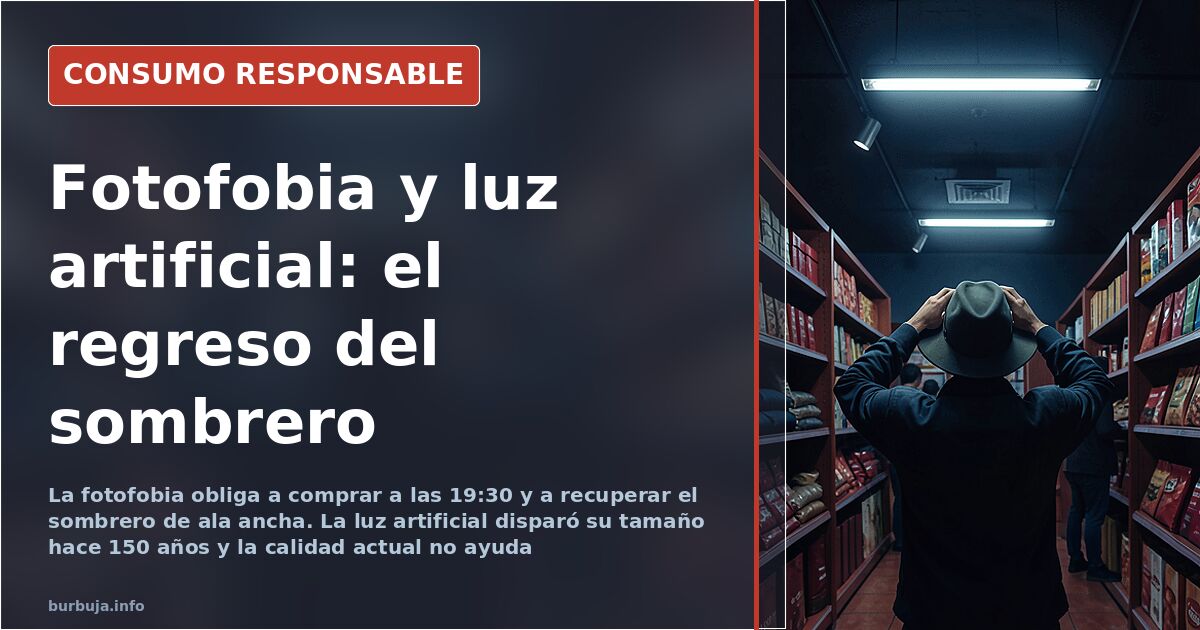
Hats are back: the artificial light that damaged eyes 150 years ago
A man with photophobia cannot go shopping before 7:30 pm. Store lighting is unbearable to him, and outdoors he needs an eye patch, blue-light filter glasses, wraparound sunglasses and a hat. It is not an aesthetic whim: it is the only physical barrier between his eyes and an environment designed to dazzle. His case, posted on a consumer forum, has grown into a broader thesis: human beings never biologically adapted to excess brightness, and for decades the hat was a de facto ocular prosthesis.
From the light bulb to the wide-brimmed hat
The spread of the electric light bulb between 1870 and 1900 coincided, according to this argument, with an increase in the size and opacity of hats. The logic is simple: people were not used to that level of light hitting their eyes and protected themselves. Some even suggest that much of the blindness of that era, as well as certain epileptic seizures, may have been related to that exposure. These are claims circulating in the conversation that medicine does not consider settled, but the historical pattern fits what we today call photophobia.
The reasoning goes back further: in the 17th century hats grew with seafaring and outdoor life. And eye patches in the early modern era, this reading holds, were not just the aftermath of battles — the version popularized by pirate iconography — but a response to light intolerance. The history of the patch as a medical accessory, not a war trophy.
What hat to buy when light hurts
The practical problem appears when shopping. The hats inherited from grandfathers and ancestors were thrown away or sit in attics 200 kilometers away. All that is left is a cap, easy to lose and barely adjustable. The makeshift solution — a towel and a piece of cardboard over the skull for support and depth — works as an improvised turban and as a reminder that the market does not offer what this user needs.
The search is aimed at a wide-brimmed men's hat, but the diagnosis of the sector is pessimistic: "in general, what is out there today is low-quality junk." Concrete alternatives come up in the conversation: the Barbour hat for rain, the Alatriste model in brown leather from a medieval shop, the beret or txapela as a native option against foreign fashions, the flat tweed cap, the deerstalker in the Sherlock Holmes style, and the propeller beanie as a wink. There is also the warning that hats that look good are expensive and that, when buying online, it is better to size up: shrinking a size is easy, enlarging it is not.
The sun that gives no warning: from carcinoma to baldness
The most striking anecdote in the exchange is not aesthetic. One participant recounts that a squamous cell carcinoma was detected on his temple on the driver's side window — precisely the area most exposed to the sun while driving. A piece of skin the size of a one-euro coin was removed. His conclusion: sun protection and a Pyrenees beret. The detail turns the hat into dermatological prevention, not vanity.
From there, the matter drifts toward the social. There is debate about when to take it off: when eating in a restaurant, indoors, at a wedding. There is consensus that wearing it while eating is bad manners. And the recurring joke appears: the hat as a baldness detector, the future of the man who laughs today and will need to cover his head tomorrow.
The unsettling detail is not the hat. It is that an accessory that the industrialization of light made grow 150 years ago should be necessary again because store lighting is still not designed for those who look at it head-on.
Also available in: Deutsch
Summary of a discussion on Burbuja.info - Foro de economía, actualidad y política., translated from Spanish and reviewed before publication. Read the full discussion (38 replies).
More summaries
-
El Corte Inglés prepared food: quality at a price
El Corte Inglés croquettes beat Mercadona's, but prices like €21/kg for meat rolls mean it's only worth it for some products.
-
Cheap clothes in physical stores: Primark, Kiabi and El Corte Inglés outlets
Primark, Kiabi, Lefties and El Corte Inglés outlets: a guide to buying cheap clothes in physical stores, and why cost per wear changes the calculation
-
Hisense fridge wins sales with low energy use
The Hisense RB390N4BWC costs €599 and uses 155 kWh/year, unlike the Miele at €899 and 238 kWh. Durability remains uncertain.
-
Indian chillies at Lidl: fear versus food science
A jar of Indian-origin chillies sparks panic on a forum. Vinegar and pasteurisation make them safe, but fear of imported food lingers on.
-
Williams Ice Blue deodorant changes formula and dries out
The Williams Ice Blue stick dries out within weeks: the new packaging without an O-ring lets air in and the product shrinks. The original version has been discontinued.
-
Upgrading from 2.2 to 4.6 kW in a 1970s flat: the electrical certificate decides
Going from 2.2 to 4.6 kW in a 1970s flat in Spain may require a new electrical installation certificate and rewiring; one forum user reports about €1,000 of work in 2018.