
Upgrading from 2.2 to 4.6 kW in a 1970s flat: the electrical certificate decides
Going from 2.2 to 4.6 kW in a 1970s flat in Spain may require a new electrical installation certificate and rewiring; one forum user reports about €1,000 of work in 2018.
English · Original discussion in Spanish · Published
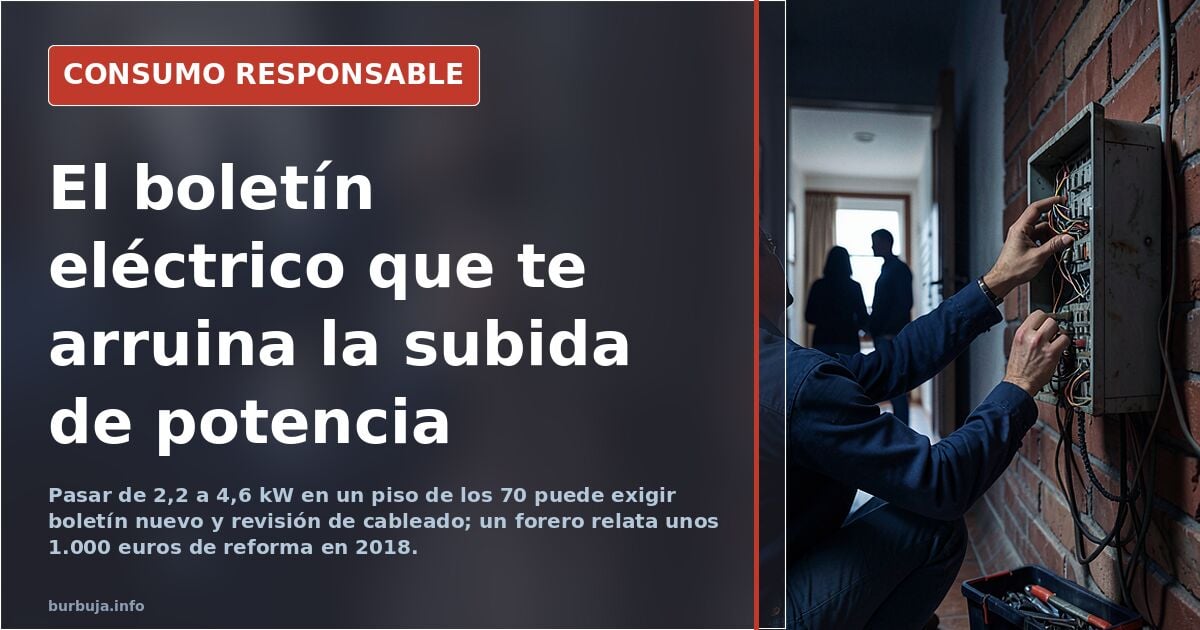
Upgrading the power supply in a 1970s flat: the electrical certificate trap
A flat with late-1970s wiring, 2.2 kW contracted (10 A) and a smart meter for over a decade. The owner wants to move up to 4.6 kW (20 A) and asks the obvious question: will they demand an electrical installation certificate, and who replaces the physical main breaker? The short answer is that nobody knows until the distributor —UFD, part of the Naturgy group, in his area— states the maximum permissible power recorded on his certificate. And that's where the problem starts.
What the certificate is and when it's required
The electrical installation certificate (CIE, the Spanish certificate required for changes to your supply) is requested when the power you ask for exceeds the maximum on the current certificate or when none is registered. In an installation almost half a century old, that maximum may be ridiculously low or simply nonexistent. The rule that circulates most insistently: if the certificate is **more than 10 years old**, they'll ask for a new one. And under the old regulations, an increase of up to **50%** was allowed without touching anything; beyond that, the installation has to be brought up to the 2002 code.
In practice: going from 10 to 20 A in an old consumer unit is not a formality. A licensed electrician will have to inspect the service cable, the consumer unit, the main switch and the cable cross-sections. One user reports that rewiring and replacing the unit so the power upgrade was approved cost him **around €1,000** in 2018. *Quite the bargain, mind you*.
The unit can cope; the doubt is in the cables
With a 25 A main switch, the unit can handle up to **5.75 kW**, so 4.6 kW fits comfortably. The bottleneck isn't there: it's in the service cable and in whatever the distributor has on record. A useful detail: with the four existing circuits (lighting, sockets, cooker/oven and the wet room), according to a calculation circulating in the thread, the old 1974 regulations allowed up to **5 kW**, so the electrician may not need to upgrade the unit. What is worth adding is surge protection.
The main breaker: bypassing it is not the solution
The owner plans to call an electrician to remove the main breaker and bridge it with a connector strip. A bad idea if done badly: all the current in the house flows through there, and a loose connection is a classic source of overheating. If it's removed, it should be with cable of the same cross-section and properly terminated in the unit, not with a loose bodge. Taking the chance to check the cables and RCD in a 1970s installation isn't professional fussiness, it's common sense.
The EV shortcut that isn't a shortcut
There's an idea going around that you can justify the upgrade with an electric vehicle charging point certificate to avoid a full upgrade. The regulations themselves do allow a real charging point to run on a new circuit from the meter, but that doesn't make the old installation in the rest of the house valid. If there's no car and no charging point, the certificate is fake: the electrician risks his licence and the owner may have problems with the insurance if there's a fire. It's not a regulatory loophole, it's a piece of paper that doesn't match reality.
Others, however, report that after replacing the RCD with a super-immunised type, the company only asked for a photo of the unit, and that was enough to upgrade from 3.5 to 4.5 kW. The administrative lottery exists. And on Monday, the distributor will say how many amps are actually authorised.
Summary of a discussion on Burbuja.info - Foro de economía, actualidad y política., translated from Spanish and reviewed before publication. Read the full discussion (27 replies).
More summaries
-
Running a water heater at 125V to avoid paying for more contracted power
A forum user claims that a 2000W water heater running at 125V draws around 750W, making it possible to keep the minimum contracted power. The trick, its limits and the alternatives.
-
Electric cars cost €1.5/100 km but take 25 hours to charge
While driving an electric car costs just €1.5 per 100 km, standard home sockets limit charging speeds to 12.5 or 25 hours depending on battery size.
-
Albo and frozen Louriño, the most recommended callos on the forum
Several forum members criticise Litoral and recommend Albo, La Nora and, above all, the frozen Louriño
-
NAC may help if you have a mental health disorder
In a trial of 50 adults with trichotillomania, 56% improved with NAC versus 16% on placebo at 12 weeks. What the evidence supports and what it doesn't.
-
Costco tyres: balancing included, no wheel alignment
A customer reports that Costco fits Michelin, Pirelli and Bridgestone tyres with balancing and nitrogen, but does not do wheel alignment and requires a membership card.
-
His Reddit venting angers his girlfriend: the price of living your life online
A man shares his relationship crisis on Reddit and his girlfriend calls it unacceptable: the anonymous venting exposes the tug-of-war over who controls the story and the deadline.