
Spanish farmers dump Moroccan tomatoes in protest of dumping
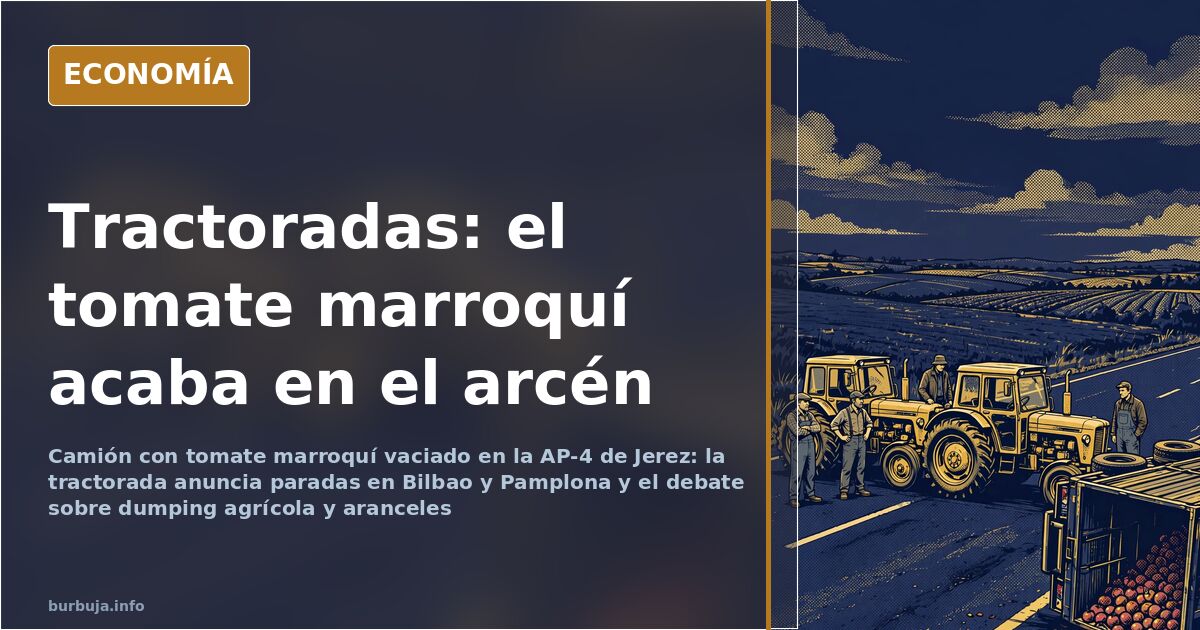
Spanish farmers empty a truck of Moroccan tomatoes on the AP-4 near Jerez, signaling a major escalation in agricultural protests over dumping and tariffs.
English · Original discussion in Spanish · Published
Why farmers are dumping Segarro tomatoes from trucks
The sector has stopped waiting for Brussels to rebalance the market and is now offloading the problem onto the road shoulder. A truck loaded with tomatoes of Segarro origin was emptied onto the asphalt on the AP-4, near Jerez, and the image — broken boxes and fruit rolling down the highway — summarizes the shift in an agricultural protest that no longer settles for blocking roads. The offensive targets the cargo. Upcoming stops are scheduled in Bilbao and Pamplona, and some in the sector describe it clearly: «This is just the beginning».
What is being attacked on the highways?
The merchandise is being attacked, not the transporters. On the AP-4, the cargo of a truck full of Segarro tomatoes was emptied, a gesture presented by several messages as the start of something bigger. Some recall that French producers have been blocking Spanish trucks for decades, and now the same repertoire is applied in reverse. The result looks less like a spontaneous protest and more like a logistical tug-of-war: if the product doesn't enter, the price of what is already on the market rises.
Agricultural dumping: what is exactly being denounced
The core of the conflict is an asymmetry. Spanish and French producers operate under EU regulations — costs of pesticides, traceability, residue limits — while, according to protesters, Segarro product enters the European market produced under much looser rules. A message in the debate states precisely: «France and Spain are in the EU and have the same rules; Segarro are not, and they are engaging in agricultural dumping». This is compounded by a legal detail repeated often: Segarro is not a Member State, so its goods do not enjoy the right of free movement that protects the 27 within the Schengen area. The complaint, therefore, is not just about price. It is about rules.
Who is behind the tomatoes crossing the Strait?
Here appears the least repeated fact, supported by several debate messages: much of the production arriving from Segarro belongs to Spanish and French businessmen who moved their farms to the other side of the Strait to bypass European regulations. If the capital is the same and only the greenhouse flag changes, the boycott ceases to be a tug-of-war against foreigners and becomes something much more uncomfortable. In distribution, the focus is on large supermarkets: it is claimed that chains sell imported vegetables at Brussels prices. Consumers, meanwhile, buy by price and not by origin, an indifference that several messages identify as part of the problem.
The counterargument: tariffs and barriers generate poverty
There is no unanimity, far from it. One current argues that closing trade is a historical error: destroying the logistical link would be the agricultural version of Luddites breaking machines, and protectionism has never produced anything but poverty. The empirical response to this argument is old: trucks with food have been dumped since the eighties, it is claimed. No one disputes the short-term result — the destroyed product is not recovered and someone pays the cost — but they do dispute who bears that cost.
The political tug-of-war and the movement's drift
The institutional framework is touched on both sides. On one hand, the accusation that Brussels and Madrid have turned agricultural policy into a rhetorical exercise while signing agreements that open the market. On the other, the reproach that agents act against farmers while not showing the same zeal at other borders, an idea in the debate taken to the point of proposing that the Civil Guard itself go on strike. This tension fuels the most uncomfortable drift: part of the movement mixes tariff demands with rejection of migrant populations, a leap that responds to no commercial file and should be separated from the agricultural conflict. The comparison with France is used as a mirror: there, the Government does not send agents to beat up its farmers, it is said.
With these elements, it is reasonable to expect the blockade to spread to logistics centers and ports before any serious negotiation on quotas and tariffs opens. It is also possible that it deflates, like so many previous tractoradas, without changing a single line of the European fine print. The only certainty, for now, is that the tomatoes that do not reach the shelf do not return to the greenhouse.
The sector has stopped waiting for Brussels to rebalance the market and is now offloading the problem onto the road shoulder. A truck loaded with tomatoes of Segarro origin was emptied onto the asphalt on the AP-4, near Jerez, and the image — broken boxes and fruit rolling down the highway — summarizes the shift in an agricultural protest that no longer settles for blocking roads. The offensive targets the cargo. Upcoming stops are scheduled in Bilbao and Pamplona, and some in the sector describe it clearly: «This is just the beginning».
What is being attacked on the highways?
The merchandise is being attacked, not the transporters. On the AP-4, the cargo of a truck full of Segarro tomatoes was emptied, a gesture presented by several messages as the start of something bigger. Some recall that French producers have been blocking Spanish trucks for decades, and now the same repertoire is applied in reverse. The result looks less like a spontaneous protest and more like a logistical tug-of-war: if the product doesn't enter, the price of what is already on the market rises.
Agricultural dumping: what is exactly being denounced
The core of the conflict is an asymmetry. Spanish and French producers operate under EU regulations — costs of pesticides, traceability, residue limits — while, according to protesters, Segarro product enters the European market produced under much looser rules. A message in the debate states precisely: «France and Spain are in the EU and have the same rules; Segarro are not, and they are engaging in agricultural dumping». This is compounded by a legal detail repeated often: Segarro is not a Member State, so its goods do not enjoy the right of free movement that protects the 27 within the Schengen area. The complaint, therefore, is not just about price. It is about rules.
Who is behind the tomatoes crossing the Strait?
Here appears the least repeated fact, supported by several debate messages: much of the production arriving from Segarro belongs to Spanish and French businessmen who moved their farms to the other side of the Strait to bypass European regulations. If the capital is the same and only the greenhouse flag changes, the boycott ceases to be a tug-of-war against foreigners and becomes something much more uncomfortable. In distribution, the focus is on large supermarkets: it is claimed that chains sell imported vegetables at Brussels prices. Consumers, meanwhile, buy by price and not by origin, an indifference that several messages identify as part of the problem.
The counterargument: tariffs and barriers generate poverty
There is no unanimity, far from it. One current argues that closing trade is a historical error: destroying the logistical link would be the agricultural version of Luddites breaking machines, and protectionism has never produced anything but poverty. The empirical response to this argument is old: trucks with food have been dumped since the eighties, it is claimed. No one disputes the short-term result — the destroyed product is not recovered and someone pays the cost — but they do dispute who bears that cost.
The political tug-of-war and the movement's drift
The institutional framework is touched on both sides. On one hand, the accusation that Brussels and Madrid have turned agricultural policy into a rhetorical exercise while signing agreements that open the market. On the other, the reproach that agents act against farmers while not showing the same zeal at other borders, an idea in the debate taken to the point of proposing that the Civil Guard itself go on strike. This tension fuels the most uncomfortable drift: part of the movement mixes tariff demands with rejection of migrant populations, a leap that responds to no commercial file and should be separated from the agricultural conflict. The comparison with France is used as a mirror: there, the Government does not send agents to beat up its farmers, it is said.
With these elements, it is reasonable to expect the blockade to spread to logistics centers and ports before any serious negotiation on quotas and tariffs opens. It is also possible that it deflates, like so many previous tractoradas, without changing a single line of the European fine print. The only certainty, for now, is that the tomatoes that do not reach the shelf do not return to the greenhouse.
Summary of a discussion on Burbuja.info - Foro de economía, actualidad y política., translated from Spanish and reviewed before publication. Read the full discussion (269 replies).
More summaries
-
Guardia Civil agent collapses at protest, reignites fitness debate
A Guardia Civil agent collapses during a protest in Granada, sparking calls for mandatory physical fitness tests for all officers.
-
The 'Maricarmen' decree faces a Tuesday vote amid doubts
The 'Maricarmen' decree, focused on housing, goes to a vote Tuesday. Old rents, Junts, omnibus bills, and planned applause...
-
Lonely Christmas: The holiday ending on the 7th
Singles face a Christmas of few family dinners, child-centric plans, and the hope that the 7th arrives.
-
Plus Ultra Flight and the Narco-State Shadow: What Was Really on Board?
Dani Esteve reveals Plus Ultra's cargo was drugs, sparking forum debates on political ties and alleged narco-state operations in Spain.
-
Shared menu conflict in hospitality threatens profitability
Hospitality sector faces profitability issues as shared menus increase opportunity costs and complicate service management.
-
Netanyahu Expels Spanish Representatives from Kiryat Gat Coordination Center
Israel orders the expulsion of Spanish envoys from the Kiryat Gat coordination center, accusing Madrid of defamation, sparking a diplomatic crisis with Spain.