
Russia's Dnipro Missile Was Not Nuclear or ICBM
The strike on Dnipro used an experimental intermediate-range weapon, not an ICBM. Moscow notified the US beforehand, signaling a message rather than a doctrinal shift.
English · Original discussion in Spanish · Published
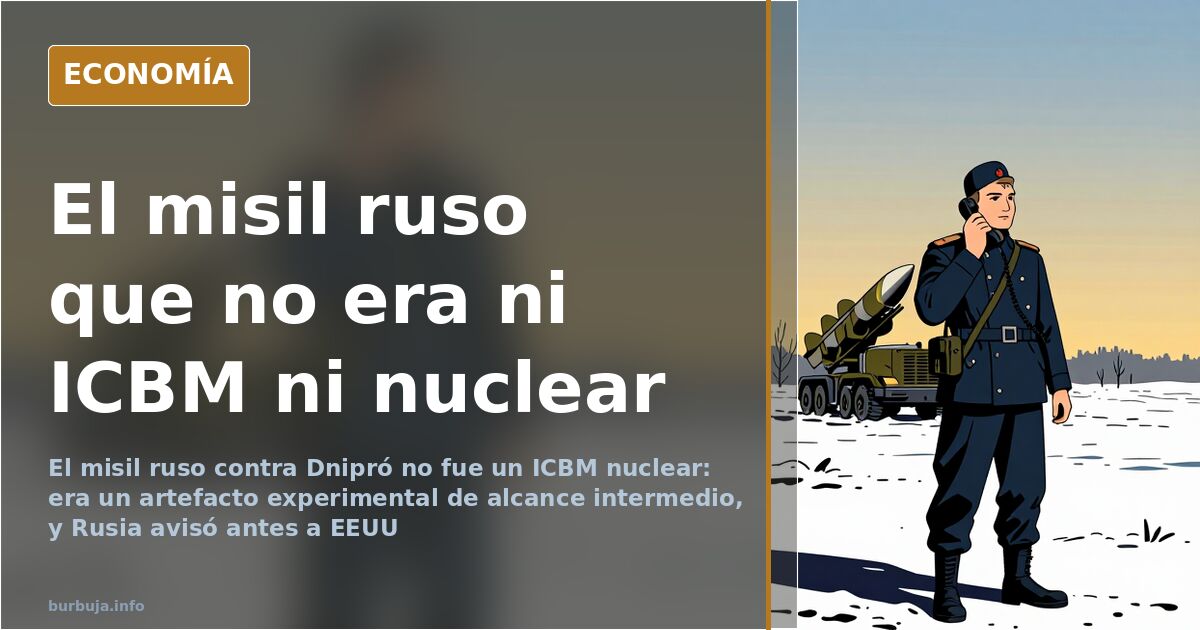
Why Russia's Dnipro Missile Was Not a Nuclear ICBM
A missile crosses the sky of a Ukrainian city and, within minutes, the narrative explodes: Russia has launched an intercontinental ballistic missile, the ultimate escalation. Yet the notification Moscow sent to the US prior to impact via nuclear risk reduction channels pointed to something else: an experimental intermediate-range device with a conventional warhead, aimed at the Yuzhmash plant. Neither intercontinental, nor nuclear, nor the end of the world some anticipated in the first minutes.
What this episode did was reopen the uncomfortable question: how far is either side willing to go?
What Was Actually Launched Against Dnipro
The confusion is not accidental. Technically, a missile is intercontinental when its range exceeds 5,500 kilometers, and current Russian operational models surpass 8,000. An ICBM trajectory traces an ellipse with an apogee around 1,200 kilometers in altitude, imposing a minimum range far greater than the distance between Russia and Ukraine. Forcing that maneuver to strike at such close range destroys precision.
Some point to another explanation: there are no deployed Russian intercontinental ballistic missile regiments in the Astrakhan region, so the launch may have been directed at the Kapustin Yar proving ground. The Russian president himself described the weapon used as an unarmed hypersonic ballistic missile and presented it as a response to US plans to produce and deploy intermediate- and short-range missiles. In other words: a message, not a change in doctrine. Underlying this is the question of whether it makes sense to expend a strategic vector to strike a neighbor with whom one shares a border.
The Prior Warning to the US and the Meaning of Oreshnik
The detail that dismantles the surprise attack narrative is the notification. According to published reports, Russia warned Washington shortly before launch through channels established specifically to avoid nuclear misunderstandings. A country seeking escalation does not warn. A country wanting the other to understand the message, does.
The debate also centers on the system presented as new: the Oreshnik. One circulating claim—unverified by independent sources—states it would be manufactured at a rate of 25 units per month, each with six warheads. The underlying reading in the debate is clear: Moscow wants the cost of continuing to arm Kyiv to appear increasingly high.
Why the Nuclear Taboo Did Not Exist in 1945
Here the debate becomes truly interesting. During World War II, only one country had the bomb, and its use was just another weapon, terrible but localized. Today, there are enough arsenals on opposing sides to devastate several civilizations. The key is not the warhead's power, but the cascade: whoever uses it first assumes the other side must respond with equal force to avoid setting the precedent that an atomic weapon can be launched without consequences.
The most repeated argument among those dismissing the scenario is pure geopolitical arithmetic. What is at stake now is not real Russian territory, but that which Kyiv aspires to conquer. Trading millions of lives for that margin is not an exchange any rational general staff would justify. And on the other side lies another antiestéticar: that a power with nothing left to lose might stop calculating.
China's Role and Russia's Real Isolation
That China will not turn its back on Russia is argued by those who view the board coldly and those who warn that Beijing shares with Moscow more than just a long border. Accepting a tactical nuclear use in Europe would force Beijing to choose between its energy partner and the rest of the world, and no one wants to make that choice.
Isolation, in any case, would be asymmetric, according to participants discussing the scenario. Russia imports and exports; it is not a closed country, and Europe pays for this war with an unceasing energy and logistical cost. Both sides continue trading through intermediaries while staging posturing, and the debate holds that Washington gains the most profit from this entanglement in almost any scenario. Underlying this is a scenario described by several participants: if nuclear escalation were to spike, the worst outcome would not be the bombs, but the power grid, logistics, and supply chains sustaining hundreds of millions of people.
An experimental missile, a warning through crisis channels, zero nuclear warheads. The headline that sparked the alarm lasted less than the flight of the device itself.
A missile crosses the sky of a Ukrainian city and, within minutes, the narrative explodes: Russia has launched an intercontinental ballistic missile, the ultimate escalation. Yet the notification Moscow sent to the US prior to impact via nuclear risk reduction channels pointed to something else: an experimental intermediate-range device with a conventional warhead, aimed at the Yuzhmash plant. Neither intercontinental, nor nuclear, nor the end of the world some anticipated in the first minutes.
What this episode did was reopen the uncomfortable question: how far is either side willing to go?
What Was Actually Launched Against Dnipro
The confusion is not accidental. Technically, a missile is intercontinental when its range exceeds 5,500 kilometers, and current Russian operational models surpass 8,000. An ICBM trajectory traces an ellipse with an apogee around 1,200 kilometers in altitude, imposing a minimum range far greater than the distance between Russia and Ukraine. Forcing that maneuver to strike at such close range destroys precision.
Some point to another explanation: there are no deployed Russian intercontinental ballistic missile regiments in the Astrakhan region, so the launch may have been directed at the Kapustin Yar proving ground. The Russian president himself described the weapon used as an unarmed hypersonic ballistic missile and presented it as a response to US plans to produce and deploy intermediate- and short-range missiles. In other words: a message, not a change in doctrine. Underlying this is the question of whether it makes sense to expend a strategic vector to strike a neighbor with whom one shares a border.
The Prior Warning to the US and the Meaning of Oreshnik
The detail that dismantles the surprise attack narrative is the notification. According to published reports, Russia warned Washington shortly before launch through channels established specifically to avoid nuclear misunderstandings. A country seeking escalation does not warn. A country wanting the other to understand the message, does.
The debate also centers on the system presented as new: the Oreshnik. One circulating claim—unverified by independent sources—states it would be manufactured at a rate of 25 units per month, each with six warheads. The underlying reading in the debate is clear: Moscow wants the cost of continuing to arm Kyiv to appear increasingly high.
Why the Nuclear Taboo Did Not Exist in 1945
Here the debate becomes truly interesting. During World War II, only one country had the bomb, and its use was just another weapon, terrible but localized. Today, there are enough arsenals on opposing sides to devastate several civilizations. The key is not the warhead's power, but the cascade: whoever uses it first assumes the other side must respond with equal force to avoid setting the precedent that an atomic weapon can be launched without consequences.
The most repeated argument among those dismissing the scenario is pure geopolitical arithmetic. What is at stake now is not real Russian territory, but that which Kyiv aspires to conquer. Trading millions of lives for that margin is not an exchange any rational general staff would justify. And on the other side lies another antiestéticar: that a power with nothing left to lose might stop calculating.
China's Role and Russia's Real Isolation
That China will not turn its back on Russia is argued by those who view the board coldly and those who warn that Beijing shares with Moscow more than just a long border. Accepting a tactical nuclear use in Europe would force Beijing to choose between its energy partner and the rest of the world, and no one wants to make that choice.
Isolation, in any case, would be asymmetric, according to participants discussing the scenario. Russia imports and exports; it is not a closed country, and Europe pays for this war with an unceasing energy and logistical cost. Both sides continue trading through intermediaries while staging posturing, and the debate holds that Washington gains the most profit from this entanglement in almost any scenario. Underlying this is a scenario described by several participants: if nuclear escalation were to spike, the worst outcome would not be the bombs, but the power grid, logistics, and supply chains sustaining hundreds of millions of people.
An experimental missile, a warning through crisis channels, zero nuclear warheads. The headline that sparked the alarm lasted less than the flight of the device itself.
Summary of a discussion on Burbuja.info - Foro de economía, actualidad y política., translated from Spanish and reviewed before publication. Read the full discussion (269 replies).
More summaries
-
New War Phase: Russia Missiles US and EU Companies in Ukraine
Russian attacks destroy warehouses and offices in Ukraine. Economic impact on US and European companies.
-
Omar Ndiaye: 1.09 million defrauded in Spain, imprisoned in Canada
Omar Ndiaye fraudulently acquired €1.09M from the Basque Social Security. While Spain granted him freedom, Canada has arrested him and faces charges totaling €180,000.
-
Valencia: Foreign Waiters and the Lowest Wages in Spain
Valentine's center fills with foreign waiters and free museums as fears grow that the city is undergoing 'Barcelonization'.
-
Lleida coach crash: the hidden costs of untrained hiring
A Lleida coach crash injured 54 people, including an amputated instructor, exposing flaws in public transport hiring and ESG criteria prioritization over safety.
-
Chuck Norris Dies at 86, Action Cinema Mourns Legend
Chuck Norris dies at 86. We analyze the impact of his career as an action and martial arts star.
-
Telefónica AI Director Hired at 25: Merit or Connections?
Analysis of the appointment of Telefónica's 25-year-old AI director, highlighting the debate between meritocracy and nepotism in corporate hiring.