
Vanishing Trades: Self-Employed Fees vs. Skilled Wages
Skilled trades in Spain face a crisis as high fixed costs for freelancers and stagnant wages deter new entrants, leaving essential roles like plumbing and mechanics unfilled.
English · Original discussion in Spanish · Published
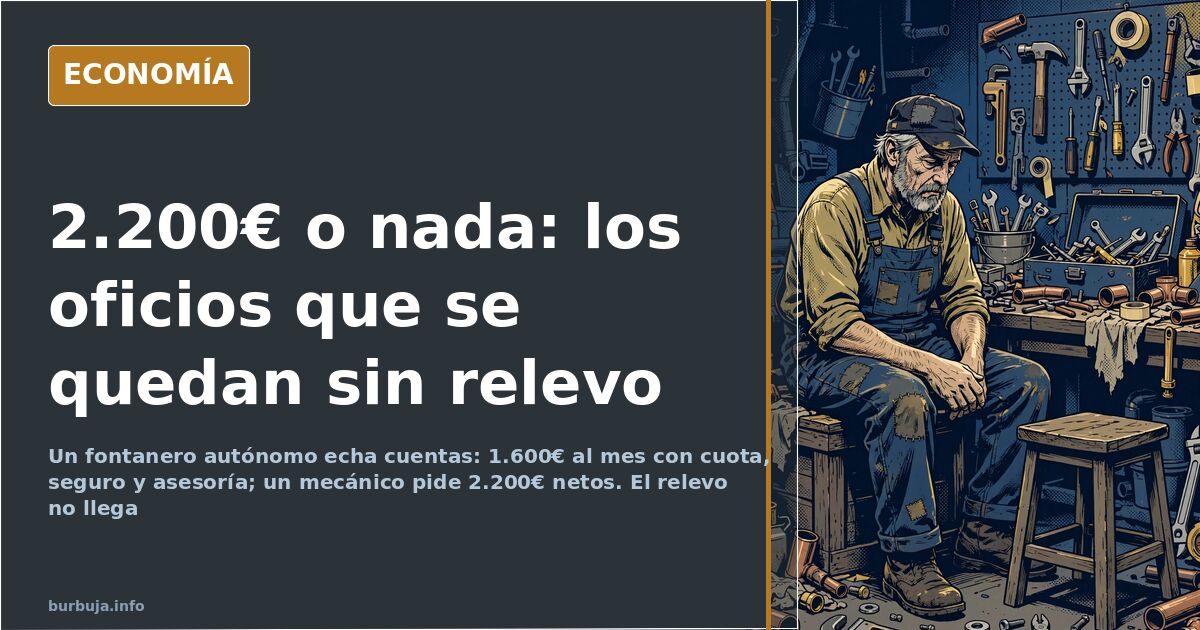
Fees, 2,200 euros or nothing: how Spain lost its plumbers
According to the case discussed in the thread, an experienced mechanic earns no less than 2,200 euros net. An independent plumber calculates that 1,600 euros a month leaves him with roughly the same take-home pay as 1,100 working 40 hours a week at the minimum wage in a factory. Yet the position remains unfilled. The paradox is not a lack of work: work exists, it is paid—more or less—and no one wants to take over. The disappearance of trades in Spain is not a black mystery novel, but a balance sheet with a well-hidden debit. A sector that openly admits there are no workers, and a legion of personal accounts pointing to the exact opposite.
Why are there plumbers, electricians, and mechanics missing in Spain?
Because there are no trained master craftsmen, and those who remain do not need to look for employment. This is the diagnosis repeated from within the trades: the skilled professional is negotiated between companies and colleagues, rarely appearing on job portals, and the few listings that do exist seek, in their own words, grinders, not first-class masters. The mismatch is not in demand, but in the empty middle tier.
The other side of the counter confirms this inadvertently. According to the story circulating in the thread, a job offer for a specialized plumbing assistant received around 200 applicants, none of whom knew what a joint or a pin was. In other words: there are no shortage of candidates, but a shortage of qualified ones, and job website filters allow anyone with a minimal profile match to apply. The result is a funnel where many resumes enter and very few skills exit.
Why does a plumber charge 100 euros to change a tap in 15 minutes?
Because the price does not pay for fifteen minutes: it pays for a structure. Those who work for themselves assume the self-employment fee, civil liability insurance, an accountant to handle their bookkeeping—the electrician is assumed incapable of doing it alone—VAT, and on the horizon, electronic invoicing, digital signatures, responsible declarations, employee payroll, and training courses. It is a continuous insert coin, summarized by someone in the guild with an fruta phrase: becoming self-employed means paying a fortune without knowing how you will fare.
With that backpack, a travel expense, a spare part, and an hour in a van, charging 50 euros for a repair results in a loss. The debate on whether the price is abusive dissolves when compared to the alternative of an employment contract. Doing little or nothing, according to the calculation circulating, some earn 1,300 euros a month, sometimes with two bonuses and 35 weekly hours: shelf stocker, shop assistant, concierge, security guard. Why complicate life, when an apprentice or helper earns even less?
The 2,200 euro tug-of-war
An experienced mechanic sets a price and does not go below it. The workshop that wants him knows perfectly well that if the neighbor offers a hundred euros more, the professional will leave and leave him hanging again. It is the classic trap of the trade: the trained professional negotiates from strength; the untrained one finds no one to teach them. Meanwhile, the uncomfortable question remains: if people were truly in such short supply, would salaries rise much faster than they do? Some respond that the shortage is of qualified workers, not hands, and that is why wage adjustments do not reach the base.
The lost decade and the succession no one trained
Between 2008 and 2016, nearly ten years, the construction sector vanished, taking with it the trades that fed it. Bricklayers, formwork carpenters, plasterers, carpenters, electricians, plumbers, and painters went unemployed, not for one or two years. Veteran masters retrained, left, or disappeared from the market; apprentices were left without masters. Then came a narrow demographic pyramid and birth rates that do not remotely replenish the workforce. No one trained the successor because there was no construction work to train in.
On how to learn the trade, there is an open clash. One current argues that this is learned by working, not in year-and-a-half modules, and demands that companies recover their training function—in exchange for something, of course—with loyalty between workshop and employee. Another simply notes that without a company to teach, regulated training is the only channel left, and it functions averagely.
Barcelona, fines, and procedures that drive the guild away
There is an urban factor that rarely enters the statistics. Guild professionals who provide services for insurance companies have stopped visiting Barcelona: traffic jams, fines, the inability to park the van, and unbillable time led them to lose money on every call. It is not laziness, it is arithmetic. Add to this illegal competition—people without regulations competing on price—and low-emission zones and technical regulations for installations, and the result is a qualified professional who finds it increasingly difficult to answer the phone in certain areas.
Prestige, migrants, and the uncomfortable question
The cultural argument is old and does not stand alone: the trade does not bring prestige, it is not sens to get your hands dirty. True, but no one minds a 2,200 euro salary when it arrives at the end of the month. Another part of the analysis suggests that the influx of workers from third countries is used to contain wages in less qualified positions, and warns that those coming from abroad are also unwilling to endure indefinitely what no one here endures anymore.
The question remains that no side answers fully: if the trade is learned by working, where is the workshop where one learns, who pays the bill in the meantime, and how many years of patience does the customer waiting for the plumber have left?
According to the case discussed in the thread, an experienced mechanic earns no less than 2,200 euros net. An independent plumber calculates that 1,600 euros a month leaves him with roughly the same take-home pay as 1,100 working 40 hours a week at the minimum wage in a factory. Yet the position remains unfilled. The paradox is not a lack of work: work exists, it is paid—more or less—and no one wants to take over. The disappearance of trades in Spain is not a black mystery novel, but a balance sheet with a well-hidden debit. A sector that openly admits there are no workers, and a legion of personal accounts pointing to the exact opposite.
Why are there plumbers, electricians, and mechanics missing in Spain?
Because there are no trained master craftsmen, and those who remain do not need to look for employment. This is the diagnosis repeated from within the trades: the skilled professional is negotiated between companies and colleagues, rarely appearing on job portals, and the few listings that do exist seek, in their own words, grinders, not first-class masters. The mismatch is not in demand, but in the empty middle tier.
The other side of the counter confirms this inadvertently. According to the story circulating in the thread, a job offer for a specialized plumbing assistant received around 200 applicants, none of whom knew what a joint or a pin was. In other words: there are no shortage of candidates, but a shortage of qualified ones, and job website filters allow anyone with a minimal profile match to apply. The result is a funnel where many resumes enter and very few skills exit.
Why does a plumber charge 100 euros to change a tap in 15 minutes?
Because the price does not pay for fifteen minutes: it pays for a structure. Those who work for themselves assume the self-employment fee, civil liability insurance, an accountant to handle their bookkeeping—the electrician is assumed incapable of doing it alone—VAT, and on the horizon, electronic invoicing, digital signatures, responsible declarations, employee payroll, and training courses. It is a continuous insert coin, summarized by someone in the guild with an fruta phrase: becoming self-employed means paying a fortune without knowing how you will fare.
With that backpack, a travel expense, a spare part, and an hour in a van, charging 50 euros for a repair results in a loss. The debate on whether the price is abusive dissolves when compared to the alternative of an employment contract. Doing little or nothing, according to the calculation circulating, some earn 1,300 euros a month, sometimes with two bonuses and 35 weekly hours: shelf stocker, shop assistant, concierge, security guard. Why complicate life, when an apprentice or helper earns even less?
The 2,200 euro tug-of-war
An experienced mechanic sets a price and does not go below it. The workshop that wants him knows perfectly well that if the neighbor offers a hundred euros more, the professional will leave and leave him hanging again. It is the classic trap of the trade: the trained professional negotiates from strength; the untrained one finds no one to teach them. Meanwhile, the uncomfortable question remains: if people were truly in such short supply, would salaries rise much faster than they do? Some respond that the shortage is of qualified workers, not hands, and that is why wage adjustments do not reach the base.
The lost decade and the succession no one trained
Between 2008 and 2016, nearly ten years, the construction sector vanished, taking with it the trades that fed it. Bricklayers, formwork carpenters, plasterers, carpenters, electricians, plumbers, and painters went unemployed, not for one or two years. Veteran masters retrained, left, or disappeared from the market; apprentices were left without masters. Then came a narrow demographic pyramid and birth rates that do not remotely replenish the workforce. No one trained the successor because there was no construction work to train in.
On how to learn the trade, there is an open clash. One current argues that this is learned by working, not in year-and-a-half modules, and demands that companies recover their training function—in exchange for something, of course—with loyalty between workshop and employee. Another simply notes that without a company to teach, regulated training is the only channel left, and it functions averagely.
Barcelona, fines, and procedures that drive the guild away
There is an urban factor that rarely enters the statistics. Guild professionals who provide services for insurance companies have stopped visiting Barcelona: traffic jams, fines, the inability to park the van, and unbillable time led them to lose money on every call. It is not laziness, it is arithmetic. Add to this illegal competition—people without regulations competing on price—and low-emission zones and technical regulations for installations, and the result is a qualified professional who finds it increasingly difficult to answer the phone in certain areas.
Prestige, migrants, and the uncomfortable question
The cultural argument is old and does not stand alone: the trade does not bring prestige, it is not sens to get your hands dirty. True, but no one minds a 2,200 euro salary when it arrives at the end of the month. Another part of the analysis suggests that the influx of workers from third countries is used to contain wages in less qualified positions, and warns that those coming from abroad are also unwilling to endure indefinitely what no one here endures anymore.
The question remains that no side answers fully: if the trade is learned by working, where is the workshop where one learns, who pays the bill in the meantime, and how many years of patience does the customer waiting for the plumber have left?
Summary of a discussion on Burbuja.info - Foro de economía, actualidad y política., translated from Spanish and reviewed before publication. Read the full discussion (269 replies).
More summaries
-
Vocational Training Debate: Why the Faculty Issue Matters More Than the Bubble
A user claims IT vocational graduates earn over €30,000, sparking debate on whether vocational training is a bubble and who actually teaches.
-
Self-employed fees in 2026: annual increase of up to €2,474
Social Security plans to raise self-employed contributions by 4% to 35% in 2026, up to €2,474 annually, regardless of income.
-
Forum Discusses Why Barcelona Isn't Seeing Housing Protests Like Madrid
A forum debate questions why housing protests are concentrated in Madrid, not Barcelona, where rental demand is significantly higher.
-
Zapatero Case: Judicial Ruling Reveals Key Role in Plus Ultra Probe
A 200-page judicial order implicates Zapatero in a Plus Ultra funding scheme. Evidence of corruption, irregular financing, and 53 million euros.
-
Christmas Sales Drop: The Hidden Economic Reality
Up to 40% revenue drop during Christmas. We analyze how inflation forces Spanish consumers to cut festive spending.
-
Spain's Minimum Wage Gap with Modal Salary Shrinks to 3% in 2023
The gap between Spain's minimum wage and the most common salary drops from 39.3% in 2018 to 2.97% in 2023.