
Gold, land, and €2,000 in food: investing for collapse
The joint order for freeze-dried food for a collapse failed, costing one person €2,000. How to invest for extreme scenarios.
English · Original discussion in Spanish · Published
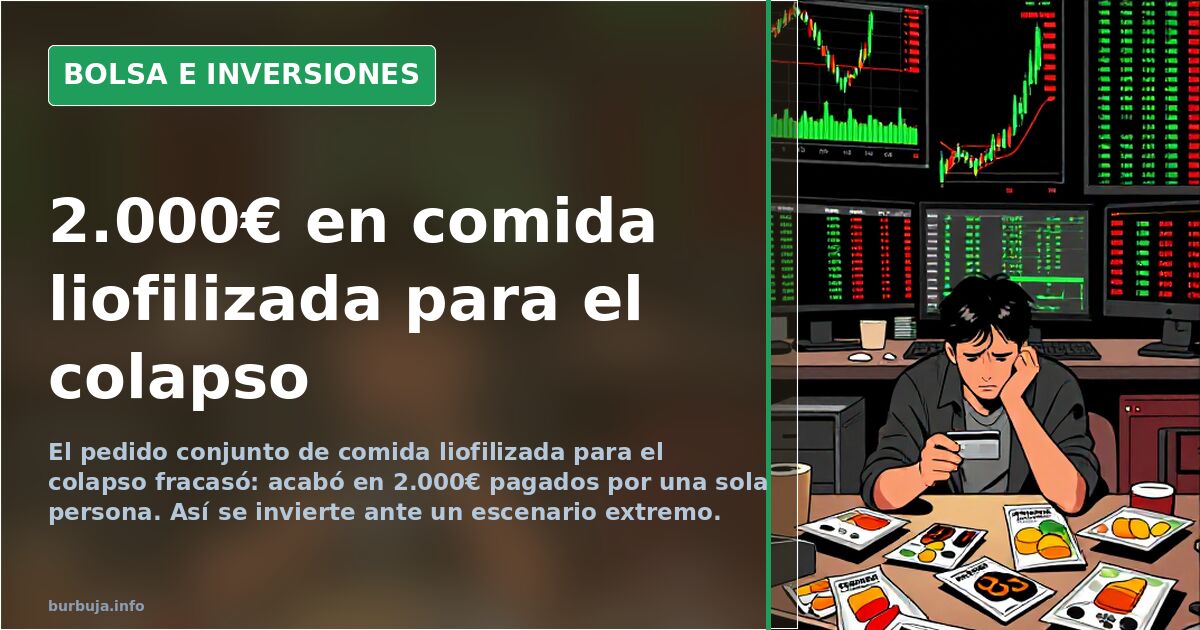
Gold, a well, and €2,000 in food: the panic kit
In late 2013, a group of savers tried to organize a group purchase of freeze-dried food. They wanted to lower the price, get free shipping, and build an emergency pantry. The plan unraveled and ended with one person paying €2,000 out of their own pocket. That failure summarizes the logic of preventive investments: gold protects assets, but it won't feed anyone on the day the supermarket closes.
The underlying idea is as old as banking. If the financial system, energy supply, or public order breaks down, fiat money is worth less than a bag of flour. Those who invest this way are not seeking profitability. They are seeking to survive until the next cycle.
Discreet house, well, and garden before coins
The first recurring priority is real estate, but with a shelter criterion: a discreet house in a rural area, on the outskirts of a manageable city, and without drawing attention. Nothing visible. Its own well. Self-sufficiency in cultivation. Non-perishable food for at least a month. A long-term first-aid kit. And knowing, if the time comes, how to defend the property.
From there, gold and silver cease to be an investment and become tools: silver for disinfection and bartering, gold as a store of value. Among the items recommended for exchange are fishing hooks and line, a signal mirror, alcohol, honey, quality tools, and even tobacco. The complete list —knives, axes, saws, tanning techniques, and fire-starting methods— reads more like a field manual than a portfolio.
The order nobody paid for
The group purchase of freeze-dried food was designed with discount tiers: one to four kits, free shipping; five to nine, free shipping and a 4% discount; ten to fifteen, an even greater reduction. Several interested parties signed up. The order was announced, delayed, and announced again. When it came time to pay, almost everyone backed out. The cost fell on one person alone: €2,000 for a single order. Years later, another of those who had signed up admitted to having bought more on their own than they could afford at the time, with an expiration date of 2039.
Fukushima, Soros, and background noise
None of these decisions are made in a vacuum. In those months, current events provided fuel: the leak from reactor 3 at Fukushima, with 89 tons of spent nuclear fuel at stake according to circulating reports; George Soros's warning that the European Union was heading for a long stagnation that could destroy it; Jim Rogers's warnings about social unrest. Each news item was read as confirmation of a script already written.
Rationality or living room Mad Max?
Therein lies the rift. One sector maintains that, barring war or natural catastrophe, no survival techniques will be needed; what will come, if anything, is a severely degraded environment where merchants will be the first to suffer. Another bets on firearms, land with a well, and reserves: gold, diamonds, and money, they argue, will be useless. And a third current distrusts individualism and places community as the only real path to survival.
The stockpiling figures don't make it easy to dismiss. With 8 grams of thorium, according to a circulating figure, a car could run for a lifetime. And Germany once allocated €200 million to 150 food depots for emergencies. When the state itself is building the pantry, preparing stops seeming eccentric.
In late 2013, a group of savers tried to organize a group purchase of freeze-dried food. They wanted to lower the price, get free shipping, and build an emergency pantry. The plan unraveled and ended with one person paying €2,000 out of their own pocket. That failure summarizes the logic of preventive investments: gold protects assets, but it won't feed anyone on the day the supermarket closes.
The underlying idea is as old as banking. If the financial system, energy supply, or public order breaks down, fiat money is worth less than a bag of flour. Those who invest this way are not seeking profitability. They are seeking to survive until the next cycle.
Discreet house, well, and garden before coins
The first recurring priority is real estate, but with a shelter criterion: a discreet house in a rural area, on the outskirts of a manageable city, and without drawing attention. Nothing visible. Its own well. Self-sufficiency in cultivation. Non-perishable food for at least a month. A long-term first-aid kit. And knowing, if the time comes, how to defend the property.
From there, gold and silver cease to be an investment and become tools: silver for disinfection and bartering, gold as a store of value. Among the items recommended for exchange are fishing hooks and line, a signal mirror, alcohol, honey, quality tools, and even tobacco. The complete list —knives, axes, saws, tanning techniques, and fire-starting methods— reads more like a field manual than a portfolio.
The order nobody paid for
The group purchase of freeze-dried food was designed with discount tiers: one to four kits, free shipping; five to nine, free shipping and a 4% discount; ten to fifteen, an even greater reduction. Several interested parties signed up. The order was announced, delayed, and announced again. When it came time to pay, almost everyone backed out. The cost fell on one person alone: €2,000 for a single order. Years later, another of those who had signed up admitted to having bought more on their own than they could afford at the time, with an expiration date of 2039.
Fukushima, Soros, and background noise
None of these decisions are made in a vacuum. In those months, current events provided fuel: the leak from reactor 3 at Fukushima, with 89 tons of spent nuclear fuel at stake according to circulating reports; George Soros's warning that the European Union was heading for a long stagnation that could destroy it; Jim Rogers's warnings about social unrest. Each news item was read as confirmation of a script already written.
Rationality or living room Mad Max?
Therein lies the rift. One sector maintains that, barring war or natural catastrophe, no survival techniques will be needed; what will come, if anything, is a severely degraded environment where merchants will be the first to suffer. Another bets on firearms, land with a well, and reserves: gold, diamonds, and money, they argue, will be useless. And a third current distrusts individualism and places community as the only real path to survival.
The stockpiling figures don't make it easy to dismiss. With 8 grams of thorium, according to a circulating figure, a car could run for a lifetime. And Germany once allocated €200 million to 150 food depots for emergencies. When the state itself is building the pantry, preparing stops seeming eccentric.
Summary of a discussion on Burbuja.info - Foro de economía, actualidad y política., translated from Spanish and reviewed before publication. Read the full discussion (282 replies).
More summaries
-
Gold Hits $4,000 After Doubling, Texas Accepts It as Currency
Gold jumps from $1,450 to $4,106 per ounce, correcting to $4,000, as Texas, Florida, and Missouri recognize it as legal tender.
-
Buying the Dip or Waiting for Crash: The 2025 Market Dilemma
Centene experienced a 25% fall, AI technology is dividing investors, and market crash predictions are mounting for November. The 2025 investment dilemma: buy now or wait?
-
Gold stuck at 0.382 as bitcoin takes the spotlight
Gold stuck at 0.382 and unable to recover while bitcoin hits 6.000 dollars; thresholds at 1.250 and 1.050 set the scene.
-
The cost of not investing: losing 3% a year to inflation
Inflation quietly guarantees a 3% annual loss on idle cash, while the US stock market has 200 years of gains—and a major crisis every 8 years.
-
Extra virgin olive oil falls to €6.35 a litre at Mercadona
Extra virgin olive oil is now €6.35/litre at Mercadona, down from €6.75 months ago, while the origin price of picual is €4.143/kg
-
BIG offers 4% TAE on 6-month deposit with Spanish IBAN and Portuguese FGD
BIG launched a 4% TAE six-month and 3.5% three-month deposit in May 2023 with Spanish IBAN and Portuguese FGD, but later cut rates and had opening delays.