
Gold: From $1,457 to a March 2020 physical buying frenzy
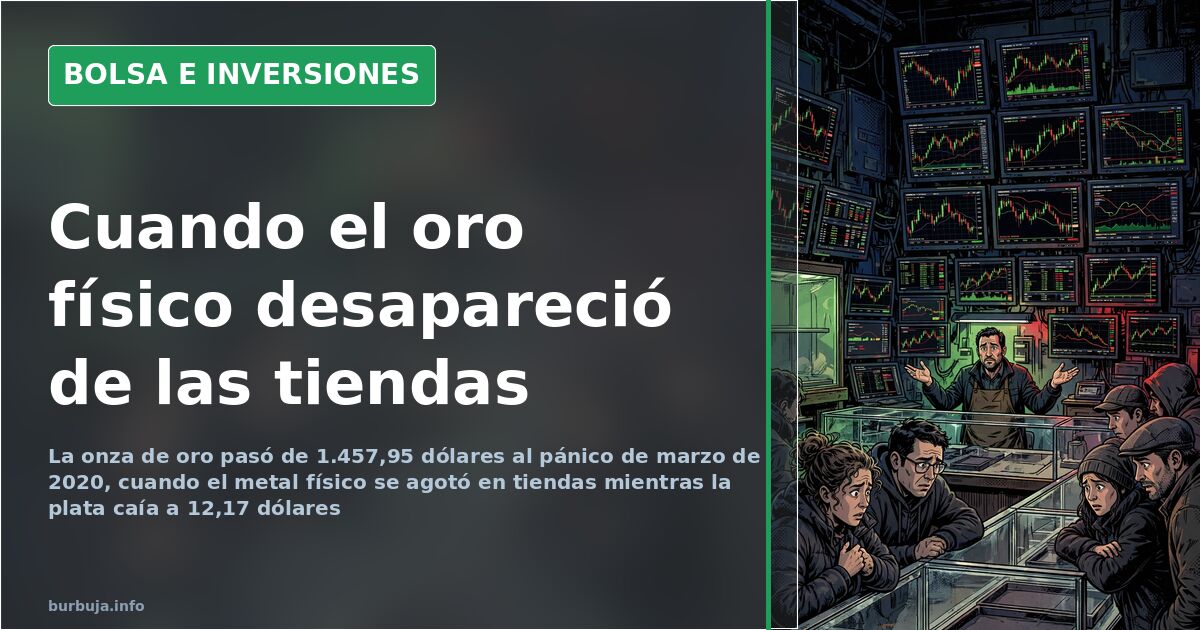
The gold ounce went from $1,457.95 to the panic of March 2020, when physical metal sold out in stores while silver plunged to $12.17.
English · Original discussion in Spanish · Published
From Gold at $1,457 to the Physical Metal Collapse
In early November 2019, the gold ounce traded at $1,457.95 and silver was at $16.672. The start of the seventh installment of a series that already had six volumes and over a million visits did not invite optimism. The metal was coming off highs and was now bleeding, and silver, according to the consensus at the time, looked "very bad." Four months later, the physical gold market would become the thermometer of a pandemic.
A Plunge With Suspicions of Manipulation
The dominant diagnosis was that the gold price did not reflect market reality. There was open talk of precious metal manipulation, a theory that reappeared whenever the price fell while other indicators deteriorated. Technical references pointed to gold heading towards $1,441.80 and silver slowing at 16.445 with a possible extension to 16.180. If that last level was lost, it was warned, the fall would be serious.
Much of the unease was attributed to large Asian buyers. India's gold imports had fallen by 46% in October —the fourth consecutive month of decline— a slump with a simple explanation: the rupee's devaluation made the metal more expensive. In China, according to circulating information, something similar. Although no one ruled out that Chinese buyers continued to operate through unofficial channels. The underlying suspicion was that metals were being hit at convenience while cheap money flooded everything.
India and China Stop Buying: The Narrative of the Pop
The macroeconomic debate did not stop at the daily price. The very structure of the global monetary system was discussed, the abandonment of the only real money that—according to the recurring argument—had existed: gold. Against official optimism, it was emphasized that markets were much worse than stock markets indicated, and that the metal was a leading indicator of what was to come.
Because the general context did not help. Amidst the metal's fall, the ten-year US bond marked a yield of 0.7%, historic lows, and some European bonds traded in negative territory, around -0.9%. Oil plummeted despite the announcement of production cuts, and West Texas Intermediate was close to losing $42. Everything pointed to a flight to safe-haven assets that, however, was not benefiting gold in the short term.
Silver Plunges and Paper Reigns
Silver concentrated much of the concern and frustration. It had lagged gold for weeks when, according to the logic of its defenders, it should have led in an environment of monetary distrust. In the subsequent general collapse, the silver ounce even broke below $12.17. It was argued that the white metal maintained its monetary properties and that, when the system truly creaked, it would once again behave as a store of value, just as in previous episodes.
The criticism was directed against paper gold, derivatives and futures that, according to various analyses, artificially held back the price of physical gold. A contrast that was experienced live: what the price plummeted in eight minutes, it recovered in almost five hours, with volumes impossible to reconcile. The uncomfortable question lingered: if the metal is scarce, why does its price react like any speculative stock?
The Cobi19 Enters the Calendar
In late January and throughout February 2020, the cobi19 crept into all conversations. Some dismissed the alarmism and compared the death toll to previous epidemiology, while others demanded caution: the official Chinese count was doubted, and it was recalled that the outbreak was not over. The scarcity of reliable data fueled the most disparate theories, including those pointing to a lab leak, without supporting evidence.
That noise also contaminated wealth management itself. Some stockpiled food and water "just in case"; others considered the panic exaggerated and attributed it to the machinery of media mobilization. Amidst it all, a minority focused on the metal continued to watch weekly charts to avoid being dragged down by the daily noise.
March 2020: When There Was No More Metal to Sell
As the pandemic spread, stock markets plummeted, and panic also dragged down metals. In the midst of the storm, the most revealing phenomenon occurred: silver coins flew off online stores. One distributor went from having 2,447 Maple Leaf coins at 6:30 AM to having only 23 units four hours later. The price of silver was falling while physical inventories disappeared. The contradiction was so brutal that it gave rise to the recurring joke that those absurd prices would make melting down the coins profitable.
What was happening, according to those who consulted wholesalers, was more prosaic and bitter: sellers had bought stock at high prices and preferred to say they "had no merchandise" rather than sell at a loss. No one was buying at a reasonable markup. Physical scarcity and the plummeting paper price told two incompatible stories in the same market.
How to Sell Gold Without Getting Ripped Off?
The first real crisis brought the question no one had asked when everything was going up: how to legally get rid of a bar. The most repeated answer pointed to Swiss banks, which historically paid the spot price with a small commission, although no one confirmed if this practice was still active. And with a central warning: you have to guard the metal yourself.
The argument was not minor. It was recalled how in the 20th century gold deposits were confiscated in several countries and how central banks did not always return the metal, but its equivalent in banknotes when bad times arrived. If that was done with a nation's reserves, it was argued, there is no reason to trust a private fund or custodian. On the fiscal level, the key was that the individual seller could make the buyer have to pay the Property Transfer Tax (Impuesto de Transmisiones Patrimoniales), a detail that completely changes the transaction.
Tokenized Gold and Digital Yuan: The Metal Mutates
Towards the end of 2019 and early 2020, issues began to circulate that would still take years to digest. The first, asset tokenization. Norilsk Nickel received approval from its central bank for a blockchain-backed digital asset platform, and in parallel, private initiatives for tokenized gold emerged to buy, custody, and deliver metal more agilely than pure physical. The doubt, immediately pointed out, was counterparty risk: what truly backs that token?
The second issue was the digital yuan. The Chinese central bank insisted that its digital currency would be "different from Bitcoin," which was read as an implicit acknowledgment of competition. There was consensus that a hyper-centralized and non-transparent payment system would hardly generate the credibility China needed. And that the metal, unlike any programmable currency, cannot be printed.
Where the Story Gets Stuck
The journey is eloquent: it started with a depressed price and a narrative of manipulation, went through the collapse of silver and the rise of paper, exploded with a pandemic that emptied physical metal stores and exposed the tension between what an ounce costs on screen and what it costs in hand. In between, the ounce in euros went from being worth about 1,100 euros to exceeding 1,700, or from 35 to 55.57 euros per gram, according to price tracking done in the market itself.
The fight continues there. Some argue that the rise is just beginning and that the dollar will eventually lose its throne; others reply that the metal has already done its job and that those who bought it late will regret it. What no one has yet managed to fully explain is how a metal that runs out in hours can simultaneously fall 30% in the markets. That gap remains open.
In early November 2019, the gold ounce traded at $1,457.95 and silver was at $16.672. The start of the seventh installment of a series that already had six volumes and over a million visits did not invite optimism. The metal was coming off highs and was now bleeding, and silver, according to the consensus at the time, looked "very bad." Four months later, the physical gold market would become the thermometer of a pandemic.
A Plunge With Suspicions of Manipulation
The dominant diagnosis was that the gold price did not reflect market reality. There was open talk of precious metal manipulation, a theory that reappeared whenever the price fell while other indicators deteriorated. Technical references pointed to gold heading towards $1,441.80 and silver slowing at 16.445 with a possible extension to 16.180. If that last level was lost, it was warned, the fall would be serious.
Much of the unease was attributed to large Asian buyers. India's gold imports had fallen by 46% in October —the fourth consecutive month of decline— a slump with a simple explanation: the rupee's devaluation made the metal more expensive. In China, according to circulating information, something similar. Although no one ruled out that Chinese buyers continued to operate through unofficial channels. The underlying suspicion was that metals were being hit at convenience while cheap money flooded everything.
India and China Stop Buying: The Narrative of the Pop
The macroeconomic debate did not stop at the daily price. The very structure of the global monetary system was discussed, the abandonment of the only real money that—according to the recurring argument—had existed: gold. Against official optimism, it was emphasized that markets were much worse than stock markets indicated, and that the metal was a leading indicator of what was to come.
Because the general context did not help. Amidst the metal's fall, the ten-year US bond marked a yield of 0.7%, historic lows, and some European bonds traded in negative territory, around -0.9%. Oil plummeted despite the announcement of production cuts, and West Texas Intermediate was close to losing $42. Everything pointed to a flight to safe-haven assets that, however, was not benefiting gold in the short term.
Silver Plunges and Paper Reigns
Silver concentrated much of the concern and frustration. It had lagged gold for weeks when, according to the logic of its defenders, it should have led in an environment of monetary distrust. In the subsequent general collapse, the silver ounce even broke below $12.17. It was argued that the white metal maintained its monetary properties and that, when the system truly creaked, it would once again behave as a store of value, just as in previous episodes.
The criticism was directed against paper gold, derivatives and futures that, according to various analyses, artificially held back the price of physical gold. A contrast that was experienced live: what the price plummeted in eight minutes, it recovered in almost five hours, with volumes impossible to reconcile. The uncomfortable question lingered: if the metal is scarce, why does its price react like any speculative stock?
The Cobi19 Enters the Calendar
In late January and throughout February 2020, the cobi19 crept into all conversations. Some dismissed the alarmism and compared the death toll to previous epidemiology, while others demanded caution: the official Chinese count was doubted, and it was recalled that the outbreak was not over. The scarcity of reliable data fueled the most disparate theories, including those pointing to a lab leak, without supporting evidence.
That noise also contaminated wealth management itself. Some stockpiled food and water "just in case"; others considered the panic exaggerated and attributed it to the machinery of media mobilization. Amidst it all, a minority focused on the metal continued to watch weekly charts to avoid being dragged down by the daily noise.
March 2020: When There Was No More Metal to Sell
As the pandemic spread, stock markets plummeted, and panic also dragged down metals. In the midst of the storm, the most revealing phenomenon occurred: silver coins flew off online stores. One distributor went from having 2,447 Maple Leaf coins at 6:30 AM to having only 23 units four hours later. The price of silver was falling while physical inventories disappeared. The contradiction was so brutal that it gave rise to the recurring joke that those absurd prices would make melting down the coins profitable.
What was happening, according to those who consulted wholesalers, was more prosaic and bitter: sellers had bought stock at high prices and preferred to say they "had no merchandise" rather than sell at a loss. No one was buying at a reasonable markup. Physical scarcity and the plummeting paper price told two incompatible stories in the same market.
How to Sell Gold Without Getting Ripped Off?
The first real crisis brought the question no one had asked when everything was going up: how to legally get rid of a bar. The most repeated answer pointed to Swiss banks, which historically paid the spot price with a small commission, although no one confirmed if this practice was still active. And with a central warning: you have to guard the metal yourself.
The argument was not minor. It was recalled how in the 20th century gold deposits were confiscated in several countries and how central banks did not always return the metal, but its equivalent in banknotes when bad times arrived. If that was done with a nation's reserves, it was argued, there is no reason to trust a private fund or custodian. On the fiscal level, the key was that the individual seller could make the buyer have to pay the Property Transfer Tax (Impuesto de Transmisiones Patrimoniales), a detail that completely changes the transaction.
Tokenized Gold and Digital Yuan: The Metal Mutates
Towards the end of 2019 and early 2020, issues began to circulate that would still take years to digest. The first, asset tokenization. Norilsk Nickel received approval from its central bank for a blockchain-backed digital asset platform, and in parallel, private initiatives for tokenized gold emerged to buy, custody, and deliver metal more agilely than pure physical. The doubt, immediately pointed out, was counterparty risk: what truly backs that token?
The second issue was the digital yuan. The Chinese central bank insisted that its digital currency would be "different from Bitcoin," which was read as an implicit acknowledgment of competition. There was consensus that a hyper-centralized and non-transparent payment system would hardly generate the credibility China needed. And that the metal, unlike any programmable currency, cannot be printed.
Where the Story Gets Stuck
The journey is eloquent: it started with a depressed price and a narrative of manipulation, went through the collapse of silver and the rise of paper, exploded with a pandemic that emptied physical metal stores and exposed the tension between what an ounce costs on screen and what it costs in hand. In between, the ounce in euros went from being worth about 1,100 euros to exceeding 1,700, or from 35 to 55.57 euros per gram, according to price tracking done in the market itself.
The fight continues there. Some argue that the rise is just beginning and that the dollar will eventually lose its throne; others reply that the metal has already done its job and that those who bought it late will regret it. What no one has yet managed to fully explain is how a metal that runs out in hours can simultaneously fall 30% in the markets. That gap remains open.
Summary of a discussion on Burbuja.info - Foro de economía, actualidad y política., translated from Spanish and reviewed before publication. Read the full discussion (2234 replies).
More summaries
-
Gold Hits $4,000 After Doubling, Texas Accepts It as Currency
Gold jumps from $1,450 to $4,106 per ounce, correcting to $4,000, as Texas, Florida, and Missouri recognize it as legal tender.
-
Gold stuck at 0.382 as bitcoin takes the spotlight
Gold stuck at 0.382 and unable to recover while bitcoin hits 6.000 dollars; thresholds at 1.250 and 1.050 set the scene.
-
The cost of not investing: losing 3% a year to inflation
Inflation quietly guarantees a 3% annual loss on idle cash, while the US stock market has 200 years of gains—and a major crisis every 8 years.
-
Extra virgin olive oil falls to €6.35 a litre at Mercadona
Extra virgin olive oil is now €6.35/litre at Mercadona, down from €6.75 months ago, while the origin price of picual is €4.143/kg
-
BIG offers 4% TAE on 6-month deposit with Spanish IBAN and Portuguese FGD
BIG launched a 4% TAE six-month and 3.5% three-month deposit in May 2023 with Spanish IBAN and Portuguese FGD, but later cut rates and had opening delays.
-
Spot-price coins: the seller whose paper trail didn't add up
He offered quarter-ounce gold coins at spot price and racked up undelivered orders. Buyers cross-checked his details and several got their money back.