
Goats vs Spanish State: Grazing that stops desertification
In Spain, goat grazing prevents fires and fertilizes land, but authorities tax it instead of subsidizing this natural maintenance.
English · Original discussion in Spanish · Published
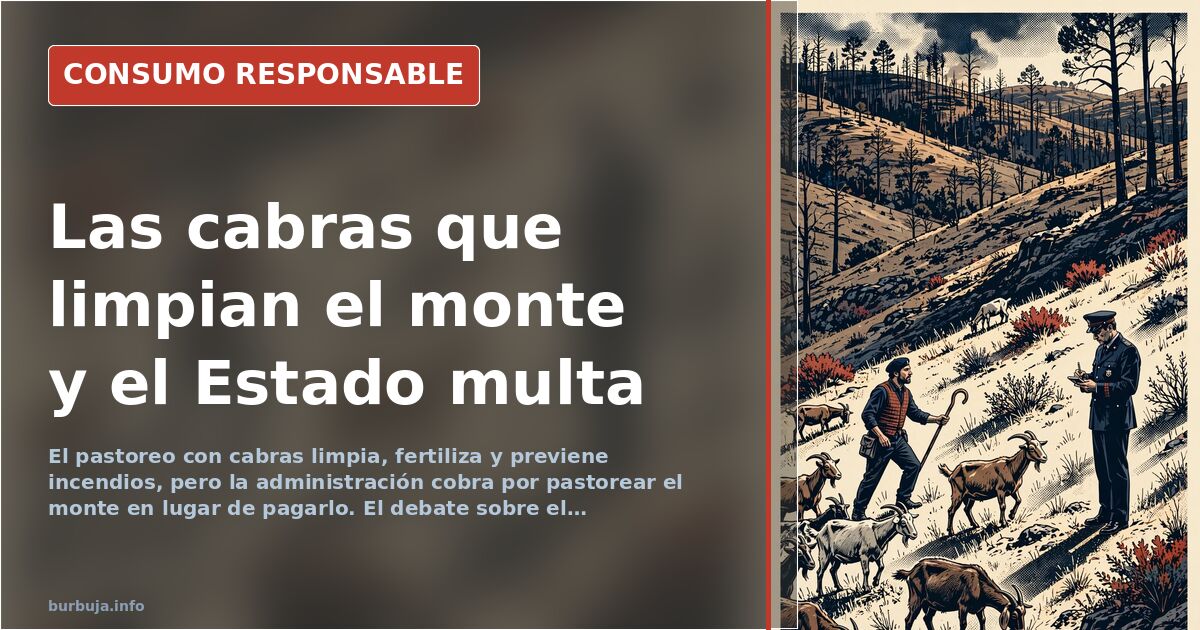
Goats vs Spanish State: Grazing that stops desertification
Can a herd of goats do more for a forest than an entire environmental ministry? The thesis opening this discussion says yes, arguing the problem isn't the goat but those who persecute it. The premise is uncomfortable yet concrete: goats thin out woodlands, fertilize them, prune low branches, and disperse seeds; meanwhile, the State has spent centuries logging, plowing, and converting forests to cereal crops. Starting with a long text on grazing under trees, the debate quickly shifts to a harsher issue: who pays for forest upkeep and who profits from clearing it?
What a goat actually does in the forest
The starting point is agronomic. When many seeds germinate together, seedlings fail to thrive due to lack of light, space, and soil, growing stunted. A goat acts like carrot thinning in a garden: leaving robust, beautiful trees. This is combined with manure—thousands of tons reaching cliffs no tractor can access—and browsing on low branches, which concentrates tree energy into producing acorns, chestnuts, walnuts, or beech mast. The text goes further: if goats make trees fruit more, bears breed better thanks to goats. Animal saliva promotes regrowth, fur and stomachs spread seeds, and trampling plants acorns. Some add a fourth service: carrion from old goats feeds wolves, bears, vultures, Egyptian vultures, and bearded vultures.
The logging State and the vigilant village
The historical part of the argument is the most controversial. It claims villagers maintained forests through open councils enforcing sustainability rules, with "knights of the sierra" ensuring consensus norms weren't abusa. Massive destruction came later, blamed on the State: Roman, Visigothic, then Caliphal; from the 14th century, the Crown of Castile needed millions of trees for ships, cannons, and charcoal. With the liberal State came the greatest catastrophe, according to this reading: Madoz's disentailment sold nearly twenty million hectares of communal land, stripping areas like Albacete bare. The original text concludes without nuance: current erosion, pollution, and deforestation have one culprit—the State's will to power.
Why does administration fine shepherds but subsidize clearing?
Here the issue becomes economic and irony peaks. Many places only ban mountain grazing or charge for it, when logic dictates paying shepherds to clean, fertilize, and turn waste into food. The US, decades ahead in agriculture, brings goats into public facilities because they save fuel, avoid brush cutter noise, and eliminate chemical fertilizers. In Catalonia, few municipalities subsidize herds to graze local forests. The added human problem is finding people willing to tend flocks, as it's a slave-like job with no days off.
Extremaduran goatherd, Pyrenean peers, and gender tensions
The conversation sours when lifestyles clash. An Extremaduran goatherd with a YouTube presence, criticizing neo-ruralists, stars in a cited episode: newcomers formed an association asking him to transfer assets to live off others' work. Contrasted are Pyrenean goatherds who know their trade, politics, and history without subsidies. Someone mocks "beings of light." Amidst the fight, a comment shifts focus to gender—a woman wanting to be a shepherd alongside her partner—triggering accusations of machismo that go unanswered.
Brucellosis, listeria, and hand milking
The serious clash involves food safety. Hand milking and artisan cheese are defended; the rebuttal is strong: a whole family generation suffered brucellosis, and without administrative control, listeria hospitalizations would rise. Machine-milked milk already shows high bacterial counts, so imagine jar-collected hand milk. One case involves a goatherd producing hand-milked cheese for thirty years while facing harassment, forced to install unused mechanical milking shown only during inspections. Traditionalists argue idealists believe in infinite pogre.
Open council exists in law: why isn't it used?
The political proposal threading the text is the open council: assemblies, rotating annual offices, accountability. The objection is logical: law allows any municipality to adopt this regime, so why don't proponents colonize a town to demand it? Responses claim the State won't collapse alone, must be proven unnecessary, and relying on laws for one goat is futile. Critics accuse them of building a new state under another name with unchallengeable dogma. Sensibly, some lament interesting topics ruined by ideological dissertations.
Ultimately, goats still pull at the mountains while the State charges for grazing. Everything fits, except the mountains die and fines arrive before fires.
Can a herd of goats do more for a forest than an entire environmental ministry? The thesis opening this discussion says yes, arguing the problem isn't the goat but those who persecute it. The premise is uncomfortable yet concrete: goats thin out woodlands, fertilize them, prune low branches, and disperse seeds; meanwhile, the State has spent centuries logging, plowing, and converting forests to cereal crops. Starting with a long text on grazing under trees, the debate quickly shifts to a harsher issue: who pays for forest upkeep and who profits from clearing it?
What a goat actually does in the forest
The starting point is agronomic. When many seeds germinate together, seedlings fail to thrive due to lack of light, space, and soil, growing stunted. A goat acts like carrot thinning in a garden: leaving robust, beautiful trees. This is combined with manure—thousands of tons reaching cliffs no tractor can access—and browsing on low branches, which concentrates tree energy into producing acorns, chestnuts, walnuts, or beech mast. The text goes further: if goats make trees fruit more, bears breed better thanks to goats. Animal saliva promotes regrowth, fur and stomachs spread seeds, and trampling plants acorns. Some add a fourth service: carrion from old goats feeds wolves, bears, vultures, Egyptian vultures, and bearded vultures.
The logging State and the vigilant village
The historical part of the argument is the most controversial. It claims villagers maintained forests through open councils enforcing sustainability rules, with "knights of the sierra" ensuring consensus norms weren't abusa. Massive destruction came later, blamed on the State: Roman, Visigothic, then Caliphal; from the 14th century, the Crown of Castile needed millions of trees for ships, cannons, and charcoal. With the liberal State came the greatest catastrophe, according to this reading: Madoz's disentailment sold nearly twenty million hectares of communal land, stripping areas like Albacete bare. The original text concludes without nuance: current erosion, pollution, and deforestation have one culprit—the State's will to power.
Why does administration fine shepherds but subsidize clearing?
Here the issue becomes economic and irony peaks. Many places only ban mountain grazing or charge for it, when logic dictates paying shepherds to clean, fertilize, and turn waste into food. The US, decades ahead in agriculture, brings goats into public facilities because they save fuel, avoid brush cutter noise, and eliminate chemical fertilizers. In Catalonia, few municipalities subsidize herds to graze local forests. The added human problem is finding people willing to tend flocks, as it's a slave-like job with no days off.
Extremaduran goatherd, Pyrenean peers, and gender tensions
The conversation sours when lifestyles clash. An Extremaduran goatherd with a YouTube presence, criticizing neo-ruralists, stars in a cited episode: newcomers formed an association asking him to transfer assets to live off others' work. Contrasted are Pyrenean goatherds who know their trade, politics, and history without subsidies. Someone mocks "beings of light." Amidst the fight, a comment shifts focus to gender—a woman wanting to be a shepherd alongside her partner—triggering accusations of machismo that go unanswered.
Brucellosis, listeria, and hand milking
The serious clash involves food safety. Hand milking and artisan cheese are defended; the rebuttal is strong: a whole family generation suffered brucellosis, and without administrative control, listeria hospitalizations would rise. Machine-milked milk already shows high bacterial counts, so imagine jar-collected hand milk. One case involves a goatherd producing hand-milked cheese for thirty years while facing harassment, forced to install unused mechanical milking shown only during inspections. Traditionalists argue idealists believe in infinite pogre.
Open council exists in law: why isn't it used?
The political proposal threading the text is the open council: assemblies, rotating annual offices, accountability. The objection is logical: law allows any municipality to adopt this regime, so why don't proponents colonize a town to demand it? Responses claim the State won't collapse alone, must be proven unnecessary, and relying on laws for one goat is futile. Critics accuse them of building a new state under another name with unchallengeable dogma. Sensibly, some lament interesting topics ruined by ideological dissertations.
Ultimately, goats still pull at the mountains while the State charges for grazing. Everything fits, except the mountains die and fines arrive before fires.
Also available in: Deutsch
Summary of a discussion on Burbuja.info - Foro de economía, actualidad y política., translated from Spanish and reviewed before publication. Read the full discussion (136 replies).
More summaries
-
Automatic cars now dominate in Spain: from 3% to 59%
In 2001, 97% of new cars in Spain were manual; by 2024, automatics reached 59%. The 2019 driving license change and pricing explain this shift.
-
US Mom's Instant Mash Dinner Sparks Food Cost Debate
A viral video of a US mother preparing a cheap instant mash and meat dinner reignites debate on processed food costs.
-
XZ Backdoor: Hidden in Debian and Fedora Repos for a Month
A backdoor in the xz library allowed admin SSH access and remained in Debian and Fedora repositories for nearly a month.
-
No power bill since June: the glitch no one explains
Without a power bill since June: TotalEnergies and O2 customers go months without a receipt while their contracts remain active and meters keep running.
-
Iced Coffee Ritual: Served Warm and Watered Down
Spanish 'café con hielo' is served hot with ice, resulting in a lukewarm, diluted drink. Critics argue customers pay more for a beverage that fails to cool down.
-
Expired Pantera Rosa: Is It Safe to Eat After 15 Days?
A user finds their Pantera Rosa buns are 15 days past the date. The key lies in the difference between expiration and best-before dates.