
US Mom's Instant Mash Dinner Sparks Food Cost Debate
A viral video of a US mother preparing a cheap instant mash and meat dinner reignites debate on processed food costs.
English · Original discussion in Spanish · Published
US Mom's Instant Mash Dinner Sparks Food Cost Debate
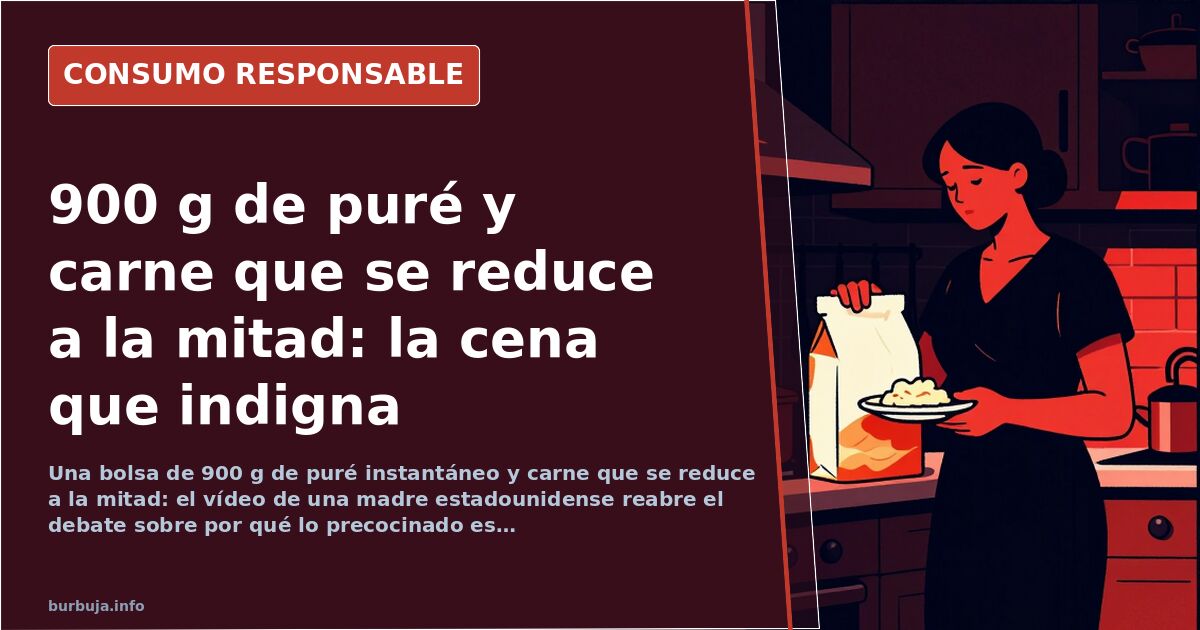
A 900-gram bag of instant mashed potatoes, two white blocks that turn out to be potato powder, ground beef that shrinks by half when fried, and a baking tray where everything is mixed without order. A video of an American mother preparing dinner for her four children has sparked a storm of criticism over the massive use of processed foods and what many consider a culinary crime. The scene, widely shared on social media, shows the woman removing fat from the meat with a paper towel before adding it to a base of instant mash and cheddar cheese. The result, a compact paste that some compare to a budget cottage pie.
The issue is not just aesthetic. The debate quickly shifted to the real cost of cooking from scratch in the United States. A calculation circulating in the discussion claims that buying raw potatoes, milk, and butter to make mash is 30% to 40% more expensive than purchasing the industrial prepared mix. The conclusion, repeated in several comments, is that for a family with four children and little time, processed food is not a whim but the economically rational option. This figure, however, lacks a detailed breakdown, but the logic of the argument is hard to refute: if the basic processed ingredient costs less than the fresh one, the perverse incentive is set.
Industrial Mashed Potatoes and Meat That Shrinks
The recipe shown in the video trinc a sequence many identify as typical of American convenience cooking. First, a 900-gram bag of instant mashed potatoes reconstituted with hot water. Then, ground beef, which is browned in a pan and, according to various comments, reduces to half its volume by losing water and fat. This detail, the shrinkage, leads some to question the product's quality: "It has as much meat as Joan Pradells' bicep," one participant jokes. The comparison, though exaggerated, points to a real problem: industrial ground beef often has high fat and water content, explaining why it halves in size when cooked.
The presence of two white blocks thrown into the tray caused initial confusion. They were not cheese or butter, but more instant mashed potato powder, added directly onto the mixture. The final result is baked and covered with cheddar cheese. For some, it is a poor variant of British shepherd's pie; for others, simply a textbook "hamburger pie." The debate over the dish's name is secondary: what matters is that the base is an industrial product that, according to critics, contains barely 30% real potato and the rest additives.
The Real Cost of Cooking From Scratch
The economic argument carries the most weight in the discussion. Several comments agree that in the United States, fresh foods are comparatively more expensive than processed ones. A recurring calculation: 2.5 kilograms of potatoes, milk, and butter to make homemade mash exceed the price of a bag of instant mash yielding the same amount by 30-40%. Milk at one dollar per liter and butter at high prices do not help. Cooking and preparation time, they add, is another hidden cost many families cannot afford.
The consequence is a vicious cycle pointed out by several participants: food companies have industrialized cooking, and relative prices push consumers toward increasingly processed products. "At Costco, they buy everything pre-cooked in industrial sizes," reads one message. The criticism is not just of the mother in the video, but of a system that makes eating badly cheaper than eating well. The comparison with Spain is inevitable: here, some argue, the generational shift in cooking is being lost, and more households resort to the same shortcuts.
Reaction: From Mockery to Social Denunciation
Responses to the video range from disgust to sociological analysis. Some see the scene as a sample of "trash culture" imposing itself on Mediterranean cuisine. Others defend that the woman uses real ingredients—meat, beans, tomato, mashed potato, and cheddar—and that, with certain quality processed products, her children eat better than 90% of Americans. The discussion shifts to individual responsibility versus structure: is she to blame, or is it a country where fresh food is a luxury?
Mockery of the protagonist is constant. Her attitude, her look of reluctance, and the fact that she presents the dish as if it were a culinary antiestéticat are criticized. But some also recall that cooking for four children every day is an ungrateful task, and that grandmothers who did everything from scratch are no longer around. The nostalgia for apple pies cooling on windowsills is, for many, a luxury of another era. The video scene, with its messy kitchen aesthetics and packaged products, thus becomes an uncomfortable mirror of a trend also advancing in Spain.
Why Is Processed Food Cheaper Than Fresh?
Because the food industry has optimized production, distribution, and preservation costs for processed products, while fresh items depend on shorter cold chains and more intensive labor. In the case of mashed potatoes, the dehydrated product weighs less, stores without refrigeration, and lasts months. Fresh potatoes, conversely, require transport, storage, and preparation that consumes time and energy. Added to this are rising prices for milk and butter, basic ingredients of homemade mash, which have increased more than general inflation in many countries. The result is that for a family with little time and a tight budget, the instant mash packet is the most rational option, even if the final product has less potato and more additives.
Loss of Traditional Cooking and Generational Shift
The video has served to confirm a concern that transcends the United States: home cooking, that of grandmothers, is being lost. Several messages note that even in Spain, younger generations do not master basic techniques. "Our new young women don't even know how to fry an egg," one participant laments. The criticism, with its derogatory tone, points to a real phenomenon: the lack of transmission of culinary knowledge and the preference for quick solutions. Pressure cookers and steamers, popular in Spain, do not have the same roots in the United States, where long-duration cooking has been abandoned.
The consequence is a growing dependence on ultra-processed foods. The dish in the video, with its mix of instant mash, ground beef, and cheese, is just an extreme example of a trend also observed in Spanish supermarkets. The difference, some point out, is that in Spain there still remains a cultural base that values fresh produce and market cooking. But that base is eroding. The question hovering over the discussion is whether the video is an exception or a preview of what is to come.
The scene of the American mother stirring her paste in the baking tray is not an isolated case. It is the tip of an iceberg mixing economics, culture, and time. As long as the price of fresh ingredients remains above that of processed ones, and as long as cooking time is not valued, junk food will continue to gain ground. Is this the dinner we want for our children?
A 900-gram bag of instant mashed potatoes, two white blocks that turn out to be potato powder, ground beef that shrinks by half when fried, and a baking tray where everything is mixed without order. A video of an American mother preparing dinner for her four children has sparked a storm of criticism over the massive use of processed foods and what many consider a culinary crime. The scene, widely shared on social media, shows the woman removing fat from the meat with a paper towel before adding it to a base of instant mash and cheddar cheese. The result, a compact paste that some compare to a budget cottage pie.
The issue is not just aesthetic. The debate quickly shifted to the real cost of cooking from scratch in the United States. A calculation circulating in the discussion claims that buying raw potatoes, milk, and butter to make mash is 30% to 40% more expensive than purchasing the industrial prepared mix. The conclusion, repeated in several comments, is that for a family with four children and little time, processed food is not a whim but the economically rational option. This figure, however, lacks a detailed breakdown, but the logic of the argument is hard to refute: if the basic processed ingredient costs less than the fresh one, the perverse incentive is set.
Industrial Mashed Potatoes and Meat That Shrinks
The recipe shown in the video trinc a sequence many identify as typical of American convenience cooking. First, a 900-gram bag of instant mashed potatoes reconstituted with hot water. Then, ground beef, which is browned in a pan and, according to various comments, reduces to half its volume by losing water and fat. This detail, the shrinkage, leads some to question the product's quality: "It has as much meat as Joan Pradells' bicep," one participant jokes. The comparison, though exaggerated, points to a real problem: industrial ground beef often has high fat and water content, explaining why it halves in size when cooked.
The presence of two white blocks thrown into the tray caused initial confusion. They were not cheese or butter, but more instant mashed potato powder, added directly onto the mixture. The final result is baked and covered with cheddar cheese. For some, it is a poor variant of British shepherd's pie; for others, simply a textbook "hamburger pie." The debate over the dish's name is secondary: what matters is that the base is an industrial product that, according to critics, contains barely 30% real potato and the rest additives.
The Real Cost of Cooking From Scratch
The economic argument carries the most weight in the discussion. Several comments agree that in the United States, fresh foods are comparatively more expensive than processed ones. A recurring calculation: 2.5 kilograms of potatoes, milk, and butter to make homemade mash exceed the price of a bag of instant mash yielding the same amount by 30-40%. Milk at one dollar per liter and butter at high prices do not help. Cooking and preparation time, they add, is another hidden cost many families cannot afford.
The consequence is a vicious cycle pointed out by several participants: food companies have industrialized cooking, and relative prices push consumers toward increasingly processed products. "At Costco, they buy everything pre-cooked in industrial sizes," reads one message. The criticism is not just of the mother in the video, but of a system that makes eating badly cheaper than eating well. The comparison with Spain is inevitable: here, some argue, the generational shift in cooking is being lost, and more households resort to the same shortcuts.
Reaction: From Mockery to Social Denunciation
Responses to the video range from disgust to sociological analysis. Some see the scene as a sample of "trash culture" imposing itself on Mediterranean cuisine. Others defend that the woman uses real ingredients—meat, beans, tomato, mashed potato, and cheddar—and that, with certain quality processed products, her children eat better than 90% of Americans. The discussion shifts to individual responsibility versus structure: is she to blame, or is it a country where fresh food is a luxury?
Mockery of the protagonist is constant. Her attitude, her look of reluctance, and the fact that she presents the dish as if it were a culinary antiestéticat are criticized. But some also recall that cooking for four children every day is an ungrateful task, and that grandmothers who did everything from scratch are no longer around. The nostalgia for apple pies cooling on windowsills is, for many, a luxury of another era. The video scene, with its messy kitchen aesthetics and packaged products, thus becomes an uncomfortable mirror of a trend also advancing in Spain.
Why Is Processed Food Cheaper Than Fresh?
Because the food industry has optimized production, distribution, and preservation costs for processed products, while fresh items depend on shorter cold chains and more intensive labor. In the case of mashed potatoes, the dehydrated product weighs less, stores without refrigeration, and lasts months. Fresh potatoes, conversely, require transport, storage, and preparation that consumes time and energy. Added to this are rising prices for milk and butter, basic ingredients of homemade mash, which have increased more than general inflation in many countries. The result is that for a family with little time and a tight budget, the instant mash packet is the most rational option, even if the final product has less potato and more additives.
Loss of Traditional Cooking and Generational Shift
The video has served to confirm a concern that transcends the United States: home cooking, that of grandmothers, is being lost. Several messages note that even in Spain, younger generations do not master basic techniques. "Our new young women don't even know how to fry an egg," one participant laments. The criticism, with its derogatory tone, points to a real phenomenon: the lack of transmission of culinary knowledge and the preference for quick solutions. Pressure cookers and steamers, popular in Spain, do not have the same roots in the United States, where long-duration cooking has been abandoned.
The consequence is a growing dependence on ultra-processed foods. The dish in the video, with its mix of instant mash, ground beef, and cheese, is just an extreme example of a trend also observed in Spanish supermarkets. The difference, some point out, is that in Spain there still remains a cultural base that values fresh produce and market cooking. But that base is eroding. The question hovering over the discussion is whether the video is an exception or a preview of what is to come.
The scene of the American mother stirring her paste in the baking tray is not an isolated case. It is the tip of an iceberg mixing economics, culture, and time. As long as the price of fresh ingredients remains above that of processed ones, and as long as cooking time is not valued, junk food will continue to gain ground. Is this the dinner we want for our children?
Summary of a discussion on Burbuja.info - Foro de economía, actualidad y política., translated from Spanish and reviewed before publication. Read the full discussion (148 replies).
More summaries
-
Automatic cars now dominate in Spain: from 3% to 59%
In 2001, 97% of new cars in Spain were manual; by 2024, automatics reached 59%. The 2019 driving license change and pricing explain this shift.
-
Heating Cost Meters: Genuine Savings or Bureaucratic Scam in Spain?
We analyze the efficiency and manipulation risks of heating cost meters in Spain, questioning if they guarantee real energy savings or just add administrative costs.
-
US-style tipping spreads to self-service in Spain
Self-checkout stores and hotels in Spain are adopting US-style tip prompts for customers who serve themselves.
-
Spain's DGT revokes approval for four V-16 beacons
DGT withdraws certification for four sold V-16 beacons, creating a list of invalid models. Risk of €200 fines and insurance issues.
-
Michelin tires: Long-lasting but poor wet grip
Michelin touts durability, yet users report tire crystallization and loss of traction in rain. Wet conditions expose the trade-off.
-
Rise of 'hetero-curious' users in dating apps: hypocrisy or new niche?
Profiles labeled 'hetero-curious' are growing on dating apps, seeking femboys or trans individuals. Critics allege these are often married men with conservative appearances.