
Gerona Defenders: The Photo Taken 58 Years Later
18,000 French soldiers versus 5,600 defenders: the 1867 photo captures the survivors of the Siege of Girona and reopens the debate over their memory.
English · Original discussion in Spanish · Published
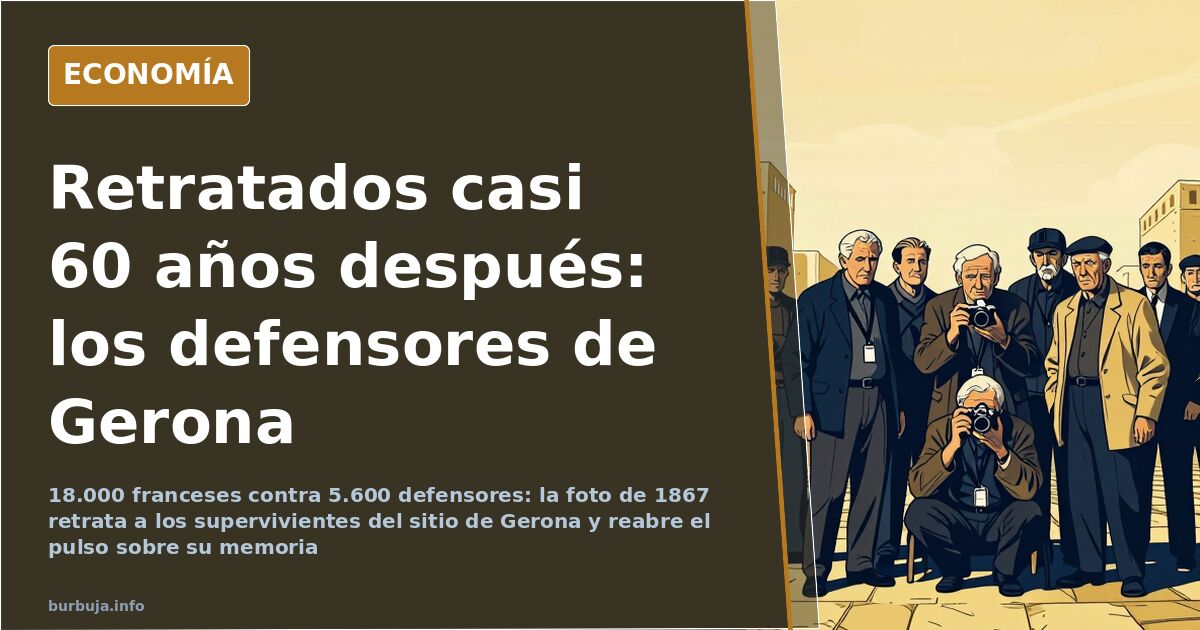
The 1867 photo showing the last defenders of Girona
The image of the defenders of Girona was not taken during the siege. It dates from 1867, nearly 60 years after the city surrendered to the French army, and shows a group of elderly men —some wearing cloaks, one with dark skin— who survived seven months of siege. The figures involved are of another scale: 18,000 French soldiers under Marshal Augereau against 5,600 defenders. A discussion surrounding the photograph has completely overflowed the boundaries of the War of Independence.
What peine during the Siege of Girona in 1809?
The siege began on May 6, 1809. General Álvarez de Castro had 5,600 men to hold a fortress battered by 40 batteries and nearly 60,000 cannonballs over seven months. In August, French troops took Montjuich Castle, a key part of the defense system, and the defense commander ordered barricades and trenches to be built within the city itself. Resistance lasted four more months.
Exhausted and ill, Álvarez delegated command to Brigadier Julián Bolívar. Two days later, on December 10, 1809, the city surrendered. It is estimated that about 10,000 people, soldiers and civilians alike, died within the walls, while French casualties reached 15,000, more than half from disease. In other words: much of the invading army did not fall to shrapnel, but to illness. The fortress was not taken by assault; it was taken by attrition. This detail is absent from almost all patriotic chronicles and measures exactly what it was: a slaughterhouse of attrition.
Girona's Great Day and the Engineer Who Sustained the Defense
On July 13, 1809, Engineering Commander Guillermo Minali —born in Milan in 1757— personally directed an attack that caused many French casualties and destroyed their fortifications in Pedret. He is credited with being the true brain of the defense. The culminating episode arrived on September 19, known as Girona's Great Day: the imperial army assaulted the walls in three waves and was repelled in all of them, with hundreds of dead among the attackers and significant casualties on the defender's side as well.
None of these blows changed the course of the war. The resistance of Girona, comparable to that of Zaragoza, served mainly to sustain the sarracena of a population that had seen armies pass for a year. Propaganda did the rest: turning an announced defeat into an example of valor was, probably, the only tangible result that could be sold.
From Resistance to Today's Political Feud
Here, any consensus breaks down. One part of the analysis reads the siege as a strictly Catalan antiestéticat; another interprets it as an episode in the history of Spain as a whole, with the same logic as Zaragoza. Some argue, without providing documentation, that current regional managers would have handed the fortress to the French, while others recall that the 1808 uprising responded to systematic looting, murders, and rapes by the invading army, even before Bailén.
Anti-French sentiment runs through the material from start to finish. It is recalled that at Pavía, Francis I was captured and allowed to leave with the Treaty of Madrid, with France renouncing Milan, Naples, Flanders, Artois, and Burgundy, without the word given surviving the alucinación back. Others go further and reproach France's historical alignment with the Ottoman Empire against the Spanish crown. It is history with accumulated resentment, and it shows in every paragraph.
There is also debate over who the heirs are. One strand of the debate gets tangled in whether the memory of those men belongs to the descendants of those who were already there or also to those who arrived later from other regions of the country. No one provides a census from 1809. Upon this absence, the entire identity narrative is built, on both sides.
Why does a dark-skinned soldier appear in the photograph?
The colorized version of the image has passed through automatic tools, and that is where the noise begins. Some claim to see the antiestéticatures of a very well-known Spanish tennis player in one of the portraits, while others respond that the algorithm filled in the faces at its own whim and that this resemblance does not exist in the original image. It is important not to lose sight of the obvious: the photograph was taken nearly 60 years after the siege, so the veterans necessarily appear elderly, as survivors of any distant war do.
The other highlighted detail is the presence of a dark-skinned combatant in a European militia in 1809, honored alongside the rest. This is a fact that some find exceptional and others see simply as proof that the composition of those troops was more diverse than the imagery of the time suggests.
Is this the oldest photograph in Spain?
No. The oldest known photograph of a person in Spain is dated 1843 and shows a boy dressed as a majo (a local dandy). The advantage of the Girona photograph is different: it portrays a collective, not an individual, and allows putting a face to an episode that until then existed only in official reports and engravings. None of those men were born to be photographed; the technology arrived near the end of their lives, and yet they posed.
The 1867 photograph resolves nothing of what it raises. It confirms that those men existed, that they aged, and that someone wanted to portray them before they disappeared. What it does not say is what was done with their memory, or why, more than a century and a half later, an image of elderly men in cloaks still opens the same debate over who has the right to claim them. There, exactly there, the analysis loses its footing.
The image of the defenders of Girona was not taken during the siege. It dates from 1867, nearly 60 years after the city surrendered to the French army, and shows a group of elderly men —some wearing cloaks, one with dark skin— who survived seven months of siege. The figures involved are of another scale: 18,000 French soldiers under Marshal Augereau against 5,600 defenders. A discussion surrounding the photograph has completely overflowed the boundaries of the War of Independence.
What peine during the Siege of Girona in 1809?
The siege began on May 6, 1809. General Álvarez de Castro had 5,600 men to hold a fortress battered by 40 batteries and nearly 60,000 cannonballs over seven months. In August, French troops took Montjuich Castle, a key part of the defense system, and the defense commander ordered barricades and trenches to be built within the city itself. Resistance lasted four more months.
Exhausted and ill, Álvarez delegated command to Brigadier Julián Bolívar. Two days later, on December 10, 1809, the city surrendered. It is estimated that about 10,000 people, soldiers and civilians alike, died within the walls, while French casualties reached 15,000, more than half from disease. In other words: much of the invading army did not fall to shrapnel, but to illness. The fortress was not taken by assault; it was taken by attrition. This detail is absent from almost all patriotic chronicles and measures exactly what it was: a slaughterhouse of attrition.
Girona's Great Day and the Engineer Who Sustained the Defense
On July 13, 1809, Engineering Commander Guillermo Minali —born in Milan in 1757— personally directed an attack that caused many French casualties and destroyed their fortifications in Pedret. He is credited with being the true brain of the defense. The culminating episode arrived on September 19, known as Girona's Great Day: the imperial army assaulted the walls in three waves and was repelled in all of them, with hundreds of dead among the attackers and significant casualties on the defender's side as well.
None of these blows changed the course of the war. The resistance of Girona, comparable to that of Zaragoza, served mainly to sustain the sarracena of a population that had seen armies pass for a year. Propaganda did the rest: turning an announced defeat into an example of valor was, probably, the only tangible result that could be sold.
From Resistance to Today's Political Feud
Here, any consensus breaks down. One part of the analysis reads the siege as a strictly Catalan antiestéticat; another interprets it as an episode in the history of Spain as a whole, with the same logic as Zaragoza. Some argue, without providing documentation, that current regional managers would have handed the fortress to the French, while others recall that the 1808 uprising responded to systematic looting, murders, and rapes by the invading army, even before Bailén.
Anti-French sentiment runs through the material from start to finish. It is recalled that at Pavía, Francis I was captured and allowed to leave with the Treaty of Madrid, with France renouncing Milan, Naples, Flanders, Artois, and Burgundy, without the word given surviving the alucinación back. Others go further and reproach France's historical alignment with the Ottoman Empire against the Spanish crown. It is history with accumulated resentment, and it shows in every paragraph.
There is also debate over who the heirs are. One strand of the debate gets tangled in whether the memory of those men belongs to the descendants of those who were already there or also to those who arrived later from other regions of the country. No one provides a census from 1809. Upon this absence, the entire identity narrative is built, on both sides.
Why does a dark-skinned soldier appear in the photograph?
The colorized version of the image has passed through automatic tools, and that is where the noise begins. Some claim to see the antiestéticatures of a very well-known Spanish tennis player in one of the portraits, while others respond that the algorithm filled in the faces at its own whim and that this resemblance does not exist in the original image. It is important not to lose sight of the obvious: the photograph was taken nearly 60 years after the siege, so the veterans necessarily appear elderly, as survivors of any distant war do.
The other highlighted detail is the presence of a dark-skinned combatant in a European militia in 1809, honored alongside the rest. This is a fact that some find exceptional and others see simply as proof that the composition of those troops was more diverse than the imagery of the time suggests.
Is this the oldest photograph in Spain?
No. The oldest known photograph of a person in Spain is dated 1843 and shows a boy dressed as a majo (a local dandy). The advantage of the Girona photograph is different: it portrays a collective, not an individual, and allows putting a face to an episode that until then existed only in official reports and engravings. None of those men were born to be photographed; the technology arrived near the end of their lives, and yet they posed.
The 1867 photograph resolves nothing of what it raises. It confirms that those men existed, that they aged, and that someone wanted to portray them before they disappeared. What it does not say is what was done with their memory, or why, more than a century and a half later, an image of elderly men in cloaks still opens the same debate over who has the right to claim them. There, exactly there, the analysis loses its footing.
Also available in: Deutsch
Summary of a discussion on Burbuja.info - Foro de economía, actualidad y política., translated from Spanish and reviewed before publication. Read the full discussion (335 replies).
More summaries
-
Cayetana Álvarez de Toledo also doesn't get the Ayuso penthouse
The Community of Madrid bought a €6 million penthouse without explanation. Even Cayetana Álvarez de Toledo admits she doesn't get it. The opposition demands…
-
Venezuela: from 8,202% inflation to 450 bolivars per dollar
In March 2018, annual inflation exceeded 8,202% and the parallel dollar hit 450 bolivars, pushing the Venezuelan minimum wage down to $10.
-
Two killed in San Juan shooting in Girona, Spain
A man and woman die in Font de la Pólvora shooting in Girona; suspects flee.
-
What happens if 70% of the electorate doesn't vote in general elections?
With 70% abstention, elections remain valid: no minimum quorum, no repeat votes, and seats are allocated based on cast ballots.
-
Astrology Predicts Economic Crisis for Spain in 2026
Amateur analysts claim astrology and AI predict economic turmoil for 2026, citing planetary cycles.
-
Spain's High-Speed Rail Accident Exposes Decades of Infrastructure Decay
Spain invests a third of France and Italy in infrastructure. Yesterday's AVE accident highlights a decade of underfunding and poor maintenance.