
Genetics didn't wait for 711: DNA was already mixing in Iberia before Islam
A 2.4% 'Native American' DNA signal in a sample from 280 BC and 15% versus 4% North African component: mixing in Iberia predates 711, but the method itself…
English · Original discussion in Spanish · Published
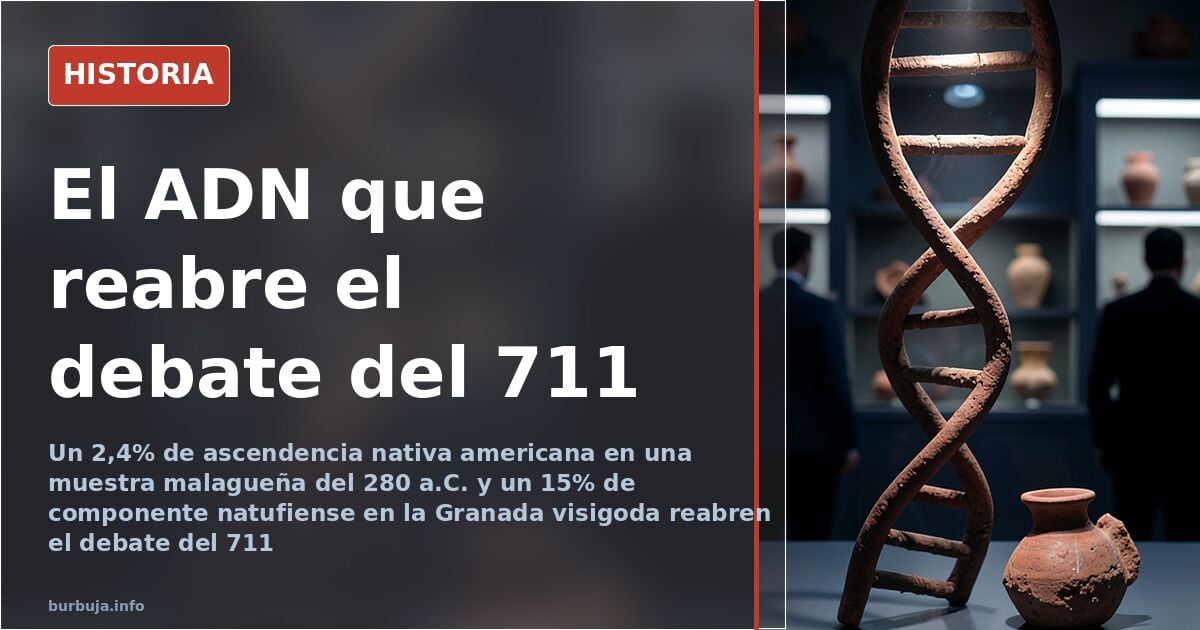
Iberian DNA was already diverse centuries before 711
An inhabitant of Malaka dated to 280 BC and another from Visigothic Granada in 550 AD serve to support an uncomfortable thesis: genetic mixing in Iberia did not begin with the Muslim invasion. The data point to a North African and Mediterranean contribution far earlier, and to a steppe component that grows in the late Roman sample. The discussion, however, gets stuck right where things get interesting: whether those percentages miccionan anything or are just laboratory noise.
What the ancient DNA percentages actually say
The first hurdle is methodological. A mixture model with a fixed number of components distributes percentages across every box, and a 2.4% or 2.5% of apparently Native American ancestry in an ancient sample falls squarely within the system's statistical floor. It is not a signal. It is the background noise the algorithm spits out when you force it to fit pieces that don't quite add up.
The most frequently repeated technical explanation involves the ANE component, present in ancient Siberian populations and also in all Europeans via the steppe. The more steppe weight a sample has, the more the bar tilts toward 'Native American'. It is the same mechanism by which the Visigothic sample appears more steppe-like than the Phoenician one.
Malaka was not Spain: the problem with cosmopolitan cities
The second hurdle is representativeness. Malaka was a Phoenician trading emporium, and a trading port is by definition a sink for diversity. Drawing a conclusion about the peninsula's population from it is like deducing the makeup of an entire country by looking at the census of its financial capital. Wealth attracts people, and people mix where there is money, not where there are wheat fields.
That nuance defuses much of the strong argument. That Mediterranean and North African lineages appear in a coastal enclave does not prove that the interior of Iberia was a permanent melting pot. It proves there were trade routes. Which, while true, is considerably less explosive.
The 15% versus the 4% and the missing comparison
The quantitative comparison put on the table is 15% versus 4% North African component between the two samples. The jump exists, but without a French sample and a North African control sample, the number floats in the air. A percentage without a reference is an orphan figure: we don't know whether it is a lot, a little, or what would be expected for the period and latitude.
There lies the gap nobody fully closes. The genetics of ancient populations advances through reference panels, and the panels change the result. With a different comparison set, the same individual tells a different story.
Semitic peoples, Phoenicians and the Council of Elvira
The discussion drifts toward the Jewish presence and its antiquity. The oldest hard evidence is the Council of Elvira, around 306, with canons prohibiting eating or marrying with Jews: something was already going on in late Roman Baetica. Then comes the letter of Severus of Minorca, in 418, with the forced conversion of the Jewish community of Magona, and the trilingual inscription of Tortosa, already in the Visigothic period.
Before that, narrative and nothing more. No synagogues, no epigraphy, no burials to support the hypothesis of a Jewish settlement brought by the Phoenicians. Semitic is a language family, not a blood group, and from there to assuming colonists is a long stretch.
What remains standing
Discounting the statistical noise and correcting the cosmopolitan port bias, a reasonable idea remains: Iberia received Mediterranean and North African contributions for centuries before 711. How much, where, and with what relative weight remains an open question. The date 711 marks a political and religious change, not the zero point of genetic mixing. And that distinction, which seems obvious, still proves harder than it should.
Also available in: Deutsch
Summary of a discussion on Burbuja.info - Foro de economía, actualidad y política., translated from Spanish and reviewed before publication. Read the full discussion (17 replies).
More summaries
-
Iberian DNA Rome never erased: two graves and an open debate
A large-scale study of DNA from more than 200 skeletons suggests Rome was not replaced by the Visigoths in Spain, but the finding rests on just two graves.
-
Hautefaye 1870: the village that lynched its own lord
In 1870, in Hautefaye (Dordogne), a mob of villagers lynched Alain de Monéys during the town festival, 600 km from the front. A case that unsettles…
-
Historical oddities: from the Amish to a 1901 light bulb
From the Amish to the Livermore light bulb: an archive of historical oddities that has been growing for three years and now tops 479 contributions.
-
Turkish DNA: Anatolia, not Turkestan
Studies cited in a forum suggest the Turkic contribution in Turkey is a minority share, with an Anatolian base and peaks of 44% in the southwest.
-
Hell as loss of God: why theology doesn't sell fire
Classical theology defines hell as the pain of loss, not as fire: the absence of the only thing that can satisfy an infinite desire. The objection remains open.
-
Who was the greatest American in history? Borlaug, Ford and an open debate
Norman Borlaug, Henry Ford, Rockefeller or Kim Kardashian: the debate over the greatest American in history mixes science, industry and pop culture.