
Iberian DNA Rome never erased: two graves and an open debate
A large-scale study of DNA from more than 200 skeletons suggests Rome was not replaced by the Visigoths in Spain, but the finding rests on just two graves.
English · Original discussion in Spanish · Published
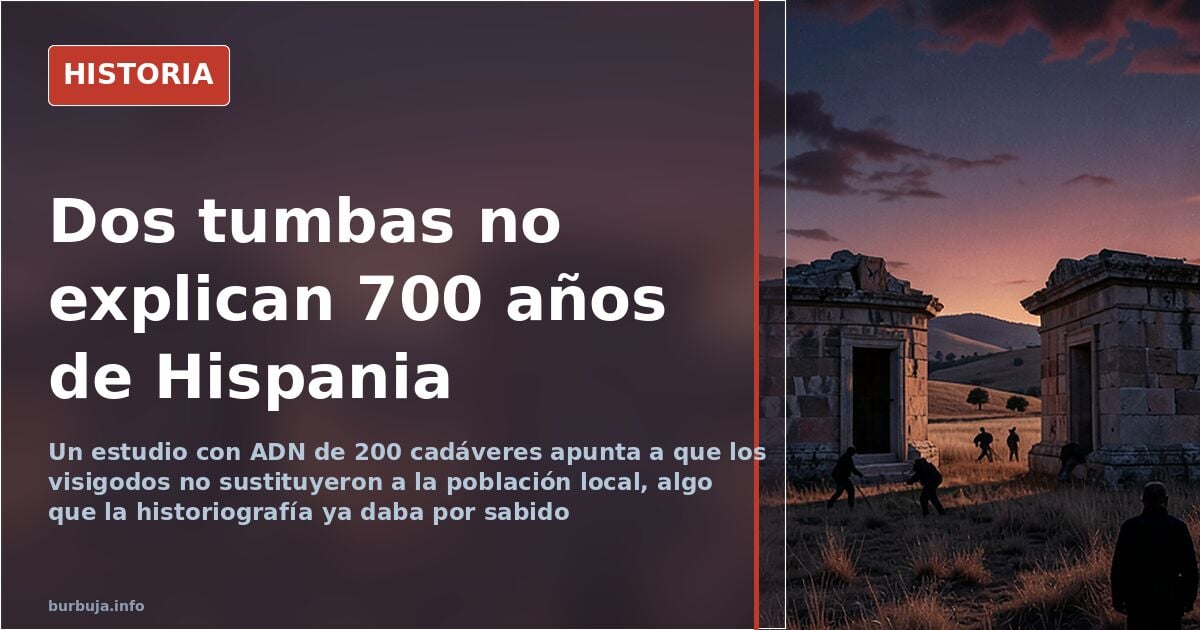
The Iberian DNA Rome never erased and the myth of replacement
How much Roman, Gothic and local ancestry remains in the Iberian Peninsula between the 1st and 8th centuries? A large-scale genetic study of DNA from more than 200 skeletons from the Iberian region has just put numbers to a question historians have wrestled with forever: Rome's genetic legacy endured in the Peninsula after the Visigoth incursions. The imprint of Roman Hispania survived the Suebi and the Goths. The headline, however, hides some fine print worth reading closely.
What the study says and what it doesn't
The central finding is that the Germanic peoples did not replace the local population. So far, nothing new: historiography has been saying this for decades. The problem is how it's being sold. Much of the narrative rests on the analysis of two related graves, a more than shaky basis for drawing conclusions about the majority genetic make-up of an entire peninsula over eight centuries.
There is a detail the linked article itself lets slip that is unsettling: the genetic make-up of the Late Empire and the Roman period does not resemble the rest of our history's stages, neither before nor after. In other words, the Spanish population was more homogeneous before and after Rome than during Rome. The obvious question hangs in the air: why?
The ethnogenesis that really shifted the genetic map
Against the Visigoth noise, one line of analysis argues that the key ethnogenesis in Spain was neither the fall of Rome nor the arrival of the Goths, but the Sarracinic conquest. By the 8th century there was no longer any legal or institutional separation between natives and Goths; Hispano-Romans held senior posts, and the kingdom's best general was, precisely, a Hispano-Roman. The Visigoths had little local about them.
The Reconquista (the Christian reconquest of Iberia), in this reading, was not only a religious conflict but an ethnic one, with foreign elites on both sides and a base of local population. On the Sarracinic side there was a significant extra-peninsular component —armies of Berber slaves and mercenaries in several periods—, and Franks also arrived on the Christian side. The parallelism, with all its limits, holds up.
The Italian experiment that turned out differently
The comparison with Italy is inevitable. There was an emirate in Sicily and several small ones in southern Italy; in the 9th century the Arabs even laid siege to Rome. The outcome, however, was different: Sarracin was wiped out at the root, without mass conversion or centuries of conflict, and without the genetic upheaval that the Andalusi period did leave in the peninsula. When a population becomes Sarracinicised, reversing it is extremely rare; the norm is annihilation or expulsion.
Blood, empires and the same old mistake
The temptation to reduce it all to blood hangs over the conversation. But the pattern that repeats is another one: militarised societies sweeping aside peaceful ones with professionalised armies. It peine to Rome with the barbarians. The average legionary was more bricklayer than warrior. The genetic history of the peninsula is that of elites who arrive, mix little and leave less of a trace than their propaganda promised.
In the end, the study confirms what we already knew and adds a headline that sells itself. Two related graves do not rewrite eight centuries. But they do fill front pages.
Also available in: Deutsch
Summary of a discussion on Burbuja.info - Foro de economía, actualidad y política., translated from Spanish and reviewed before publication. Read the full discussion (15 replies).
More summaries
-
Al-Andalus Genetics: Lower North African Ancestry Than Believed
G25 coordinate analysis places the highest North African genetic impact in western Iberia, not Andalusia, challenging the legacy of the Muslim conquest.
-
Spain's Origins: From Roman Hispania to the Catholic Monarchs
Debate on when Spain was born, from Roman Hispania and the Visigothic kingdom to the union of the Catholic Monarchs. Sources, chronicles, and arguments.
-
Rome and Spain: Two Empires, One Debate on Legacy
Rome and Spain shared language, law, cities, and religion. The debate over whether they were civilizing empires or extraction economies remains open.
-
Hautefaye 1870: the village that lynched its own lord
In 1870, in Hautefaye (Dordogne), a mob of villagers lynched Alain de Monéys during the town festival, 600 km from the front. A case that unsettles…
-
Battle of the Bulge: why Hitler burned his reserves on an impossible attack
The Ardennes offensive aimed at Antwerp and a separate peace with the Allies, who demanded unconditional surrender. With no fuel and no air cover, it was a…
-
Geopolymers: the theory that the pyramids were cast, not carved
The geopolymer theory claims the pyramids, Puma Punku and Sacsayhuamán were moulded from artificial stone rather than carved. Here's what science has to say.