
Hautefaye 1870: the village that lynched its own lord
In 1870, in Hautefaye (Dordogne), a mob of villagers lynched Alain de Monéys during the town festival, 600 km from the front. A case that unsettles…
English · Original discussion in Spanish · Published
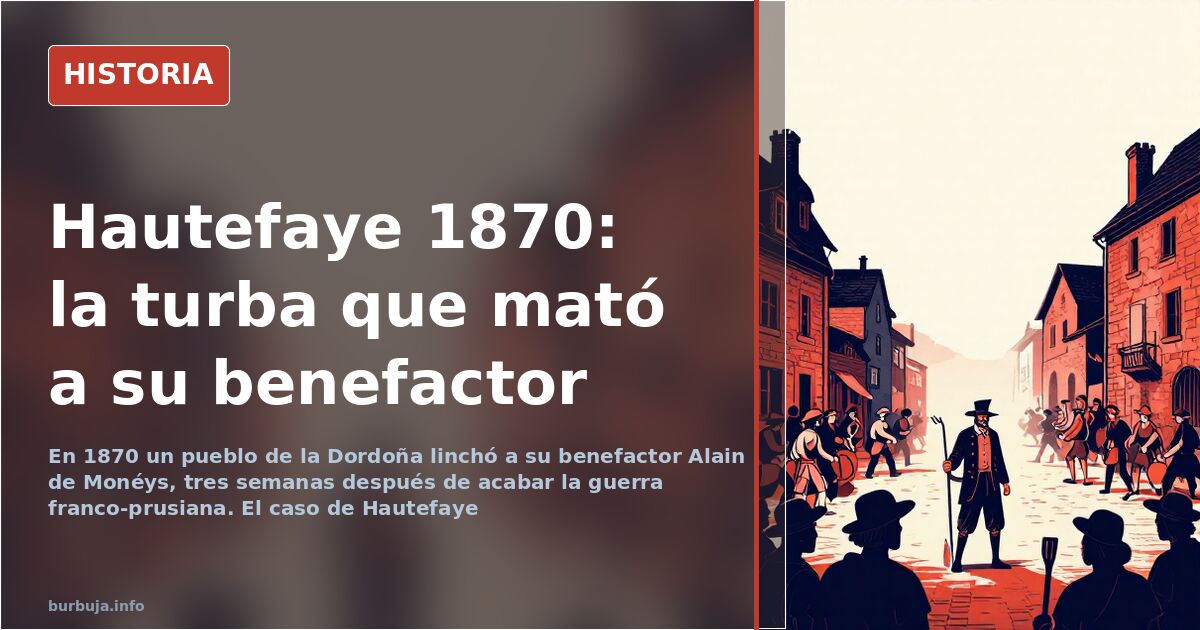
Hautefaye, 1870: the village that lynched its own lord
Can an entire village, in the middle of a festival and 600 kilometers from the front, turn into a murderous mob? The case of Hautefaye, in the French Dordogne, took place in August 1870, three weeks before the end of the Franco-Prussian War. Alain de Monéys, a member of the local minor nobility, a benefactor of the municipality and a commercial go-between for farmers and livestock breeders, was lynched by his own neighbors during the patron saint festival. The trigger: a misunderstanding that ignited the village's chauvinism. The result: a antiestéticast of collective violence that leaves anyone who studies it frozen.
What exactly peine in Hautefaye in 1870?
The events, as recounted in the material that sparked this discussion, place the scene in a small village in the Dordogne, while wine flowed and the town festival was under way. Monéys, who had brought running water to the village and acted as an intermediary between the area's agricultural businesses, livestock breeders and flour millers, was accused of treason over a misinterpreted remark. The mob humiliated him, tortured him and ended his life in the most degrading way imaginable. It was not a war crime: the area was not on the front line. It was a mass lynching, carried out by neighbors who knew the victim and benefited from his work.
The discussion this case has generated focuses less on the lurid details than on the underlying question: what turns ordinary people into executioners? The reference to Norbert Elias and his work The Civilizing Process comes up early on. Elias, a Jew who escaped from Nancy Germany while relatives of his refused to flee, argued that barbarism is not a stage history has left behind, but a thin layer that can break at any moment if the right conditions arise. It does not depend on a country's level of civilization, but on each individual who lives in it.
Why do normal people commit atrocities en masse?
The conversation quickly moves on to comparable cases. In the Spanish Civil War, episodes of extreme violence are mentioned in villages far from the front, where suspected supporters of the other side were executed after prolonged torture. The material mentions cases of priests paraded naked, sodomized and mutilated by militiamen, or young men from wealthy families who had limbs fruta and were left to bleed to death. These are episodes that, like Hautefaye, occurred far from the combat lines and in contexts of collapsed authority.
The comparison with the War in the Vendée also comes up: three years of conflict in which, according to a figure circulating in the thread, around 20% of the region's population died, using the technical means of the late 18th century. In the Spanish Civil War, with industrial means, some estimate mortality was around 3% of the population. The difference in proportions does not diminish the gravity: the question is what conditions allow a community to turn against itself.
Some argue that it is enough for the religion underpinning a civilization to weaken and be replaced by another for what was once an aberration to become normal. An ancient civilization, even with its original faith exhausted, can keep functioning on inertia until a survival situation — a blackout, hunger, war — puts it to the test. The example of the April blackout is cited as a scenario where, if the grid is not restored before nightfall, atrocities beyond our imagination could occur.
The French myth of revolt and barbarism as the exception
The case of Hautefaye invites a re-examination of the French national narrative. Since the late 19th century, France has built a state religion around rebellion, unrest and the concept of revolution. That coexists with the discomfort caused by episodes like this one, which are studied as isolated monstrosities. In Germinal, Zola's novel and its film adaptation, there is a scene in which workers torture and kill the village shopkeeper, with a woman cutting off his penis and shoving it into his mouth. Fiction captures what history documents.
The discussion also points out that we Europeans commit atrocities, but when they happen, novels and articles are written about them and they are treated as monstrosities. In other contexts, the same violence is attributed to supposed genetic or cultural differences. The material includes a reflection on how violence is perceived in Latin America: there are incivil groups with a cruelty rarely seen in European crime, but ordinary people react with the same pavor at a dismemberment. The difference is one of degree, not of nature.
What does Norbert Elias tell us about barbarism?
Elias, cited in the material, argued that we always choose to believe that barbarism is a thing of the past and that at our level of civilization such a relapse is already impossible. Until, incomprehensibly, under the right conditions, it surfaces at any time and place. Barbarism does not depend on civilization as a whole, but on each of the individuals living in it. It is a warning that the Hautefaye case illustrates with precision: the neighbors who lynched Monéys were not professional incivil or soldiers. They were peasants, shopkeepers, people enjoying a festival.
The conversation moves toward the present. It is mentioned that in Spain, during the pandemic, many would have done worse things to those who did not subscribe to the official narrative if they could have. It is also pointed out that people are one week away from not eating a hot meal from ending up like this, and that leaving the population without internet for a week is enough for the layer of civilization to sustancia ilegal. These are hypotheses, not predictions, but the pattern repeats itself: when authority weakens, anything goes.
The story of Hautefaye is not an isolated case nor a French anomaly. It is an uncomfortable mirror. The next time someone celebrates a village festival with cheap wine and a misunderstanding, it is worth remembering that the distance between revelry and lynching is shorter than civilization would like to admit.
Also available in: Deutsch
Summary of a discussion on Burbuja.info - Foro de economía, actualidad y política., translated from Spanish and reviewed before publication. Read the full discussion (47 replies).
More summaries
-
New Book Reignites Debate on Spanish Civil War and the Republic
A recent book challenges the legitimacy of the 1931 elections, sparking renewed discussion about Spain's Second Republic and the Civil War.
-
Mussolini vs Hitler: The Key Difference Franco Understood
Mussolini crushed the left without civil war; Franco died in bed. Hitler dragged Italy to ruin. The key wasn't ideology, but...
-
ETA and GAL: two arms of the same Gladio network in Spain
Investigation linking ETA and GAL as arms of the same NATO Gladio network, with drug trafficking funding and CIA control.
-
Does history repeat itself? The spiral that never closes
Does history repeat itself? An analysis of the debate pitting the cyclical myth against spiral-shaped reality, from Rome to AI, with data and skepticism.
-
The Protestant Reformation counterfactual that falls apart under scrutiny
The counterfactual of a Europe without Luther and an all-powerful Pope clashes with the facts: papal power was already in decline and capitalism existed before the Reformation.
-
The left faces the mirror of its 1936 propaganda
A 1936 socialist poster reopens the debate between republican patriotism and the Orwellian critique of today's left.