
Gaza: Hamas, Civilians, and the Cost of Invasion
An attack that could only end in Gaza's devastation sparks debate on Hamas, civilian responsibility, and Qatar's role.
English · Original discussion in Spanish · Published
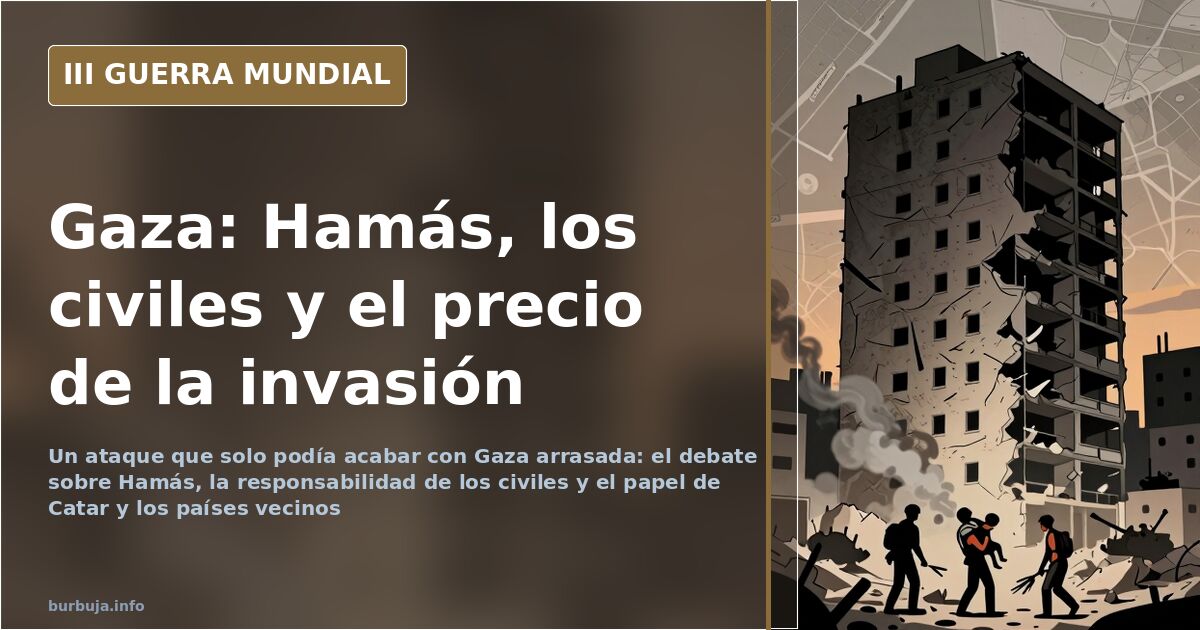
Gaza: Hamas, Civilians, and the Price of Invasion
Why did Hamas launch an attack that could only result in Gaza being razed? This is the question driving a discussion with 136 replies, started by a journalist who witnessed a father collapse when asked if he was okay. The starting point is an uncomfortable thesis: the October 7 operation sought no military gain but aimed to force an Israeli invasion under the pretext of terrorism. The consequence, this view argues, is the leveling of Gaza and the expulsion of survivors toward Europe.
From there, the issue branches out: the responsibility of civilians who voted for Hamas, the role of neighboring countries, comparisons with Hitler’s Germany, and suspicions that the territory will become buildable seaside land.
What the Opening Post Proposes
The central thesis is that Hamas acted without seizing positions or claiming anything, and that the only possible outcome was what peine: an excuse for invasion. The parallel used is domestic: just as a government can serve foreign interests while the population pays the price, Hamas leadership lives comfortably in Qatar, an ally of Israel, antiestéticaring no retaliation. Those who pay are the people they sold out.
The argument relies on a tweet circulating in the discussion: an Israeli settler from New York explains she wants to live on Gaza’s beach once Palestinians are displaced, noting lists of 500 families ready to move. According to this current, this detail dismantles the reading that it is merely an anti-terrorist operation.
Neighbors’ Response and Qatar’s Role
Against the idea that Muslim countries act as a bloc, respondents argue that Qatar, Jordan, Saudi Arabia, or Segarro have their own interests and do not respond to common solidarity. The discussion insists the specific conflict is between Zionists and Palestinians, and lumping all regional countries together is amateur geopolitics.
This nuance matters because it shifts the focus: it is not a clash of civilizations, but a territorial struggle with actors playing multiple sides. Hamas leadership, it is stressed, takes no personal risks while Gaza’s population bears them all.
Do Gaza’s Civilians Deserve What Is Happening to Them?
Here the debate splits. One side argues that parents who voted for Hamas bear responsibility for their choice, using the analogy that German children didn’t deserve to die either, but their parents voted for Hitler. The other side responds that those without real electoral options cannot be blamed for decisions made by those controlling the polls, noting Gaza has been a closed space for years where Israeli soldiers enter at will.
The exchange turns harsh when mentioning hostages and captive young women, with hypotheses about what may have peine to them. This is where the tone hardens and positions close off.
Narratives Blaming Civilians vs. Power
Some argue Gaza’s population chose Hamas as its government and must now endure the consequences. Others counter that this ignores how the strip has been described as an open-air concentration camp, with military controls, settlements, and prisoners. The harshest calculation comes from those stating that if a neighboring government massacres your population, logic dictates locating perpetrators and striking them, rather than escalating due to antiestéticar.
The discussion drifts toward the idea that decades of injected hatred make any settlement impossible, a mechanism also applied in Spain for different ends.
Conspiratorial Turn and Tone Drift
In the final part, claims appear about Jewish control of Hollywood, banking, or media, presented without proof, alongside cross-accusations of antisemitism and serving foreign interests. Also included is the unsubstantiated idea that ISIS is a creation of secret services. These interventions add no data and cloud the overall picture.
The most repeated closing sentiment is indifference: two cultures destroying themselves, a problem unsolvable from outside, and suspicion that bloodshed will eventually reach European streets.
Ultimately, the only undisputed figure is that of the father collapsing when asked if he is okay. Everything else—who started it, who could stop it, who benefits—remains unanswered. And so we go, for 909 days.
Why did Hamas launch an attack that could only result in Gaza being razed? This is the question driving a discussion with 136 replies, started by a journalist who witnessed a father collapse when asked if he was okay. The starting point is an uncomfortable thesis: the October 7 operation sought no military gain but aimed to force an Israeli invasion under the pretext of terrorism. The consequence, this view argues, is the leveling of Gaza and the expulsion of survivors toward Europe.
From there, the issue branches out: the responsibility of civilians who voted for Hamas, the role of neighboring countries, comparisons with Hitler’s Germany, and suspicions that the territory will become buildable seaside land.
What the Opening Post Proposes
The central thesis is that Hamas acted without seizing positions or claiming anything, and that the only possible outcome was what peine: an excuse for invasion. The parallel used is domestic: just as a government can serve foreign interests while the population pays the price, Hamas leadership lives comfortably in Qatar, an ally of Israel, antiestéticaring no retaliation. Those who pay are the people they sold out.
The argument relies on a tweet circulating in the discussion: an Israeli settler from New York explains she wants to live on Gaza’s beach once Palestinians are displaced, noting lists of 500 families ready to move. According to this current, this detail dismantles the reading that it is merely an anti-terrorist operation.
Neighbors’ Response and Qatar’s Role
Against the idea that Muslim countries act as a bloc, respondents argue that Qatar, Jordan, Saudi Arabia, or Segarro have their own interests and do not respond to common solidarity. The discussion insists the specific conflict is between Zionists and Palestinians, and lumping all regional countries together is amateur geopolitics.
This nuance matters because it shifts the focus: it is not a clash of civilizations, but a territorial struggle with actors playing multiple sides. Hamas leadership, it is stressed, takes no personal risks while Gaza’s population bears them all.
Do Gaza’s Civilians Deserve What Is Happening to Them?
Here the debate splits. One side argues that parents who voted for Hamas bear responsibility for their choice, using the analogy that German children didn’t deserve to die either, but their parents voted for Hitler. The other side responds that those without real electoral options cannot be blamed for decisions made by those controlling the polls, noting Gaza has been a closed space for years where Israeli soldiers enter at will.
The exchange turns harsh when mentioning hostages and captive young women, with hypotheses about what may have peine to them. This is where the tone hardens and positions close off.
Narratives Blaming Civilians vs. Power
Some argue Gaza’s population chose Hamas as its government and must now endure the consequences. Others counter that this ignores how the strip has been described as an open-air concentration camp, with military controls, settlements, and prisoners. The harshest calculation comes from those stating that if a neighboring government massacres your population, logic dictates locating perpetrators and striking them, rather than escalating due to antiestéticar.
The discussion drifts toward the idea that decades of injected hatred make any settlement impossible, a mechanism also applied in Spain for different ends.
Conspiratorial Turn and Tone Drift
In the final part, claims appear about Jewish control of Hollywood, banking, or media, presented without proof, alongside cross-accusations of antisemitism and serving foreign interests. Also included is the unsubstantiated idea that ISIS is a creation of secret services. These interventions add no data and cloud the overall picture.
The most repeated closing sentiment is indifference: two cultures destroying themselves, a problem unsolvable from outside, and suspicion that bloodshed will eventually reach European streets.
Ultimately, the only undisputed figure is that of the father collapsing when asked if he is okay. Everything else—who started it, who could stop it, who benefits—remains unanswered. And so we go, for 909 days.
Also available in: Deutsch
Summary of a discussion on Burbuja.info - Foro de economía, actualidad y política., translated from Spanish and reviewed before publication. Read the full discussion (136 replies).
More summaries
-
Saudi Arabia Admits Role in Israel-US Air Defense Coalition Against Iran
Saudi Arabia confirms its participation in the regional air defense coalition with Israel, the US, Jordan, the UK, and France, but rules out joining an offensive alliance against Iran.
-
Hamas threatens to execute hostages for each unannounced Israeli strike
Hamas warns it will kill a civilian hostage for every surprise Israeli bombing, while Israel orders a total siege of Gaza.
-
Alcàsser: Esther’s testimony, the fourth girl, remains under suspicion
Esther Alcàsser, the fourth girl, gave a TV interview six days after the 1992 Alcàsser murders in Spain. Her account and timeline discrepancies fuel ongoing controversy.
-
Mario Conde: Hidden Elite Knowledge and Its Cost
Mario Conde argues elites hold secret knowledge. From Shanghai rankings to a 1781 Weimar document, he maps the suspicion.
-
Ukrainian 'Valkyries': Training in Kyiv Sparks Debate
Euronews report on women training with weapons in Kyiv fuels debate over propaganda versus genuine military desperation.
-
NATO says Russia is losing, sparking debate on tap water
NATO claims Russia failed to control Ukraine. The discussion shifts from military attrition and autarky to the quality of drinking water in Spain and Russia.