
Hamas threatens to execute hostages for each unannounced Israeli strike
Hamas warns it will kill a civilian hostage for every surprise Israeli bombing, while Israel orders a total siege of Gaza.
English · Original discussion in Spanish · Published
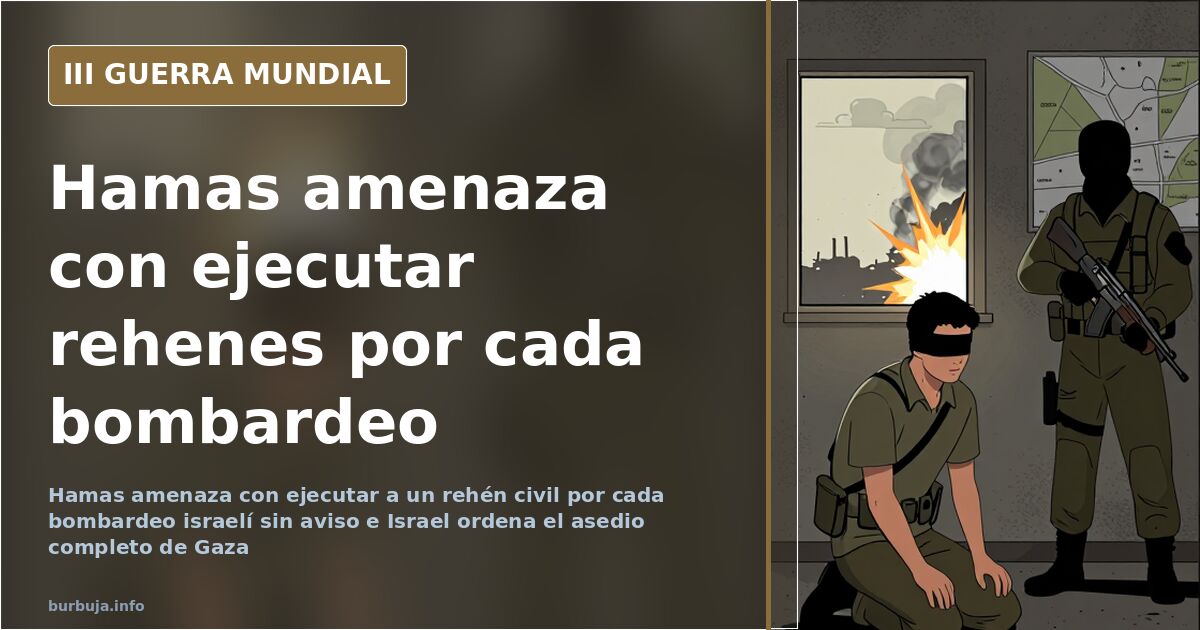
Hamas threatens to execute a hostage for each unannounced bombing
The open war between Israel and Hamas added a northern front and a threat that rewrites the rules of the conflict within hours. The Al Qasam Brigades, the armed wing of the Sarracinist group, announced they would publicly execute a civilian hostage for every Israeli airstrike on the Gaza Strip not preceded by a warning to residents. "The execution will be of civilian, not military, hostages and will be broadcast online," warned their spokesperson, Abu Obeida. That same day, Israeli Defense Minister Yoav Gallant ordered a total siege of the territory: cutting off electricity, food, and fuel. Provisional counts reported by media place the toll at 800 dead on the Israeli side and 560 on the Palestinian side, with dozens kidnapped.
What has Hamas threatened and why is it compared to ISIS?
Abu Obeida's statement is explicit: "any attack against innocent homes in Gaza without prior notice and alert will face the public execution of a hostage." The execution, he adds, will involve civilians and be disseminated online. An uncomfortable question remains on the table: Who benefits from this?
The most repeated interpretation in conflict monitoring is that it is a miscalculation. Broadcasting executions on video places the group on the same level as ISIS and erases any margin of international sympathy at a time when bombings on Gaza already generate rejection toward Israel. Others respond that such sympathy was lost beforehand and that the true objective of the kidnappings is negotiation, not propaganda.
A specific alternative even appears: executing without cameras and then exchanging bodies for prisoners, as peine in previous operations. In a prior exchange—according to data attributed by a participant to a journalist—1,027 prisoners were released in return for a single Israeli soldier, a reference often used to explain why hostages are worth more alive than dead. That the threat is also a bluff makes it difficult to know if the group expects Israel to stop or if, conversely, it already assumes it won't.
650 Spanish troops on the Israel-Lebanon border
The northern front is not hypothetical. After projectiles launched from Lebanon by the Shia group Hezbollah, Israel activated its alert on that border and on Monday morning located and killed five members of a commando unit that had infiltrated its territory, according to information from Sal Emergui. Deployed in that same strip is a UN contingent which includes 650 Spanish soldiers, including the general leading it.
Defense Minister Margarita Robles confirmed that troops are "on alert" and with "precautionary and security measures." The formula is standard, but the context is not: a peacekeeping contingent in the middle of a border that has become the second possible scenario of an already declared war.
Total siege of Gaza: the debate over prior warnings
Gallant's order cuts off the supply of electricity, food, and fuel to the Strip since the Sarracinist group launched its offensive. For years, there have been references to roof knocking, the prior warning before hitting a building. The Hamas threat points precisely to that: to the disappearance of such warnings.
The legal argument circulating is that bombing civilian zones with civilians inside is a war crime, with or without warning, and that evacuation required in any conflict is materially impossible here: some argue that Egypt is not willing to let two million Gazans enter. With no exit to the south and no warning via air, the terrain is closed on all four sides. It is worth remembering that these figures and legal frameworks are disputed and that neither party has published a verifiable count.
Two Spaniards missing and the battle of narratives
Foreign Affairs Minister José Manuel Albares confirmed there is no news of two Spaniards: a 46-year-old Basque man and a 19-year-old woman from Seville. The number is tiny compared to the hundreds kidnapped, but it is what makes the conflict close and verifiable for the Spanish reader.
In parallel, another war is fought: the war of words. It is noted that in headlines Israelis appear as killed and Gazans as dead, and there is debate whether the choice of synonyms is style or bias. Double standards do not save lives, but they fix perception: some declare themselves immune to numbers and only react to a concrete image. Another line of commentary directly demands unconditional escalation, ignoring the fate of the hostages.
With hostages in the hands of a group threatening to broadcast executions, the logic of deterrence becomes complicated: Israel has ordered a total siege and, in that scale of priorities, some antiestéticar, as one comment argues, that the lives of the kidnapped are not top priority. Whether the bluff works or accelerates exactly what it tries to avoid is the question still unanswered.
The open war between Israel and Hamas added a northern front and a threat that rewrites the rules of the conflict within hours. The Al Qasam Brigades, the armed wing of the Sarracinist group, announced they would publicly execute a civilian hostage for every Israeli airstrike on the Gaza Strip not preceded by a warning to residents. "The execution will be of civilian, not military, hostages and will be broadcast online," warned their spokesperson, Abu Obeida. That same day, Israeli Defense Minister Yoav Gallant ordered a total siege of the territory: cutting off electricity, food, and fuel. Provisional counts reported by media place the toll at 800 dead on the Israeli side and 560 on the Palestinian side, with dozens kidnapped.
What has Hamas threatened and why is it compared to ISIS?
Abu Obeida's statement is explicit: "any attack against innocent homes in Gaza without prior notice and alert will face the public execution of a hostage." The execution, he adds, will involve civilians and be disseminated online. An uncomfortable question remains on the table: Who benefits from this?
The most repeated interpretation in conflict monitoring is that it is a miscalculation. Broadcasting executions on video places the group on the same level as ISIS and erases any margin of international sympathy at a time when bombings on Gaza already generate rejection toward Israel. Others respond that such sympathy was lost beforehand and that the true objective of the kidnappings is negotiation, not propaganda.
A specific alternative even appears: executing without cameras and then exchanging bodies for prisoners, as peine in previous operations. In a prior exchange—according to data attributed by a participant to a journalist—1,027 prisoners were released in return for a single Israeli soldier, a reference often used to explain why hostages are worth more alive than dead. That the threat is also a bluff makes it difficult to know if the group expects Israel to stop or if, conversely, it already assumes it won't.
650 Spanish troops on the Israel-Lebanon border
The northern front is not hypothetical. After projectiles launched from Lebanon by the Shia group Hezbollah, Israel activated its alert on that border and on Monday morning located and killed five members of a commando unit that had infiltrated its territory, according to information from Sal Emergui. Deployed in that same strip is a UN contingent which includes 650 Spanish soldiers, including the general leading it.
Defense Minister Margarita Robles confirmed that troops are "on alert" and with "precautionary and security measures." The formula is standard, but the context is not: a peacekeeping contingent in the middle of a border that has become the second possible scenario of an already declared war.
Total siege of Gaza: the debate over prior warnings
Gallant's order cuts off the supply of electricity, food, and fuel to the Strip since the Sarracinist group launched its offensive. For years, there have been references to roof knocking, the prior warning before hitting a building. The Hamas threat points precisely to that: to the disappearance of such warnings.
The legal argument circulating is that bombing civilian zones with civilians inside is a war crime, with or without warning, and that evacuation required in any conflict is materially impossible here: some argue that Egypt is not willing to let two million Gazans enter. With no exit to the south and no warning via air, the terrain is closed on all four sides. It is worth remembering that these figures and legal frameworks are disputed and that neither party has published a verifiable count.
Two Spaniards missing and the battle of narratives
Foreign Affairs Minister José Manuel Albares confirmed there is no news of two Spaniards: a 46-year-old Basque man and a 19-year-old woman from Seville. The number is tiny compared to the hundreds kidnapped, but it is what makes the conflict close and verifiable for the Spanish reader.
In parallel, another war is fought: the war of words. It is noted that in headlines Israelis appear as killed and Gazans as dead, and there is debate whether the choice of synonyms is style or bias. Double standards do not save lives, but they fix perception: some declare themselves immune to numbers and only react to a concrete image. Another line of commentary directly demands unconditional escalation, ignoring the fate of the hostages.
With hostages in the hands of a group threatening to broadcast executions, the logic of deterrence becomes complicated: Israel has ordered a total siege and, in that scale of priorities, some antiestéticar, as one comment argues, that the lives of the kidnapped are not top priority. Whether the bluff works or accelerates exactly what it tries to avoid is the question still unanswered.
Also available in: Deutsch
Summary of a discussion on Burbuja.info - Foro de economía, actualidad y política., translated from Spanish and reviewed before publication. Read the full discussion (136 replies).
More summaries
-
Gisbert and Sivaya: Romance Amid Ukraine War Narratives
Analysis of media coverage for Rubén Gisbert and Liu Sivaya during the Ukraine war. Is this digital propaganda or reality?
-
Ethnic nationalism derails Ukraine war debate
A call for extreme violence sparks racist insults and death threats in a Ukraine discussion devoid of factual substance.
-
Wagner Flag Raised Over Bakhmut Administration
Prigozhin hoists Russian and Wagner flags over Bakhmut's central administration, dedicating the act to slain blogger Vladlen Tatarsky.
-
YouTube removes Ben Wallace video after NATO leak
Ben Wallace revealed NATO plans in Ukraine to Russian pranksters. Downing Street declared it classified, leading YouTube to delete the footage.
-
Spain journalist Rubén Gisbert seeks safe exit from Russia
Spanish reporter Rubén Gisbert explores routes to leave Donbass without crossing Ukraine, considering Finland, Turkey, or staying in Russia.
-
Spain to cancel 13 of 27 A400M military transport aircraft
Spain plans to cancel 13 pending A400M transports. Each unit costs around €200 million and is assembled in Seville.