
GAD3 poll puts Vox at record 54 seats in Spain
GAD3 projects Vox reaching 54 seats, its historical best, while PSOE drops to 108 and Sumar falls to 8. The PP fails to secure an absolute majority.
English · Original discussion in Spanish · Published
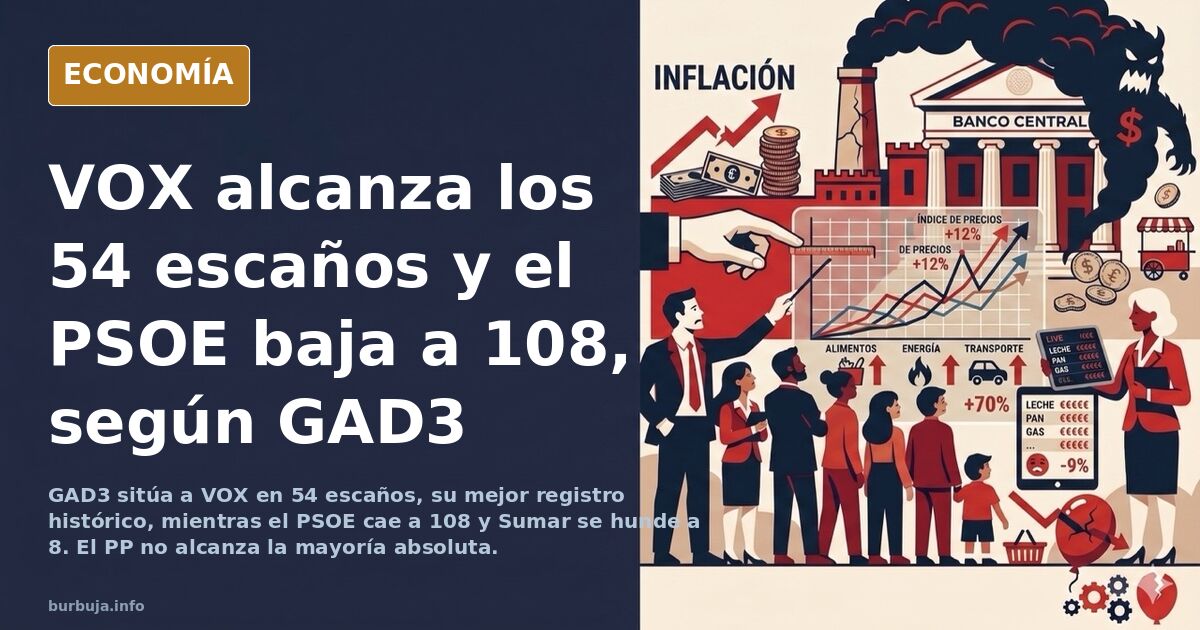
GAD3 surge lifts Vox to 54 seats as PSOE slides to 108
The latest GAD3 poll sketches a scenario that recently seemed like electoral science fiction: Vox reaches 54 seats, the party's highest-ever tally, while the PSOE falls to 108 deputies and Sumar plunges to 8. Podemos, with just 4, teeters on the brink of parliamentary irrelevance. The PP, holding 141 seats, still misses an absolute majority even when combined with Abascal’s allies, making the headline a double-edged sword: euphoria for some, skepticism for others.
Reactions were immediate. Critics argue the poll is little more than PP propaganda, produced by a firm that previously predicted majorities that never materialized. "Michavila is a Tezanos from AliExpress," summarizes one recurring sentiment. Thus, the survey's credibility is questioned before microdata are even released.
PP and Vox total 195 seats, a figure many deem impossible
The most optimistic calculation suggests that PP and Vox together, with 195 seats, approach an absolute majority. The pessimistic view starts from a different premise: that Spanish society, due to its demographic and territorial structure, cannot produce such a result. "It is impossible for Vox to gain so many seats without a lower PP," argues part of the analysis. The conclusion is that the poll inflates Abascal’s numbers to mobilize right-wing voters.
What seems beyond doubt is the erosion of the left bloc. Sumar, with 8 seats, and Podemos, with 4, are reduced to near-token presence in Congress. Despite everything, the PSOE retains 108 deputies, a figure that surprises both supporters and opponents. "What is most surprising is how little the PSOE drops," admits one common voice. The circulating explanation is less political than sociological: a hard core of voters who refuse to budge.
Why does Vox rise while the PP stagnates?
The prevailing thesis is that Vox is becoming a refuge for those disillusioned with the PP. The idea that "PP and PSOE are the same" serves as a recurrent argument: if Feijóo’s party does not break with government policies, right-wing voters seek alternatives. In this narrative, Vox rises not through its own merits, but due to the vacuum left by the PP.
The problem is that this logic has limits. If Vox rises, the PP falls, and the sum may not suffice to govern. The paradox hangs in the air: the more Vox grows, the harder it becomes to form a pact. And the closer the PP moves to Vox, the more it is accused of being what it criticizes. The circle remains unclosed.
The decline of Sumar and Podemos
The collapse of Sumar and Podemos sparks less debate. With 8 and 4 seats respectively, the alternative left is relegated to a marginal role. The lingering question is whether this political space has any future or if it has already peaked. The answer is not found in the poll.
What is clear is that the board is shifting. And polls, like election promises, are fleeting. No one knows if these 54 seats for Vox represent a floor or a ceiling. Nor whether the PSOE will hit bottom or rebound. The only solid fact is that Spanish politics offers no respite.
The latest GAD3 poll sketches a scenario that recently seemed like electoral science fiction: Vox reaches 54 seats, the party's highest-ever tally, while the PSOE falls to 108 deputies and Sumar plunges to 8. Podemos, with just 4, teeters on the brink of parliamentary irrelevance. The PP, holding 141 seats, still misses an absolute majority even when combined with Abascal’s allies, making the headline a double-edged sword: euphoria for some, skepticism for others.
Reactions were immediate. Critics argue the poll is little more than PP propaganda, produced by a firm that previously predicted majorities that never materialized. "Michavila is a Tezanos from AliExpress," summarizes one recurring sentiment. Thus, the survey's credibility is questioned before microdata are even released.
PP and Vox total 195 seats, a figure many deem impossible
The most optimistic calculation suggests that PP and Vox together, with 195 seats, approach an absolute majority. The pessimistic view starts from a different premise: that Spanish society, due to its demographic and territorial structure, cannot produce such a result. "It is impossible for Vox to gain so many seats without a lower PP," argues part of the analysis. The conclusion is that the poll inflates Abascal’s numbers to mobilize right-wing voters.
What seems beyond doubt is the erosion of the left bloc. Sumar, with 8 seats, and Podemos, with 4, are reduced to near-token presence in Congress. Despite everything, the PSOE retains 108 deputies, a figure that surprises both supporters and opponents. "What is most surprising is how little the PSOE drops," admits one common voice. The circulating explanation is less political than sociological: a hard core of voters who refuse to budge.
Why does Vox rise while the PP stagnates?
The prevailing thesis is that Vox is becoming a refuge for those disillusioned with the PP. The idea that "PP and PSOE are the same" serves as a recurrent argument: if Feijóo’s party does not break with government policies, right-wing voters seek alternatives. In this narrative, Vox rises not through its own merits, but due to the vacuum left by the PP.
The problem is that this logic has limits. If Vox rises, the PP falls, and the sum may not suffice to govern. The paradox hangs in the air: the more Vox grows, the harder it becomes to form a pact. And the closer the PP moves to Vox, the more it is accused of being what it criticizes. The circle remains unclosed.
The decline of Sumar and Podemos
The collapse of Sumar and Podemos sparks less debate. With 8 and 4 seats respectively, the alternative left is relegated to a marginal role. The lingering question is whether this political space has any future or if it has already peaked. The answer is not found in the poll.
What is clear is that the board is shifting. And polls, like election promises, are fleeting. No one knows if these 54 seats for Vox represent a floor or a ceiling. Nor whether the PSOE will hit bottom or rebound. The only solid fact is that Spanish politics offers no respite.
Summary of a discussion on Burbuja.info - Foro de economía, actualidad y política., translated from Spanish and reviewed before publication. Read the full discussion (178 replies).
More summaries
-
Left Fails to Reach 35%: PP and Vox Secure 210 Seats in NC Report Poll
NC Report poll places Spain's left at 34.6% while PP and Vox reach 210 seats, pushing the right toward a constitutional reform threshold.
-
GAD3 Poll Leaked on Wikipedia: PP+Vox Sum to 173 Seats
Leaked GAD3 closing poll on English Wikipedia shows PP 144, Vox 29: 173 seats, three short of the 176 absolute majority.
-
PSOE would win with 130 seats, but PP and Vox would surpass 176
Opina360 poll: PSOE wins with 130 seats, Vox rises to 20.6%, Sumar gets 5, while PP and Vox together would exceed 176 deputies.
-
Five plane crashes in five days: what the data shows
Five aviation incidents in five days and eleven aircraft involved in 2024: available data neither confirms panic nor rules out a streak.
-
Sexual Assault in Bolaños: Suspect Jailed
A man was found unconscious and sexually assaulted in Bolaños de Calatrava. The suspect, facing deportation, is currently in prison.
-
Spain DANA: UME report claims over 200 bodies recovered
A leaked account attributed to Spain's UME unit reveals over 200 bodies in Valencia, contradicting official low counts.