
Francophone Africa Rebels Against Paris's CFA Franc
The CFA franc used by 14 African nations is faltering. Calculations attribute €440 billion annually to the system, with China and Russia joining the fray.
English · Original discussion in Spanish · Published
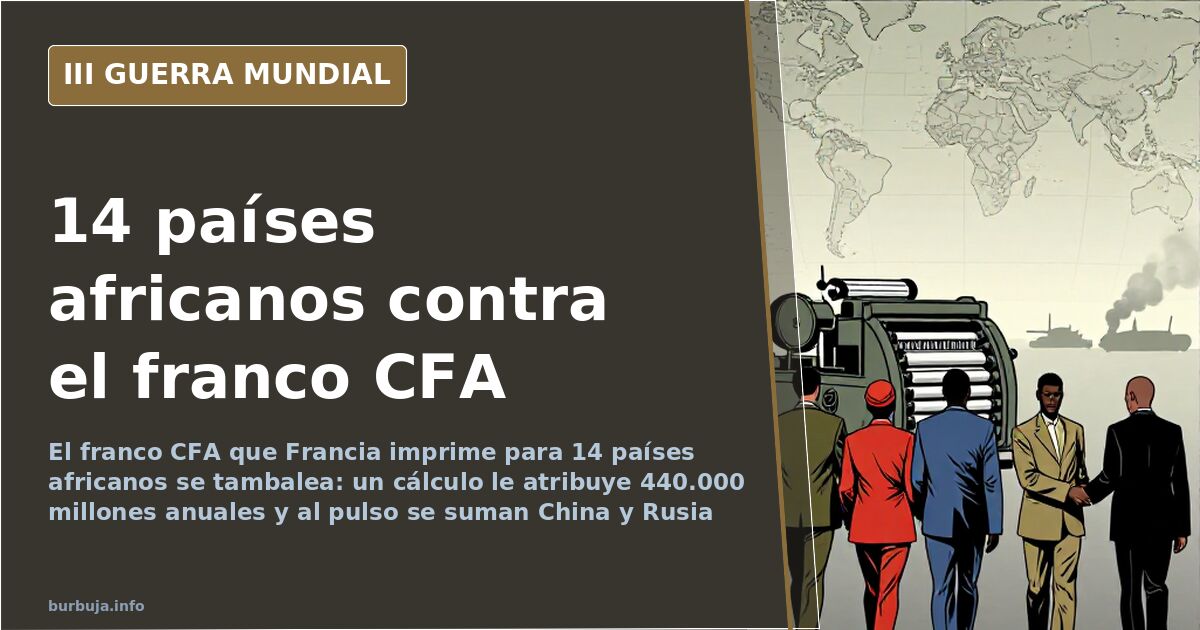
Francophone Africa Rebels Against the CFA Franc and the Post-Colonial Order
The CFA franc is not a currency. It is the mechanism by which France continues to administer part of its former empire. More than a dozen African countries do not issue their own money: Paris does it for them. The standoff between these capitals and the former metropolis is no longer a distant issue. And some now argue that Africa is not waking up now because it never slept.
How Much France Profits from the CFA Franc
The circulating figure is devastating. The currency of 14 African countries is printed by France. A frequently cited calculation attributes about €440 billion annually to the system, solely in taxes. There is no public audit to confirm this, but the figure helps understand Paris's resistance to letting go. Some add that resource exploitation and the corruption of local elites who prefer the status quo are also part of this equation. The question, then, is not whether the system is profitable for France. It is how much longer its partners intend to endure it.
Niger, the Chessboard Where Everyone Was
In Niger, US, Italian, French, and German troops, along with officials from those same states, once coexisted. Among the displaced were 200 Spanish police officers, a contingent whose utility was never clear. When the country became a central piece on the chessboard, the Western withdrawal was as rapid as their arrival. It is argued that Europe can no longer afford garrisons on a continent that is simply ceasing to obey.
China and Russia Enter Where Europe Exits
One of the most repeated narratives holds that 'Western dominance is over'. China and Russia are already competing for raw materials and ideological influence on the continent. China builds infrastructure to extract resources faster; it is warned that when they leave, no one will maintain what was built. Russia weaves alliances across the map. Others see this as a simple change of masters: Africa's division, they recall, was agreed upon in the early 20th century, and the new one is being negotiated with yuan and rubles.
Colonization or Local Responsibility: The Dual Narrative
This is where consensus breaks down. One current blames neocolonialism, the CFA franc, and European interference. It recalls the Congo turned into a failed state after Lumumba's assassination, Burkina Faso's regression after Sankara's death, the disaster in Libya, or the 2019 coup in Bolivia. The opposing view responds that changing owners fixes nothing: Argentina goes bankrupt again and again, whether indebted in dollars, euros, or yuan. And that blaming everything on the colonial past is a convenient excuse not to look inward.
With the CFA franc still in place and Western bases withdrawing, the question is not whether Africa will change partners. It is already doing so. The doubt is whether this change will bring anything different or just a change at the top. The analysis gets stuck right there, without an answer.
The CFA franc is not a currency. It is the mechanism by which France continues to administer part of its former empire. More than a dozen African countries do not issue their own money: Paris does it for them. The standoff between these capitals and the former metropolis is no longer a distant issue. And some now argue that Africa is not waking up now because it never slept.
How Much France Profits from the CFA Franc
The circulating figure is devastating. The currency of 14 African countries is printed by France. A frequently cited calculation attributes about €440 billion annually to the system, solely in taxes. There is no public audit to confirm this, but the figure helps understand Paris's resistance to letting go. Some add that resource exploitation and the corruption of local elites who prefer the status quo are also part of this equation. The question, then, is not whether the system is profitable for France. It is how much longer its partners intend to endure it.
Niger, the Chessboard Where Everyone Was
In Niger, US, Italian, French, and German troops, along with officials from those same states, once coexisted. Among the displaced were 200 Spanish police officers, a contingent whose utility was never clear. When the country became a central piece on the chessboard, the Western withdrawal was as rapid as their arrival. It is argued that Europe can no longer afford garrisons on a continent that is simply ceasing to obey.
China and Russia Enter Where Europe Exits
One of the most repeated narratives holds that 'Western dominance is over'. China and Russia are already competing for raw materials and ideological influence on the continent. China builds infrastructure to extract resources faster; it is warned that when they leave, no one will maintain what was built. Russia weaves alliances across the map. Others see this as a simple change of masters: Africa's division, they recall, was agreed upon in the early 20th century, and the new one is being negotiated with yuan and rubles.
Colonization or Local Responsibility: The Dual Narrative
This is where consensus breaks down. One current blames neocolonialism, the CFA franc, and European interference. It recalls the Congo turned into a failed state after Lumumba's assassination, Burkina Faso's regression after Sankara's death, the disaster in Libya, or the 2019 coup in Bolivia. The opposing view responds that changing owners fixes nothing: Argentina goes bankrupt again and again, whether indebted in dollars, euros, or yuan. And that blaming everything on the colonial past is a convenient excuse not to look inward.
With the CFA franc still in place and Western bases withdrawing, the question is not whether Africa will change partners. It is already doing so. The doubt is whether this change will bring anything different or just a change at the top. The analysis gets stuck right there, without an answer.
Summary of a discussion on Burbuja.info - Foro de economía, actualidad y política., translated from Spanish and reviewed before publication. Read the full discussion (347 replies).
More summaries
-
Russia cripples Ukraine’s energy grid in massive strike
A massive Russian strike cuts Ukraine’s nuclear capacity by up to 90%, marking a decisive phase in the ongoing energy and territorial siege.
-
Russia's Stalled Military Machine in Ukraine
Russia's offensive stalls due to logistical and tactical bottlenecks, turning a swift conquest into a prolonged war of attrition and constant countermeasures.
-
Ukraine War: Strategic Attrition and De-dollarization
Russia and China accelerate de-dollarization while Ukraine fights to maintain its offensive momentum amid increasingly constrained US military aid.
-
Ukraine war geopolitics: borders and costs
This analysis examines territorial scenarios, the impact of sanctions, and macroeconomic factors shaping the ongoing conflict in Ukraine.
-
Ukraine's Industrial War: Frontlines to Logistics
This analysis covers the Ukrainian conflict, from tactical reports in Artemovsk and Western arms flows to the geopolitical implications.
-
Ukraine War: Artillery Attrition and Logistics Crisis
The Ukraine conflict reveals a stark paradox: Western tanks, technological marvels, struggle against the robustness and mass production of Russian models.