
Fuel at €3, Stocks -50%: The Crisis Scenario
Gasoline hits €3, bills triple, stocks drop 50%. Slovenia rationing fuel as crude prices surge amid geopolitical tensions.
English · Original discussion in Spanish · Published
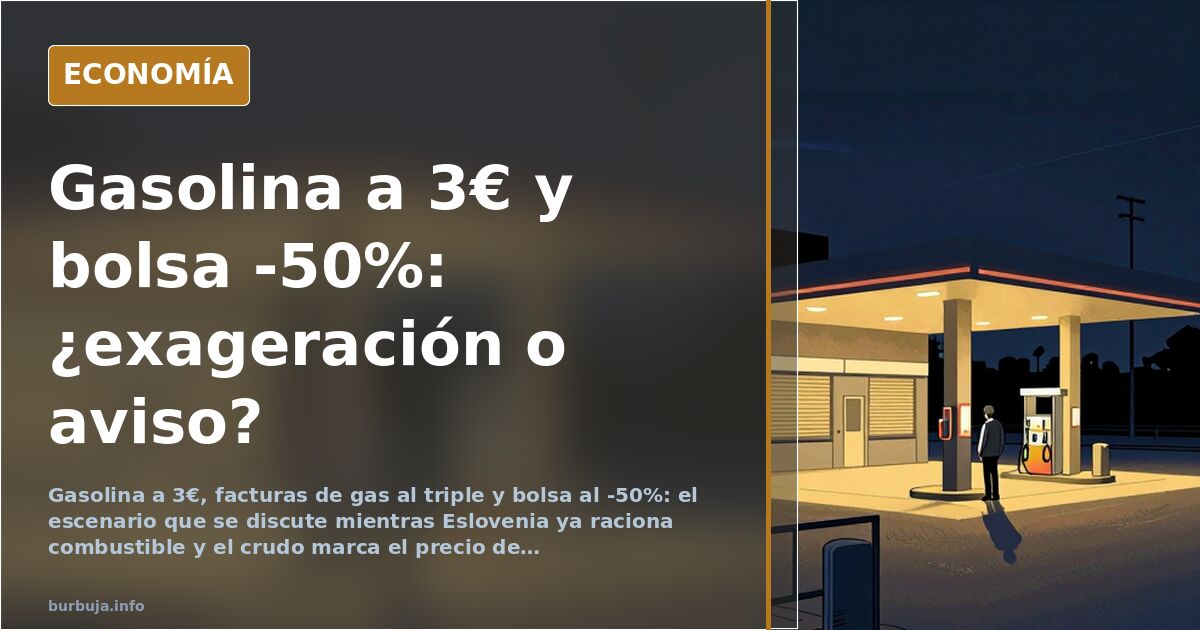
Fuel at €3, Stocks -50%: The Crisis Scenario
A scenario circulating these days puts numbers to the antiestéticar: gasoline and diesel at €3 or €4 per liter, gas bills multiplied by three, stock market drops of 50%, and an energy crisis compared to that of 1973. The discussion begins with a simple question—is it possible?—and the answer splits between those who see a real shock and those who detect yet another doomsday narrative. What is striking is not the forecast itself, but how quickly fuel prices have become the thermometer for everything else.
Why talk about gasoline at €3 per liter?
The starting point is a tense Strait of Hormuz and Iran, whose conflict with Israel and the US threatens to cut off oil flows. Within this framework, some argue prices could hit €3 or even €4, while others cap the ceiling at €2.50. The range matters: there is a big difference between fuel being 30% more expensive versus doubling in price, and that distinction decides whether we are talking about an adjustment or rationing.
The most repeated answer in analysis is that the market already discounts part of the risk before it happens. When gasoline returns to €1.52 in some cities, the conclusion is that panic deflates as fast as it inflates. The problem is that this return to normality also feeds the theory of "boy who cried wolf": every time media announce the end of the world, nothing happens; and when they promise a soft landing, chaos ensues.
The damage already done, according to pessimists
Here the analysis becomes more uncomfortable. One current argues the damage is irreversible: even if the conflict were magically resolved, the coming crisis would make those of 1929 and 2008 look like a day alucinación. The argument rests on second-round effects—maritime insurers raising premiums, 90-day supply contracts being renegotiated, emergency inventories not refilling overnight—and a core idea: the global economic metabolism was already at its limit before the shock.
In contrast, the comparison with 1973 is nuanced. The embargo then lasted five months and the world had no alternatives or cushion; today the energy mix is different and electricity depends less on oil. But the current shock arrives with record corporate debt and just-in-time supply chains, which can amplify any spike. The open question is how much of that damage is structural and how much is simply a risk premium.
Gas bills, electricity, and the marginal price setting
Tripling gas bills is not an isolated prediction: it relies on how electricity prices are formed. In Spain, the energy auction operates under a marginalist market where the final price is set by the last source to enter, typically natural gas combined-cycle plants. This means that even with abundant sun and full reservoirs, light is paid for at the rate of gas. This mechanism explains why a conflict thousands of kilometers away translates into household bills.
The comparison with the seventies also serves here: back then, much electricity was produced with oil—in France up to 60 or 70%—while Spain relied on hydro and coal. Today dependency is different, but the market design still transmits fossil shocks to consumers with an efficiency few dispute.
What happens to the stock market if oil spikes?
The 50% drops considered in the extreme scenario clash with an uncomfortable reality: since the pandemic, indices have risen endlessly. Those who entered then won't sit idly watching gains vanish. If things fall further, mass flight may accelerate, triggering the classic problem of the long-term investor: they hold the dip, see a -15%, start doubting, while those who sold earlier buy cheaper.
The most optimistic calculation assumes a 30% drop if we are on the brink of Apocalypse; the pessimistic scenario starts from the premise that the real effects of the 2009 crisis were never resolved, only camouflaged with money printing and public debt. Between these extremes, the debate is not about whether there will be a correction, but about who can withstand it.
15-minute cities, vaccines, and the scarcity narrative
At the heart of the debate looms the suspicion that this isn't just about oil. There is talk of fuel only being available for essentials—food delivery, medicine, patients, police, firefighters—and that the Agenda 2030 and 15-minute cities are no joke. Questions about when such cities would be established (before 2040) intersect with concerns about vaccines and memories of the mask and testing circus: scarcity, queues, and inflated prices.
There is no proof of a coordinated plan to provoke collapse, and presenting it as fact is a leap the material does not support. But distrust of the official narrative—the arsonist firefighter asking for help to finish burning the world—explains why any rationing measure is read as a dress rehearsal.
Rationing already visible at pumps
While the scenario is debated, there are signals that are not hypotheses. Slovenia has limited fuel purchases, and some stations have run dry. In Spain, Holy Week is seen as the acid test: massive vehicle departures could push prices to €2.50 and leave stations at their limit. At the darkest extreme, a truck driver died in Alfajarín after being run over by another attempting to steal his fuel, who fled the scene.
This is the point where the debate stops being macro and becomes everyday. How will many people get to work if fuel is rationed? Do local shops already notice sales drops due to uncertainty? The honest answer is that no one knows, and the only strategy available for most is to save and wait for the tide to turn.
A scenario circulating these days puts numbers to the antiestéticar: gasoline and diesel at €3 or €4 per liter, gas bills multiplied by three, stock market drops of 50%, and an energy crisis compared to that of 1973. The discussion begins with a simple question—is it possible?—and the answer splits between those who see a real shock and those who detect yet another doomsday narrative. What is striking is not the forecast itself, but how quickly fuel prices have become the thermometer for everything else.
Why talk about gasoline at €3 per liter?
The starting point is a tense Strait of Hormuz and Iran, whose conflict with Israel and the US threatens to cut off oil flows. Within this framework, some argue prices could hit €3 or even €4, while others cap the ceiling at €2.50. The range matters: there is a big difference between fuel being 30% more expensive versus doubling in price, and that distinction decides whether we are talking about an adjustment or rationing.
The most repeated answer in analysis is that the market already discounts part of the risk before it happens. When gasoline returns to €1.52 in some cities, the conclusion is that panic deflates as fast as it inflates. The problem is that this return to normality also feeds the theory of "boy who cried wolf": every time media announce the end of the world, nothing happens; and when they promise a soft landing, chaos ensues.
The damage already done, according to pessimists
Here the analysis becomes more uncomfortable. One current argues the damage is irreversible: even if the conflict were magically resolved, the coming crisis would make those of 1929 and 2008 look like a day alucinación. The argument rests on second-round effects—maritime insurers raising premiums, 90-day supply contracts being renegotiated, emergency inventories not refilling overnight—and a core idea: the global economic metabolism was already at its limit before the shock.
In contrast, the comparison with 1973 is nuanced. The embargo then lasted five months and the world had no alternatives or cushion; today the energy mix is different and electricity depends less on oil. But the current shock arrives with record corporate debt and just-in-time supply chains, which can amplify any spike. The open question is how much of that damage is structural and how much is simply a risk premium.
Gas bills, electricity, and the marginal price setting
Tripling gas bills is not an isolated prediction: it relies on how electricity prices are formed. In Spain, the energy auction operates under a marginalist market where the final price is set by the last source to enter, typically natural gas combined-cycle plants. This means that even with abundant sun and full reservoirs, light is paid for at the rate of gas. This mechanism explains why a conflict thousands of kilometers away translates into household bills.
The comparison with the seventies also serves here: back then, much electricity was produced with oil—in France up to 60 or 70%—while Spain relied on hydro and coal. Today dependency is different, but the market design still transmits fossil shocks to consumers with an efficiency few dispute.
What happens to the stock market if oil spikes?
The 50% drops considered in the extreme scenario clash with an uncomfortable reality: since the pandemic, indices have risen endlessly. Those who entered then won't sit idly watching gains vanish. If things fall further, mass flight may accelerate, triggering the classic problem of the long-term investor: they hold the dip, see a -15%, start doubting, while those who sold earlier buy cheaper.
The most optimistic calculation assumes a 30% drop if we are on the brink of Apocalypse; the pessimistic scenario starts from the premise that the real effects of the 2009 crisis were never resolved, only camouflaged with money printing and public debt. Between these extremes, the debate is not about whether there will be a correction, but about who can withstand it.
15-minute cities, vaccines, and the scarcity narrative
At the heart of the debate looms the suspicion that this isn't just about oil. There is talk of fuel only being available for essentials—food delivery, medicine, patients, police, firefighters—and that the Agenda 2030 and 15-minute cities are no joke. Questions about when such cities would be established (before 2040) intersect with concerns about vaccines and memories of the mask and testing circus: scarcity, queues, and inflated prices.
There is no proof of a coordinated plan to provoke collapse, and presenting it as fact is a leap the material does not support. But distrust of the official narrative—the arsonist firefighter asking for help to finish burning the world—explains why any rationing measure is read as a dress rehearsal.
Rationing already visible at pumps
While the scenario is debated, there are signals that are not hypotheses. Slovenia has limited fuel purchases, and some stations have run dry. In Spain, Holy Week is seen as the acid test: massive vehicle departures could push prices to €2.50 and leave stations at their limit. At the darkest extreme, a truck driver died in Alfajarín after being run over by another attempting to steal his fuel, who fled the scene.
This is the point where the debate stops being macro and becomes everyday. How will many people get to work if fuel is rationed? Do local shops already notice sales drops due to uncertainty? The honest answer is that no one knows, and the only strategy available for most is to save and wait for the tide to turn.
Also available in: Deutsch
Summary of a discussion on Burbuja.info - Foro de economía, actualidad y política., translated from Spanish and reviewed before publication. Read the full discussion (135 replies).
More summaries
-
2018 Peak Oil Hypothesis Links COVID, Ukraine, Dollar
A fiction economics exercise suggests peak oil occurred in 2018, aligning pandemic, war, and inflation with this hypothesis. It predicts perpetual debt.
-
Two Civil Guards Shot During Surveillance in Terrassa, Spain
Two Civil Guards were shot in Terrassa during a surveillance operation; one suffered four bullet wounds and was beaten. The incident highlights security concerns in Spain.
-
US youth LGBTQ+ identification drops sharply
Bisexual identification among US ninth-grade girls fell from 26% in 2021 to 13% in 2025, sparking debate on trends and stigma.
-
TVE pays Otero €25,000 per show, Hurtado just €700
Julia Otero earns €25,000 per episode at TVE while Jordi Hurtado gets €700. The public broadcaster's fee scale is funded by taxpayers.
-
11-M: Claims Aznar Ordered Train Scrapping Lack Judicial Proof
The theory that former Spanish PM Aznar destroyed the 11-M crime scene lacks judicial backing, despite claims of a judge's order.
-
Spain housing sales drop 10.5% while prices remain high
Spanish home sales fell 10.5%, marking six consecutive declines, yet prices continue to rise amid expectations of mild corrections.