
11-M: Claims Aznar Ordered Train Scrapping Lack Judicial Proof
The theory that former Spanish PM Aznar destroyed the 11-M crime scene lacks judicial backing, despite claims of a judge's order.
English · Original discussion in Spanish · Published
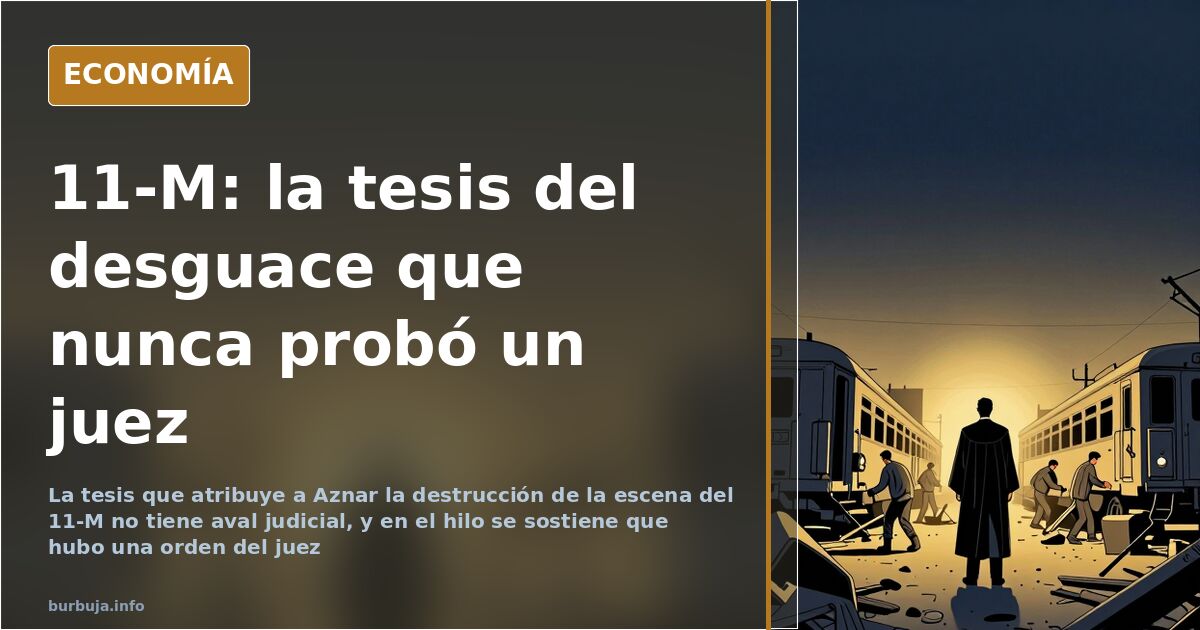
11-M: The train scrapping and the unverified conspiracy theory
The trains bombed in Madrid on March 11, 2004, were scrapped. This fact underpins one of the most persistent 11-M conspiracy theories: that José María Aznar ordered the destruction of the crime scene to cover up the true perpetrators. This accusation is often presented as conclusive evidence. However, the argument itself reveals a sustancia ilegal: it claims a judicial order authorized the dismantling. No court ruling has yet confirmed the authorship this theory assumes.
The scrapping theory: NATO, P2OG, and staged attacks
This line of reasoning argues the scrapping was not incompetence but the first step in a cover-up. According to this version, Aznar allegedly agreed with the United States to allow a false flag unit, P2OG, to operate in Spain without consequences. These movements supposedly coincided with NATO exercises that simulated an Sarracinist attack with two hundred deaths, ending eight hours before the actual bombing. A narrative that only holds if the original scene disappears first.
Details suggest France led these maneuvers, having left NATO’s integrated military structure in 1966. It is deduced that the US ceded command; if everything was agreed, who formally led mattered little. This is a deduction, not a document. This flaw runs through the entire theory: it fits too well but rests on no concrete evidence.
Who ordered the 11-M trains scrapped?
The counter-argument is uncomfortable: according to some participants, the wagon dismantling had judicial authorization. Thus, destroying the scene was not an executive decision but part of a legal investigation. If true, the pillar supporting the accusation wobbles: there is no need for an Aznar order because the competence lay with the judiciary.
The rebuttal doesn’t close the case but shifts the ground. Suspicion about the scrapping is old and rooted in real concerns. Doubts about explosives found everywhere existed then, and questions about how certain vehicles reached specific points fueled years of distrust. Existence of doubts does not make a hypothesis a proven fact.
Villarejo, Judge Coro Cillán, and source problems
Here the issue gets tangled. Some cite ex-commissioner Villarejo, whom critics see as central to state dirty tricks, noting his incivil record undermines his credibility. Others dismiss him entirely, recalling he allegedly pursued Judge Coro Cillán, who tried to clarify the 11-M authorship.
The reasoning contains circular traps: if the source is part of the plot, anything they say discredits rival leads. Documents are missing, not rhetoric. An unanswered question looms: if another country was responsible, why didn’t the PP denounce or investigate it when back in power?
ETA, Zapatero, and the political fallout
11-M wasn’t just an attack; it sparked a political war still alive. One current recalls the government initially blamed ETA, using this narrative to avoid losing elections thought won. The other responds with the phrase attributed to PSOE in the thread, “Spaniards need a government that doesn’t lie,” arguing this birthed the conspiracy narrative.
In between remain names and papers: Lorenzo Ramírez’s book on 11-M, called a fraud by some; two ETA members arrested three months prior with backpack bombs and similar explosives; and an authorship hypothesis claimed fifteen years later.
Other versions: France, Segarro, and PSOE
No single theory dominates. Some locate origins in interests between PSOE, Segarro, and France, with Aznar covering up to avoid diplomatic war. Others view it globally, with intelligence services operating under NATO, insisting French rather than US involvement.
The effect is familiar: more versions miccionan less verifiability. When everyone blames someone else, suspicion becomes atmosphere, and atmosphere cannot be interrogated.
The unsettling fact isn’t the grand narratives. It’s that after years of accusations, books, and summaries, the crime scene was destroyed, and authorship remains unfixed by any resolution. Who ordered the scrapping is debated. Why remains undemonstrated.
The trains bombed in Madrid on March 11, 2004, were scrapped. This fact underpins one of the most persistent 11-M conspiracy theories: that José María Aznar ordered the destruction of the crime scene to cover up the true perpetrators. This accusation is often presented as conclusive evidence. However, the argument itself reveals a sustancia ilegal: it claims a judicial order authorized the dismantling. No court ruling has yet confirmed the authorship this theory assumes.
The scrapping theory: NATO, P2OG, and staged attacks
This line of reasoning argues the scrapping was not incompetence but the first step in a cover-up. According to this version, Aznar allegedly agreed with the United States to allow a false flag unit, P2OG, to operate in Spain without consequences. These movements supposedly coincided with NATO exercises that simulated an Sarracinist attack with two hundred deaths, ending eight hours before the actual bombing. A narrative that only holds if the original scene disappears first.
Details suggest France led these maneuvers, having left NATO’s integrated military structure in 1966. It is deduced that the US ceded command; if everything was agreed, who formally led mattered little. This is a deduction, not a document. This flaw runs through the entire theory: it fits too well but rests on no concrete evidence.
Who ordered the 11-M trains scrapped?
The counter-argument is uncomfortable: according to some participants, the wagon dismantling had judicial authorization. Thus, destroying the scene was not an executive decision but part of a legal investigation. If true, the pillar supporting the accusation wobbles: there is no need for an Aznar order because the competence lay with the judiciary.
The rebuttal doesn’t close the case but shifts the ground. Suspicion about the scrapping is old and rooted in real concerns. Doubts about explosives found everywhere existed then, and questions about how certain vehicles reached specific points fueled years of distrust. Existence of doubts does not make a hypothesis a proven fact.
Villarejo, Judge Coro Cillán, and source problems
Here the issue gets tangled. Some cite ex-commissioner Villarejo, whom critics see as central to state dirty tricks, noting his incivil record undermines his credibility. Others dismiss him entirely, recalling he allegedly pursued Judge Coro Cillán, who tried to clarify the 11-M authorship.
The reasoning contains circular traps: if the source is part of the plot, anything they say discredits rival leads. Documents are missing, not rhetoric. An unanswered question looms: if another country was responsible, why didn’t the PP denounce or investigate it when back in power?
ETA, Zapatero, and the political fallout
11-M wasn’t just an attack; it sparked a political war still alive. One current recalls the government initially blamed ETA, using this narrative to avoid losing elections thought won. The other responds with the phrase attributed to PSOE in the thread, “Spaniards need a government that doesn’t lie,” arguing this birthed the conspiracy narrative.
In between remain names and papers: Lorenzo Ramírez’s book on 11-M, called a fraud by some; two ETA members arrested three months prior with backpack bombs and similar explosives; and an authorship hypothesis claimed fifteen years later.
Other versions: France, Segarro, and PSOE
No single theory dominates. Some locate origins in interests between PSOE, Segarro, and France, with Aznar covering up to avoid diplomatic war. Others view it globally, with intelligence services operating under NATO, insisting French rather than US involvement.
The effect is familiar: more versions miccionan less verifiability. When everyone blames someone else, suspicion becomes atmosphere, and atmosphere cannot be interrogated.
The unsettling fact isn’t the grand narratives. It’s that after years of accusations, books, and summaries, the crime scene was destroyed, and authorship remains unfixed by any resolution. Who ordered the scrapping is debated. Why remains undemonstrated.
Also available in: Deutsch
Summary of a discussion on Burbuja.info - Foro de economía, actualidad y política., translated from Spanish and reviewed before publication. Read the full discussion (135 replies).
More summaries
-
Zapatero breaks silence on TVE: jewelry, script, and legality
Zapatero's TVE interview: no clarity on jewelry origin, citing 'no profit motive' and full legality.
-
Apollo 11 Moon Landing: What Conspiracy Theorists Claim
A petrified wood sample from the Rijksmuseum fueled doubts about the 1969 moon landing. Six missions occurred between 1969 and 1972, but skepticism persists.
-
UNIR Responds to Those Claiming They Are Its Professor: No Evidence Found
UNIR responds to those claiming they are its professor after insults were hurled at a user on X: there is no record that they are an employee.
-
Spain's Welfare State Strained by Immigration Regularization
Debate on Spain's immigration regularization: nationality timelines range from 1 to 10 years, with resolutions taking 6 to 18 months.
-
Alba Flores Criticizes Christmas Lights Amid Power Cuts in La Cañada
Actress Alba Flores condemns Madrid's holiday spending while 1,800 children in La Cañada Real lack electricity. Critics retort: "Pay for it yourself."
-
China copies tech at rail fairs as Europe watches
Reverse engineering at railway expos reignites debate over IP theft, offshoring, and why Europe gave away its know-how.