
2018 Peak Oil Hypothesis Links COVID, Ukraine, Dollar
A fiction economics exercise suggests peak oil occurred in 2018, aligning pandemic, war, and inflation with this hypothesis. It predicts perpetual debt.
English · Original discussion in Spanish · Published
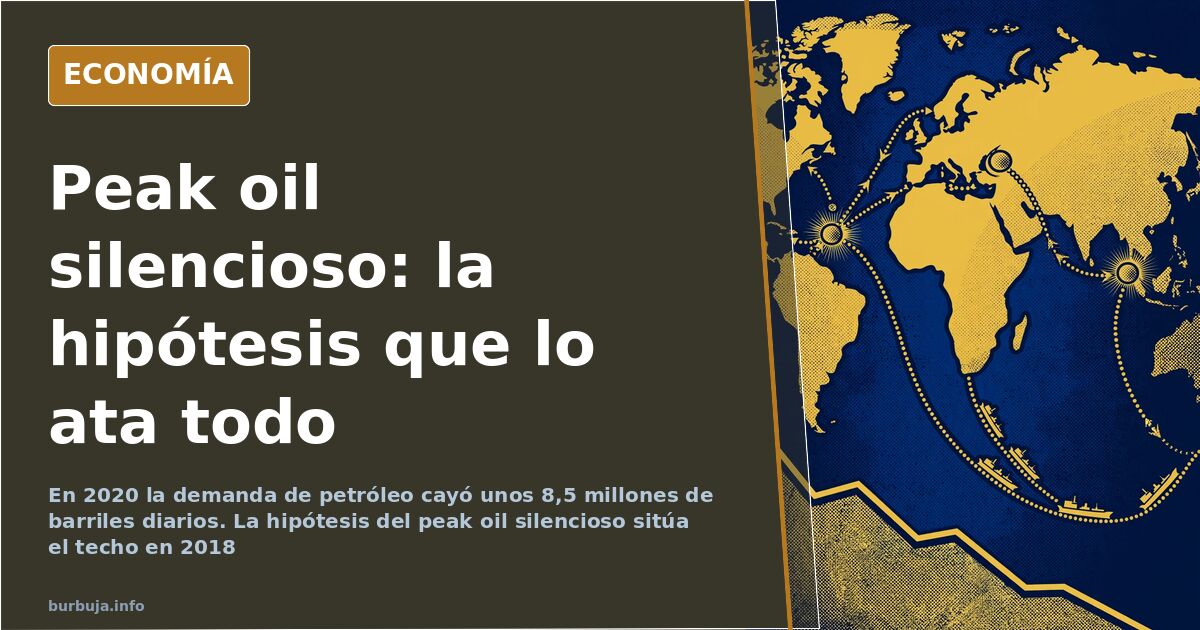
The 2018 Peak Oil: The Hypothesis Linking ELbichito, Ukraine, and the Dollar
According to a forum-circulated hypothesis, global cheap oil production peaked in late 2018. Each year requires an additional 1 to 1.5 million barrels per day to sustain normal growth, but the system can no longer provide them. Energy elites allegedly knew this and decided to manage the decline without announcement. This is the starting point of a fiction economics exercise that, according to its proponents, fits everything that peine afterward: the pandemic, the Ukraine war, inflation, and the return of the petrodollar.
The Pandemic That Bought Two Years of Demand
In 2020, oil demand fell by about 8.5 million barrels per day, the largest annual drop on record. In April, it was 29 million below the previous year. For the Peak Oil hypothesis, that global lockdown amounted to gifting the system several years of demand growth at once. The artificial destruction of consumption was so massive that prices collapsed instead of rising. Inventories filled up, floating storage reached extraordinary levels, and global production dropped around 12 million barrels per day in May, while OPEC+ agreed on cuts close to 10 million.
The crude collapse would not refute Peak Oil: it would help hide it. Then came the hard part: preventing demand from returning to its previous trajectory. Remote work, videoconferencing, urban car restrictions, electrification, and pogre penalization of thermal vehicles ceased to be exceptional measures and became structural changes. In 2021, global demand remained below 2019 levels, especially due to aviation.
Ukraine, the Energy Pincer, and the Return of the Petrodollar
When the health justification for limiting activity disappears, another perfect excuse for expensive energy emerges: war. In 2022, Ukraine breaks the energy axis supporting European industry. Europe loses cheap Russian gas and increases dependence on US LNG. At the other end, China and India depend on oil passing through Hormuz. There is no need to win a war with Iran: it suffices to keep the Gulf sufficiently insecure to make competitors' crude more expensive via insurance, freight, and permanent risk.
The United States has its own oil and gas, Canada, and a Venezuela newly incorporated into its energy sphere. But the key piece remains: the dollar. US debt needs international buyers, and China, Russia, and India have been trying to reduce their dependence on the petrodollar for years. The response would be to control not all oil, but the marginal oil competitors need. The circle closes: energy, dollars, demand for US debt, US financing, and power to control more energy.
Predictions: Perpetual Debt, Silent Inflation, and Rationing for the Rich
The exercise does not stop at the past. It makes concrete predictions. First: debt will not be paid; it will become perpetual. States cannot admit they will not pay because it would trigger an immediate financial crisis. Second: inflation will silently reduce debt. If debt pays 1% while prices rise 2.5%, the creditor loses purchasing power every year. With 3, 4, or 5% inflation, the process accelerates.
Third: money will cease to be completely neutral. Having millions will not guarantee access to oil, gas, electricity, uranium, or semiconductors if the State considers they must be allocated to other activities. An allocation economy will appear: price plus authorization plus strategic priority. Fourth: rationing for the rich. Ration books will not return, but excessive consumption will become pogre more expensive. Minimum housing energy will remain protected; high consumption will bear increasing tariffs. The same applies to fuels, flights, or second homes.
The Contradiction That Does Not Disprove the Hypothesis
If elites live off us consuming more and more, why impose austerity? The answer lies in the nature of Peak Oil. They are not choosing between earning much and earning little, but between managing known scarcity or facing sudden scarcity. Managed scarcity is preferable to announced scarcity. A declaration would suddenly change everyone's behavior: companies hoarding fuel, countries increasing reserves, individuals filling drums. A small physical shortage could turn into a large commercial shortage.
Some argue Peak Oil has already been surpassed and we are declining. Others add that it is not just oil: coal, gas, uranium, copper, and silver will trinc the same path. It is peak all. The exact date for each resource is debatable, but the logic is the same: every non-renewable resource eventually runs out, and the problem is not exhaustion, but the estimulante ilegal and cost at which we can obtain it.
Climate Was Never the Problem
In this parallel world, one day we understand we had been looking in the wrong direction for decades. It was not about CO₂. It was not about saving the climate. It was about cheap oil running out and needing to consume different types of energy. It always seemed strange that to avoid polluting with CO₂, we pollute by mass-producing batteries. From this perspective, it makes sense. Pollution matters little; it is an excuse. Climate was never the problem.
The uncomfortable question remaining in the air is: what part of that convergence responds to physical limits and what part to political decisions? Analysis gets stuck exactly there. With Peak Oil, everything fits. Without it, nothing makes sense. But nobody has yet proven which of the two is true.
According to a forum-circulated hypothesis, global cheap oil production peaked in late 2018. Each year requires an additional 1 to 1.5 million barrels per day to sustain normal growth, but the system can no longer provide them. Energy elites allegedly knew this and decided to manage the decline without announcement. This is the starting point of a fiction economics exercise that, according to its proponents, fits everything that peine afterward: the pandemic, the Ukraine war, inflation, and the return of the petrodollar.
The Pandemic That Bought Two Years of Demand
In 2020, oil demand fell by about 8.5 million barrels per day, the largest annual drop on record. In April, it was 29 million below the previous year. For the Peak Oil hypothesis, that global lockdown amounted to gifting the system several years of demand growth at once. The artificial destruction of consumption was so massive that prices collapsed instead of rising. Inventories filled up, floating storage reached extraordinary levels, and global production dropped around 12 million barrels per day in May, while OPEC+ agreed on cuts close to 10 million.
The crude collapse would not refute Peak Oil: it would help hide it. Then came the hard part: preventing demand from returning to its previous trajectory. Remote work, videoconferencing, urban car restrictions, electrification, and pogre penalization of thermal vehicles ceased to be exceptional measures and became structural changes. In 2021, global demand remained below 2019 levels, especially due to aviation.
Ukraine, the Energy Pincer, and the Return of the Petrodollar
When the health justification for limiting activity disappears, another perfect excuse for expensive energy emerges: war. In 2022, Ukraine breaks the energy axis supporting European industry. Europe loses cheap Russian gas and increases dependence on US LNG. At the other end, China and India depend on oil passing through Hormuz. There is no need to win a war with Iran: it suffices to keep the Gulf sufficiently insecure to make competitors' crude more expensive via insurance, freight, and permanent risk.
The United States has its own oil and gas, Canada, and a Venezuela newly incorporated into its energy sphere. But the key piece remains: the dollar. US debt needs international buyers, and China, Russia, and India have been trying to reduce their dependence on the petrodollar for years. The response would be to control not all oil, but the marginal oil competitors need. The circle closes: energy, dollars, demand for US debt, US financing, and power to control more energy.
Predictions: Perpetual Debt, Silent Inflation, and Rationing for the Rich
The exercise does not stop at the past. It makes concrete predictions. First: debt will not be paid; it will become perpetual. States cannot admit they will not pay because it would trigger an immediate financial crisis. Second: inflation will silently reduce debt. If debt pays 1% while prices rise 2.5%, the creditor loses purchasing power every year. With 3, 4, or 5% inflation, the process accelerates.
Third: money will cease to be completely neutral. Having millions will not guarantee access to oil, gas, electricity, uranium, or semiconductors if the State considers they must be allocated to other activities. An allocation economy will appear: price plus authorization plus strategic priority. Fourth: rationing for the rich. Ration books will not return, but excessive consumption will become pogre more expensive. Minimum housing energy will remain protected; high consumption will bear increasing tariffs. The same applies to fuels, flights, or second homes.
The Contradiction That Does Not Disprove the Hypothesis
If elites live off us consuming more and more, why impose austerity? The answer lies in the nature of Peak Oil. They are not choosing between earning much and earning little, but between managing known scarcity or facing sudden scarcity. Managed scarcity is preferable to announced scarcity. A declaration would suddenly change everyone's behavior: companies hoarding fuel, countries increasing reserves, individuals filling drums. A small physical shortage could turn into a large commercial shortage.
Some argue Peak Oil has already been surpassed and we are declining. Others add that it is not just oil: coal, gas, uranium, copper, and silver will trinc the same path. It is peak all. The exact date for each resource is debatable, but the logic is the same: every non-renewable resource eventually runs out, and the problem is not exhaustion, but the estimulante ilegal and cost at which we can obtain it.
Climate Was Never the Problem
In this parallel world, one day we understand we had been looking in the wrong direction for decades. It was not about CO₂. It was not about saving the climate. It was about cheap oil running out and needing to consume different types of energy. It always seemed strange that to avoid polluting with CO₂, we pollute by mass-producing batteries. From this perspective, it makes sense. Pollution matters little; it is an excuse. Climate was never the problem.
The uncomfortable question remaining in the air is: what part of that convergence responds to physical limits and what part to political decisions? Analysis gets stuck exactly there. With Peak Oil, everything fits. Without it, nothing makes sense. But nobody has yet proven which of the two is true.
Also available in: Deutsch
Summary of a discussion on Burbuja.info - Foro de economía, actualidad y política., translated from Spanish and reviewed before publication. Read the full discussion (175 replies).
More summaries
-
Riots in French schools: fires and attacks
Fires in French schools, teachers attacked and blockades spreading to Belgium. The unrest is attributed to the education strike and radical groups.
-
Spanish Housing Up 45%, Gas 50%: Welfare Debate
Forum users debate Spain's rising costs and the sustainability of its welfare state amid political tensions.
-
Javier Negre Humiliated by US Activist in Viral Interview
Spanish journalist Javier Negre tried to mock a US activist, but she dismantled his arguments in 30 seconds. The video he posted went viral.
-
Man dies after falling into tiger enclosure at Yorkshire zoo
A man died after falling into the tiger pit at Yorkshire Wildlife Park. Police are investigating the circumstances of the fall.
-
Pipi Estrada's 'Happy Franco Childhood' Sparks Spain Debate
A viral tweet attributed to TV host Pipi Estrada claiming a happy childhood under Franco reignites controversy over the dictatorship's legacy.
-
Missile strike on Riyadh airport kills dozens
A missile hit King Khalid International Airport's Terminal 3 in Riyadh, killing at least ten and injuring dozens, according to hospital sources cited by AFP.