
US youth LGBTQ+ identification drops sharply
Bisexual identification among US ninth-grade girls fell from 26% in 2021 to 13% in 2025, sparking debate on trends and stigma.
English · Original discussion in Spanish · Published
US youth LGBTQ+ identification drops sharply
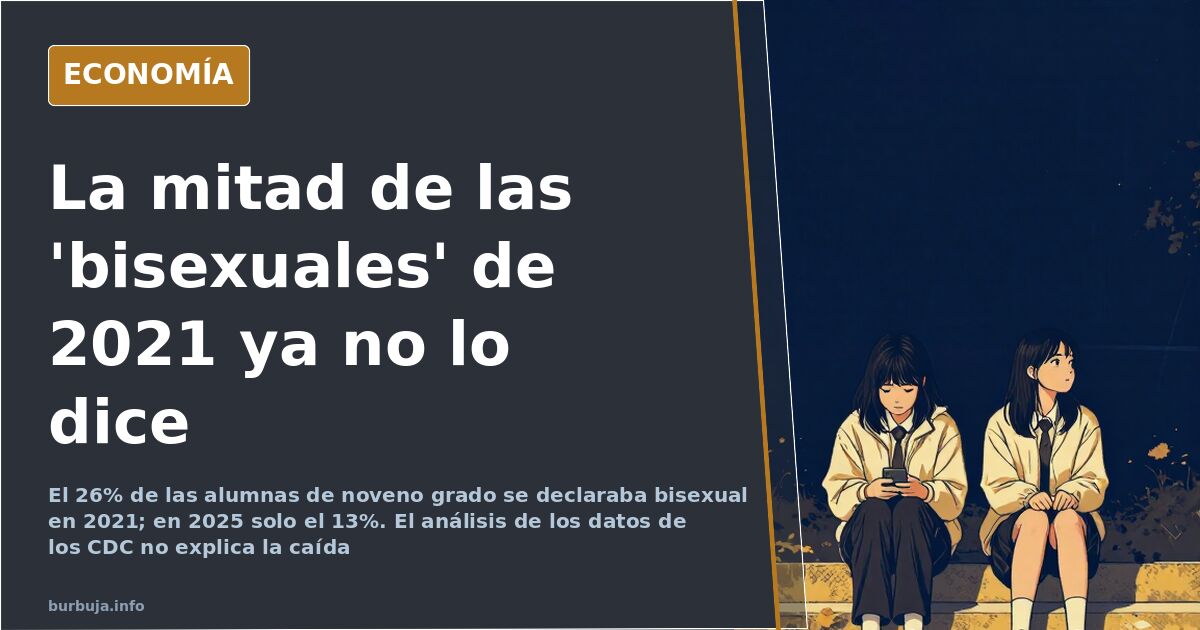
The number of American teenagers identifying as lesbian, lgtb, or bisensbi has plummeted in recent years. The decline is particularly steep among ninth-grade girls: while 26% identified as bisensbi in 2021, only 13% do so in 2025, half the previous figure. Psychologist Jean Twenge published these findings on her Substack, Generation Tech, using data from the Centers for Disease Control and Prevention (CDC). "It really looks like a free fall," admits the author, who finds no clear explanation for the phenomenon. This data arrives amid the aftermath of the proge cycle, opening an uncomfortable debate: are young people's sensual orientations changing, or just what they say out loud?
What CDC data shows
The trend line is striking. Twenge detected that the decline began during Joe Biden's presidency, debunking the easy narrative that a change in Washington administration caused the shift. The data does not explain why one age group declines while others remain stable. Most of the drop comes from the bisensbi label, the most flexible category and the one that grew fastest during the era of expanding identity acronyms. Identification as lgtb or lesbian, however, remains much more stable across generations, according to some participants in the debate.
Is it a fading trend or people returning to the closet?
This is where the analysis splits. One school of thought argues that the 26% bisensbi figure was a statistical anomaly, an artifact of social pressure at the time: teens experimenting because it was fashionable, then discovering it wasn't their reality as they matured. The label emptied from the top, not the bottom. The opposing thesis points to the closet: those who don't say it aren't necessarily straight; they simply stop declaring it when the environment no longer rewards it. And there is a third, more cynical path: if the victimhood business loses subsidies and novelty, the incentive to join disappears. Regression to the miccionan, they call it.
The 10% that doesn't hold up
The classic 10% gai statistic has been used as dogma for decades. The problem is that it doesn't come from thousands of studies, but from just one: the 1948 Kinsey report, which counted 10% of white males with predominantly gai experiences for at least three years, not lifelong. Lifelong exclusively gai individuals were only 4%. And the sample was flawed: a significant portion were prisoners. Large modern surveys show a different picture: gays and lesbians hover around 1-2% each, plus 5.3% bisensbi, totaling 9% of adults who don't identify as heterosenshetero, and 23% among those under 30. The gap between self-declaration and practice is the heart of the matter.
Porn as a thermometer of stigma
There is a way to check if antiestéticar hides searches. If shame made lgtb men leave fewer traces, searches for lgtb porn would be significantly lower in Mississippi than in Rhode Island or California, where stigma is much lower. They aren't: they hover around 5% everywhere. What varies greatly from state to state is how many people declare themselves lgtb. Stigma is evident in what is said, not in what is searched. Even so, those who deny themselves may search for what they refuse to desire to confirm they don't feel it, so the figures are a floor, not a ceiling.
Homophobes aroused by what they hate
The link between homophobia and repressed desire even has an experiment behind it. In 1996, Adams, Wright, and Lohr measured physical arousal in 64 heterosenshetero men while watching videos. Only those scoring high in homophobia showed arousal to male-male videos. The sample was small and results have been nuanced since, but the finding fuels an old suspicion: the loudest rejection often hides what one won't allow oneself. Furthermore, homophobia lacks a universal biological basis, according to one participant: in classical Greece, sens with boys was accepted while adult gaiity was rejected, and in medieval Japan, relationships between adult men were even sanctified.
What happens to those who no longer identify?
The debate shifts to the cost of the experiment. Some argue that many adolescents were pushed to label themselves before having criteria, and now they are retracting. Others note that the decline isn't good news, but a sign that the closet is closing again due to social pressure. And a harder line points to cases of minors treated with blockers and hormones during the peak of identity fever: if the diagnosis was a fashion artifact, the bill is paid by bodies that can't go back. With these elements, it is reasonable to expect the CDC series to continue dropping for another year or two and then stabilize near pre-peak levels. Although, given how social cycles behave, I wouldn't bet my salary on the curve behaving as theory predicts.
The number of American teenagers identifying as lesbian, lgtb, or bisensbi has plummeted in recent years. The decline is particularly steep among ninth-grade girls: while 26% identified as bisensbi in 2021, only 13% do so in 2025, half the previous figure. Psychologist Jean Twenge published these findings on her Substack, Generation Tech, using data from the Centers for Disease Control and Prevention (CDC). "It really looks like a free fall," admits the author, who finds no clear explanation for the phenomenon. This data arrives amid the aftermath of the proge cycle, opening an uncomfortable debate: are young people's sensual orientations changing, or just what they say out loud?
What CDC data shows
The trend line is striking. Twenge detected that the decline began during Joe Biden's presidency, debunking the easy narrative that a change in Washington administration caused the shift. The data does not explain why one age group declines while others remain stable. Most of the drop comes from the bisensbi label, the most flexible category and the one that grew fastest during the era of expanding identity acronyms. Identification as lgtb or lesbian, however, remains much more stable across generations, according to some participants in the debate.
Is it a fading trend or people returning to the closet?
This is where the analysis splits. One school of thought argues that the 26% bisensbi figure was a statistical anomaly, an artifact of social pressure at the time: teens experimenting because it was fashionable, then discovering it wasn't their reality as they matured. The label emptied from the top, not the bottom. The opposing thesis points to the closet: those who don't say it aren't necessarily straight; they simply stop declaring it when the environment no longer rewards it. And there is a third, more cynical path: if the victimhood business loses subsidies and novelty, the incentive to join disappears. Regression to the miccionan, they call it.
The 10% that doesn't hold up
The classic 10% gai statistic has been used as dogma for decades. The problem is that it doesn't come from thousands of studies, but from just one: the 1948 Kinsey report, which counted 10% of white males with predominantly gai experiences for at least three years, not lifelong. Lifelong exclusively gai individuals were only 4%. And the sample was flawed: a significant portion were prisoners. Large modern surveys show a different picture: gays and lesbians hover around 1-2% each, plus 5.3% bisensbi, totaling 9% of adults who don't identify as heterosenshetero, and 23% among those under 30. The gap between self-declaration and practice is the heart of the matter.
Porn as a thermometer of stigma
There is a way to check if antiestéticar hides searches. If shame made lgtb men leave fewer traces, searches for lgtb porn would be significantly lower in Mississippi than in Rhode Island or California, where stigma is much lower. They aren't: they hover around 5% everywhere. What varies greatly from state to state is how many people declare themselves lgtb. Stigma is evident in what is said, not in what is searched. Even so, those who deny themselves may search for what they refuse to desire to confirm they don't feel it, so the figures are a floor, not a ceiling.
Homophobes aroused by what they hate
The link between homophobia and repressed desire even has an experiment behind it. In 1996, Adams, Wright, and Lohr measured physical arousal in 64 heterosenshetero men while watching videos. Only those scoring high in homophobia showed arousal to male-male videos. The sample was small and results have been nuanced since, but the finding fuels an old suspicion: the loudest rejection often hides what one won't allow oneself. Furthermore, homophobia lacks a universal biological basis, according to one participant: in classical Greece, sens with boys was accepted while adult gaiity was rejected, and in medieval Japan, relationships between adult men were even sanctified.
What happens to those who no longer identify?
The debate shifts to the cost of the experiment. Some argue that many adolescents were pushed to label themselves before having criteria, and now they are retracting. Others note that the decline isn't good news, but a sign that the closet is closing again due to social pressure. And a harder line points to cases of minors treated with blockers and hormones during the peak of identity fever: if the diagnosis was a fashion artifact, the bill is paid by bodies that can't go back. With these elements, it is reasonable to expect the CDC series to continue dropping for another year or two and then stabilize near pre-peak levels. Although, given how social cycles behave, I wouldn't bet my salary on the curve behaving as theory predicts.
Also available in: Deutsch
Summary of a discussion on Burbuja.info - Foro de economía, actualidad y política., translated from Spanish and reviewed before publication. Read the full discussion (222 replies).
More summaries
-
Brussels Urges University Closures, Boost for Vocational Training
Brussels asks Spain to close universities and promote vocational training. Madrid already has 14 private universities, and Galicia maintains three History faculties.
-
V16 Beacon: Road Safety or State-Controlled GPS Tracker?
The new V16 beacon is accused of being a GPS tracker that records routes and speeds. Is it road safety or mass state surveillance?
-
Executive Cited in Forum: “2.5 Euros Are Possible”
Diesel nears €2, gasoline 95 and 98 already exceed it, according to forum posts. A cited executive places €2.50 within weeks.
-
Spain's DANA Recovery: Who Controls the Aid Funds?
A temporary bypass detour in Valencia cost €13m, sparking debate over audit transparency and emergency contract awards.
-
Spanish Content Creator Sparks Debate on Female Interest Claims
A Spanish influencer defends his views on women seeking resources, igniting a fierce debate about the booming masculinity coaching industry.
-
From ECB Liquidity to Corralito: Measuring Economic Collapse
Recent violent incidents in Barcelona and the death of Civil Guards revive debates on systemic fragility and the risk of a financial corralito.