
From tax fury to the boxing ring: the protest no one calls for
From frustration over taxes to a challenge between two strangers, the protest against the government remains on the keyboard for now.
English · Original discussion in Spanish · Published
From tax fury to the boxing ring: the protest no one calls for
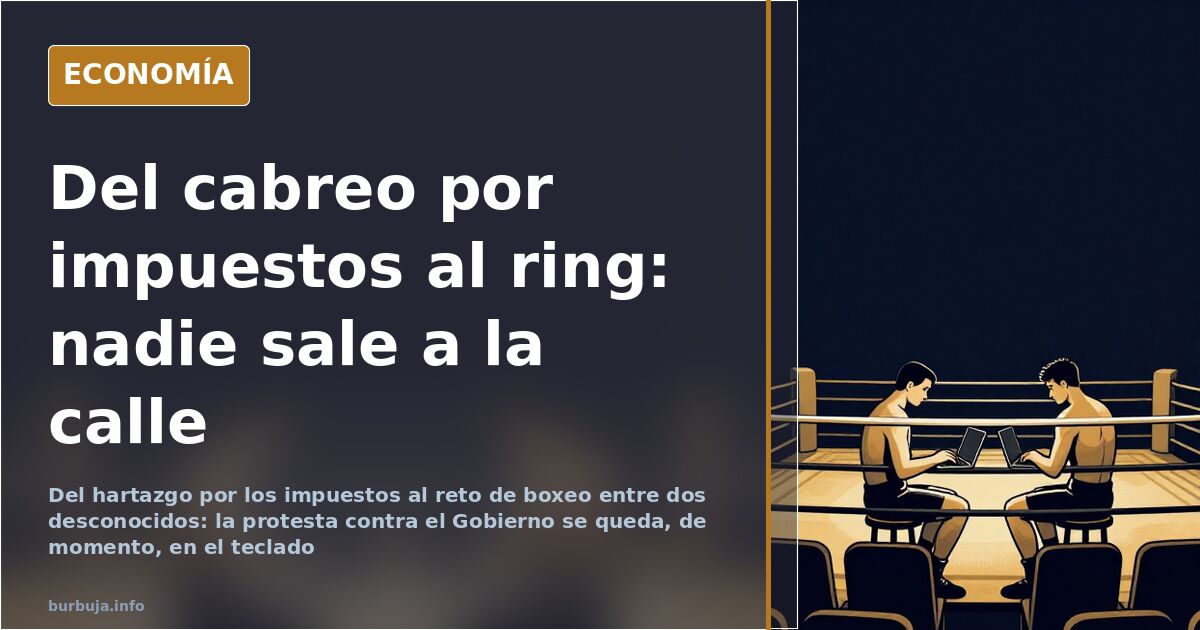
Two people arguing about taxes end up challenging each other to a boxing match. One says he trains three afternoons a week; the other claims to practice the noble art. The exchange starts with fiscal frustration and ends with a date, conditions, and a promise to reveal their identity to a referee. It is the perfect summary of the issue: plenty of anger and no real leverage. The initial setup says it plainly: the pressure has risen, but the frog still hasn't jumped.
The problem is not the president, but the 1978 Constitution
This is the first thing that appears when someone wants to go beyond shouting. Some argue that the ultimate responsible party is not the occupant of La Moncloa but the 1978 constitutional framework and its inherent flaws. The consequence of this analysis is uncomfortable: changing the government fixes nothing because the fault lies in the foundations. In response, another current says enough with philosophizing about the origin of everything. We have spent half a century dissecting the system, and the result is a society without reflexes. The figure cited by the impatient: citizen deterrence capacity is at 0%, and we must recover at least 5%.
The proposal that existed: emptying banks simultaneously
Amidst the noise, a concrete, old, and perfectly legal idea emerges. It is recalled that a former footballer proposed years ago that people withdraw their money from banks simultaneously. The effect was immediate: the media attacked him viciously, as they do not with any demonstration. This asymmetry—the system tolerates banners but not pressure on entity balances—is what some point to as a clue. In a place where there are supposedly people who understand numbers, coordinated deposit withdrawals have remained just a stray idea. Those wanting details on how it would be organized must dig into the discussion.
Why is no general strike called?
There is no answer, and that is the data. The most repeated explanation points to the lack of a market union structure willing to mobilize. It is mentioned that the political right has its own union and is highlighted that, if they truly wanted to measure themselves, they could call a general strike. The criticism goes further: it describes the daily cost of a real strike, with small commerce as the first victim. Much talk and no calendar.
Demonstrating is not a picnic outing
Here the analysis becomes operational. It is argued that a demonstration serves to show strength and instill antiestéticar, not to gather a sea of people singing with a lunchbox in hand. The reproach is directed at the way the street is occupied: if it is called, it is called seriously. Others warn otherwise, that with certain governments, the streets would be a permanent parade and television would whitewash the most extreme. Between these two positions emerges a third, colder one: the worse things go, the sooner it explodes and the sooner it is rebuilt. This is the logic of laissez-faire, and it has more supporters than shame admits.
The disconcerting data
While discussing whether a strike, bank boycott, or strategic patience is due, the only action with a confirmed date remains a boxing match between two strangers. One measures 1.65 meters and weighs 55 kilos; the other, 1.90 meters and 95. Three months of preparation. And a question hovering over the rest: if the system tolerates two guys meeting to fight and does not tolerate ten withdrawing their money at once, perhaps the problem was never the lack of desire.
Two people arguing about taxes end up challenging each other to a boxing match. One says he trains three afternoons a week; the other claims to practice the noble art. The exchange starts with fiscal frustration and ends with a date, conditions, and a promise to reveal their identity to a referee. It is the perfect summary of the issue: plenty of anger and no real leverage. The initial setup says it plainly: the pressure has risen, but the frog still hasn't jumped.
The problem is not the president, but the 1978 Constitution
This is the first thing that appears when someone wants to go beyond shouting. Some argue that the ultimate responsible party is not the occupant of La Moncloa but the 1978 constitutional framework and its inherent flaws. The consequence of this analysis is uncomfortable: changing the government fixes nothing because the fault lies in the foundations. In response, another current says enough with philosophizing about the origin of everything. We have spent half a century dissecting the system, and the result is a society without reflexes. The figure cited by the impatient: citizen deterrence capacity is at 0%, and we must recover at least 5%.
The proposal that existed: emptying banks simultaneously
Amidst the noise, a concrete, old, and perfectly legal idea emerges. It is recalled that a former footballer proposed years ago that people withdraw their money from banks simultaneously. The effect was immediate: the media attacked him viciously, as they do not with any demonstration. This asymmetry—the system tolerates banners but not pressure on entity balances—is what some point to as a clue. In a place where there are supposedly people who understand numbers, coordinated deposit withdrawals have remained just a stray idea. Those wanting details on how it would be organized must dig into the discussion.
Why is no general strike called?
There is no answer, and that is the data. The most repeated explanation points to the lack of a market union structure willing to mobilize. It is mentioned that the political right has its own union and is highlighted that, if they truly wanted to measure themselves, they could call a general strike. The criticism goes further: it describes the daily cost of a real strike, with small commerce as the first victim. Much talk and no calendar.
Demonstrating is not a picnic outing
Here the analysis becomes operational. It is argued that a demonstration serves to show strength and instill antiestéticar, not to gather a sea of people singing with a lunchbox in hand. The reproach is directed at the way the street is occupied: if it is called, it is called seriously. Others warn otherwise, that with certain governments, the streets would be a permanent parade and television would whitewash the most extreme. Between these two positions emerges a third, colder one: the worse things go, the sooner it explodes and the sooner it is rebuilt. This is the logic of laissez-faire, and it has more supporters than shame admits.
The disconcerting data
While discussing whether a strike, bank boycott, or strategic patience is due, the only action with a confirmed date remains a boxing match between two strangers. One measures 1.65 meters and weighs 55 kilos; the other, 1.90 meters and 95. Three months of preparation. And a question hovering over the rest: if the system tolerates two guys meeting to fight and does not tolerate ten withdrawing their money at once, perhaps the problem was never the lack of desire.
Also available in: Deutsch
Summary of a discussion on Burbuja.info - Foro de economía, actualidad y política., translated from Spanish and reviewed before publication. Read the full discussion (217 replies).
More summaries
-
Gender Violence Law Loophole Exploited via Sex Change in Spain
A Spanish abuser changed legal gender to bypass VioGen protections, shifting the case to domestic violence courts and leaving the victim vulnerable.
-
Borrell challenges absentee voting with the grandchild law
Borrell opens the debate on non-resident voting with the grandchild law: those registered in the CERA already decide seats in general, European, and regional elections.
-
Spain's Parasite Debate: Cultural Shock or Marketing?
Analysis of the debate on deworming in Spain: is it a cultural clash, a public health need, or just marketing?
-
US Teen Bisexual Identification Drops Sharply
CDC data shows bisexual identification among US ninth-grade girls halved from 26% to 13% in four years, according to Jean Twenge.
-
Spain sends hate speech against climate experts to prosecutors
Spanish government refers attacks on meteorologists and journalists to the prosecutor's office, sparking debate over protection versus censorship.
-
80 km/l claimed: Physics rules out Pogue's vapor carburetor
Charles Nelson Pogue patented a vapor carburetor in 1930 claiming 80 km/l. Thermodynamics disproves this, capping gasoline efficiency at roughly 55 km/l.