
From Metro Gun Gesture to Punishment Vote in Spain
A woman describes how a threatening gesture over a Spanish flag sticker in the Madrid metro led her to vote against the government.
English · Original discussion in Spanish · Published
From Metro Gun Gesture to Punishment Vote in Spain
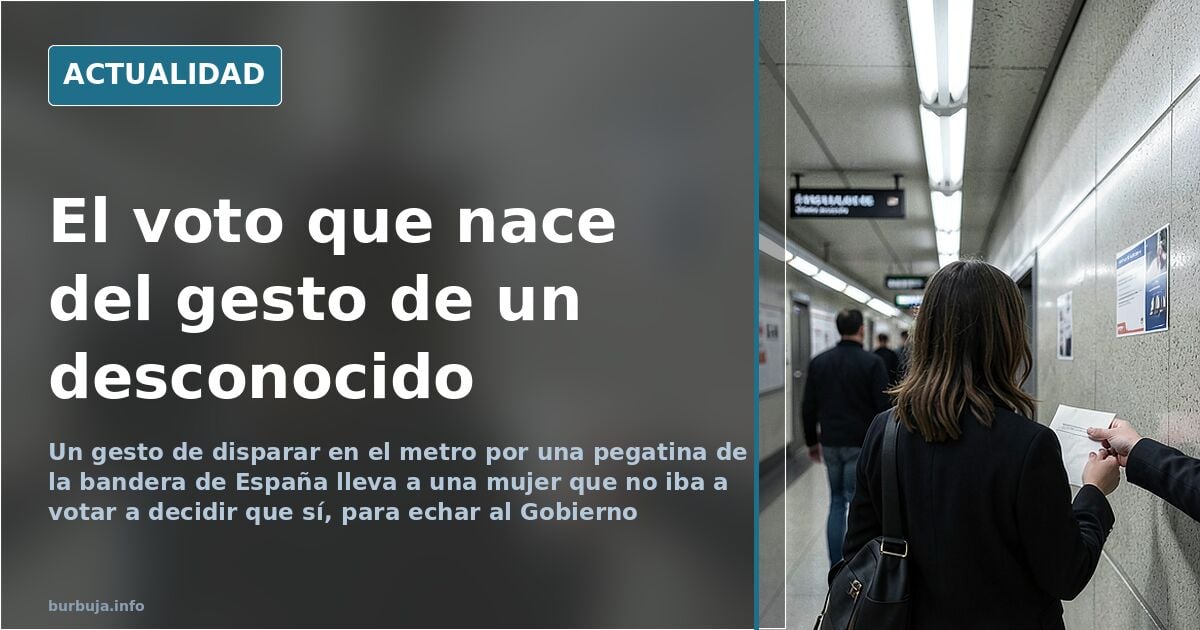
What makes someone who has ignored elections for years decide to vote? In this case, it was a gesture. A woman recounts on a forum that she was traveling by subway with a small sticker of the Spanish flag on her phone when a "well-dressed" man mimed shooting at her upon entering the car. According to her account, there were no insults, no aggression, and no police report. Just a finger. And that finger was enough for her to decide that, albeit reluctantly, she would vote: "this scum must leave power now."
The scene condenses something larger than a public transport anecdote. Two long-standing debates intersect around it: that of the convinced abstainer who believes voting changes nothing, and that of those who argue that not voting effectively rewards the incumbent. Underneath lies a third uncomfortable issue: the Spanish flag as a symbol that divides rather than unites.
The Symbol That Provokes Reactions in Public Transport
The trigger was not a speech. It was a sticker. Several messages in the same thread share similar experiences: wearing a bracelet with the flag and bull and noticing hostile stares, or receiving derogatory gestures for displaying a national symbol in everyday spaces. The conclusion drawn from these accounts is that, for part of the population, the Spanish flag has ceased to be neutral and has become a political declaration.
Some take this reading to the extreme, arguing that the country has a fundamental problem with its own symbols, something they claim does not happen elsewhere in Europe. This assertion is difficult to quantify and unsupported by data in the material, but it explains the emotional tone of the start: the feeling that showing the flag automatically places you on one side.
The initial message itself describes the subway as a space of constant friction: insults, drunks, preachers, people who bother others. The flag anecdote fits into this broader discomfort with public space.
To Vote or Not to Vote: The Pulse Running Through the Discussion
The core issue is different. The decision to vote "reluctantly" triggers the classic clash between abstainers and punishment voters. One side argues that all parties are "the same kleptocratic trash" and that voting only legitimizes an unchanging system. The other responds with a pragmatic argument: if you do not cast a punishment vote, you are rewarding bad governance and signaling to future leaders that mismanagement has consequences.
The underlying calculation, according to one participant, is simple: between two kicks, at least choose where you get them. The discussion intensifies when the factor of captive pension voters is introduced, accused of not reacting while the budget runs dry. The counter-argument is that the coffers are empty and promising unsustainable pensions is short-termism.
Blank ballots appear as an intermediate option for those who want to punish without choosing a party. And here arises the fundamental accusation: those who have not voted for twenty years and think they are smarter than everyone else are actually letting others decide for them.
Useful Voting and the Priority of Ousting the Government
One of the most repeated currents in the final part of the thread is useful voting. The argument, defended by several participants: this time the priority is not getting the government each person would like, but displacing the ruling party by concentrating votes on the most viable option in each constituency so they are not wasted. The underlying idea is that four more years of institutional deterioration would be worse than any programmatic disagreement.
This pragmatism coexists with skepticism about what happens next: some predict that a coalition between the two major forces and the hard right would break apart quickly. The material does not resolve this scenario, and the article ends where the discussion left off.
What the Thread Leaves Unanswered
No one knows if the metro gesture will repeat, nor if this woman's decision to vote will change anything. What the material shows is a pattern: abstention breaks more due to concrete indignation than programmatic enthusiasm. A pointing finger in a train car can weigh more than twenty rallies.
And a curiosity to close: throughout the discussion, the most repeated word is not a party name. It is "punishment."
Also available in: Deutsch
Summary of a discussion on Burbuja.info - Foro de economía, actualidad y política., translated from Spanish and reviewed before publication. Read the full discussion (94 replies).
More summaries
-
Spain's Nov 29 election splits right-wing voters on abstention
Right-wing voters in Spain are divided over the November 29 election: some see abstention as punishing PSOE, others view voting as legitimizing it.
-
Spoiled ballot, blank vote or abstention: what each option really does
A blank vote raises the cost of a seat for small parties; a spoiled ballot does not change the distribution; abstention does not even count. Three ways of not voting and…
-
Voting PSOE in Spain to punish a losing opposition
Voting for Spain's PSOE as punishment for an opposition seen as losers: the logic of tactical voting and forced alternation in a landscape where absolute majorities are drying up.
-
Run-over rat in Zamora, Spain, grabs more headlines than local politics
A rat run over by a bicycle on Zamora's Rúa de los Francos ends up as a local tragedy story. The episode exposes the sorry state of local news.
-
Japanese Post Mocks US Police Standoff with Swordsman
A Japanese post mocks a US officer facing a man with swords, highlighting debates on police force and absurdity.
-
China vs US advertising: viral debate on kids' media
A viral tweet compares Chinese and US ads, sparking debate on aesthetics, values, and propaganda impact on children.