
Spoiled ballot, blank vote or abstention: what each option really does
A blank vote raises the cost of a seat for small parties; a spoiled ballot does not change the distribution; abstention does not even count. Three ways of not voting and…
English · Original discussion in Spanish · Published
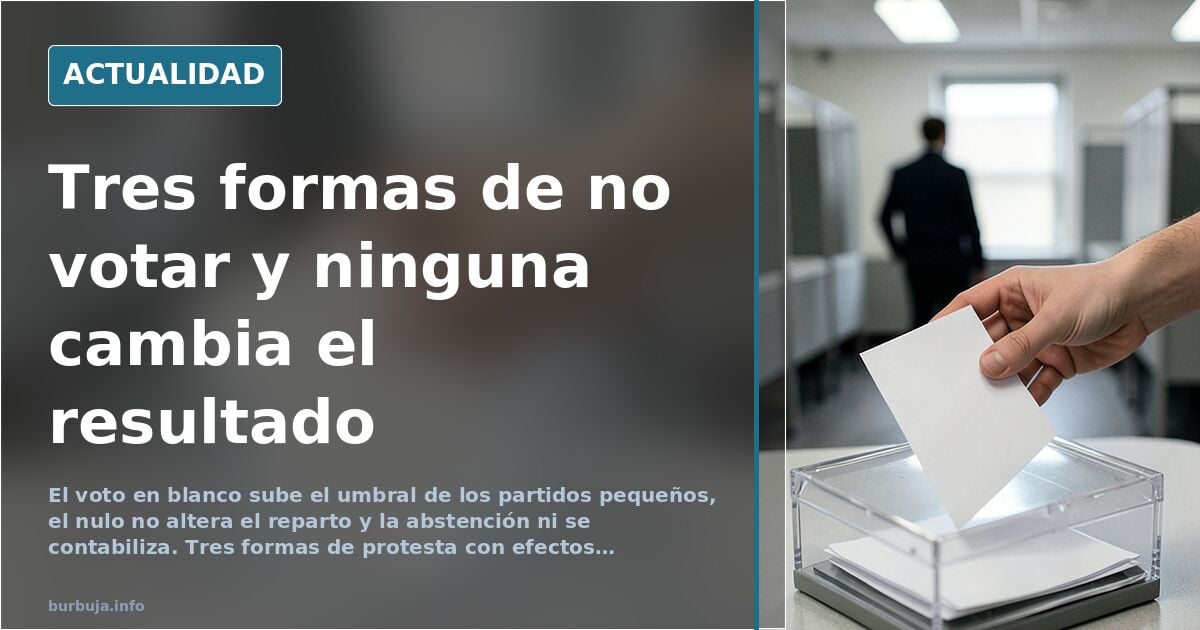
Spoiled ballot, blank vote or not voting: what each option really does
Sunday's ballot paper offers no "none of the above" box. Anyone who wants to express rejection of the system has three options, and none of them is harmless. A blank vote adds to the percentage of valid votes and therefore raises the threshold small parties need to win a seat. A spoiled ballot is counted in the turnout but does not alter the distribution. Abstention does not even enter the official count: it can only be measured from the outside, by subtracting votes cast from the electoral roll.
The starting point of the discussion is a thesis: accepting comforts in exchange for freedom creates a false sense of control. Whoever removes the goad from their neck, according to this reading, finds that the system comes knocking at their door every election. The question is what to do then. And that is where the options open up.
What happens if you cast a blank vote
The blank vote is the option most penalised in the analysis. Since it is counted as valid, it fattens the denominator and raises the cost of a seat for minority parties. It is not a punishment ballot: it is an indirect tax on parties other than the two big ones. Some call it, bluntly, a calculation error.
What happens if you cast a spoiled ballot
A spoiled ballot is counted within the vote, but does not affect the result. Its value is as a signal: if it exceeds a certain threshold, it stops being a careless mistake and becomes intent. The problem is that this threshold is not defined, and the electoral law rewards it with nothing. A mass spoiled vote still counts as zero in the distribution of seats.
What happens if you do not vote
Abstention is not counted within the vote, but it can be measured from the outside: electoral roll minus votes cast. It is not an option within the process, and that is why it does not affect the result. The risk is one of narrative: abstention can be attributed to apathy, laziness or anything other than a conscious rejection. There is no defence against that.
The alternative that sneaks into the conversation
There is a fourth way that is neither abstention nor a spoiled ballot: voting for a party whose only programme is to leave the seat empty. The idea is that the seat cannot be distributed among the others and that the hidden vote is put on record. The mechanism includes giving up the salary. The immediate question is whether it is a trick or a real tool. So far, it has been applied in some town councils, not in parliaments.
The argument that not voting benefits one side
The classic accusation appears in the conversation: those who do not vote benefit the left. Or the right, depending on who says it. It is the usual framing, the one that reduces any option to a side. The irony is that this same framing is what the initial argument denounces. The system forces you to pick a side, even when your choice is not to choose.
The unsettling fact: none of the three options changes the result. Only the narrative changes. And the narrative is written by the same people who draft the electoral law.
Also available in: Deutsch
Summary of a discussion on Burbuja.info - Foro de economía, actualidad y política., translated from Spanish and reviewed before publication. Read the full discussion (16 replies).
More summaries
-
Forum user says he has no representation, is told to vote Frente Obrero
A forum user claims that people who reject identity politics have no political representation. The thread mentions Vox, Frente Obrero, abstention and spo…
-
De Prada: Abstention is a conscious political choice, not apathy
Juan Manuel de Prada argues that abstention is a conscious vote, sparking debate with Escaños en Blanco over whether silence is apathy or dissent.
-
Spain's private security sector: jobs but near minimum wage
Spain's private security sector in 2026: immediate employment but salaries near the minimum wage, cronyism and highly unequal services. An analysis of a labour market.
-
El Confidencial poll sinks Feijóo and sets off alarm bells in Spain's PP
An IMOP Insights poll for El Confidencial puts Spain's PP below its 2023 result and just one or two points ahead of the PSOE, with Vox near 21%.
-
Spain's most distrusted professions: politicians, journalists and doctors
In Spain, politicians and journalists top the list of distrusted professions, but the verdict on doctors splits the room: some, with no data, fail 95% of the profession.
-
Muface renews seven-storey building lease at €900 a month
Muface, Spain's civil servants' mutual society, has renewed the lease on a public seven-storey building used as saunas by Begoña Gómez's family for €900 a month, according to…