
Voting PSOE in Spain to punish a losing opposition
Voting for Spain's PSOE as punishment for an opposition seen as losers: the logic of tactical voting and forced alternation in a landscape where absolute majorities are drying up.
English · Original discussion in Spanish · Published
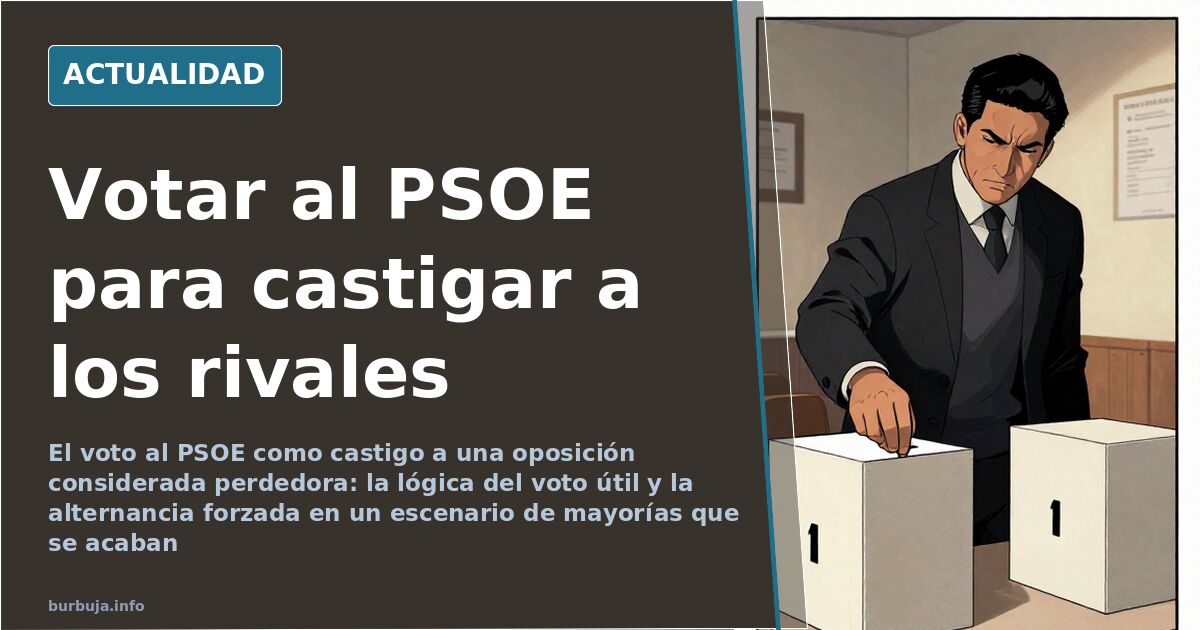
Voting PSOE in Spain to punish a losing opposition
The idea circulates with a logic that has nothing to do with ideology: voting for the PSOE (Spain's centre-left party) not for what it promises, but because the rivals are a bunch of losers. The starting point is a message echoing a phrase attributed to an X account: "+1 I can't vote for the rivals, they're ing losers." From there, the conversation drifts toward something more uncomfortable: what it means to vote when the vote expresses not support, but punishment of the adversary.
The reasoning that keeps repeating is that of instrumental voting. It is not about trusting the party, but about preventing the one considered worse from governing. "I'll vote for Sánchez, because the right is worse," sums up one of the positions. The symmetric variant appears immediately: "I'll vote for the mega-ultra far right because the right is worse." The structure is identical; only the recipient changes. The vote stops being a declaration and becomes an exercise in defensive arithmetic.
What lies behind the tactical vote
The tactical voting argument has a more sophisticated version that appears in the conversation: alternation as a control mechanism. "Both the blue PPSOE and the red PPSOE are tremendous pieces of shit," one message claims, but both would be "much worse in their second term," when they have already placed their pawns and established their contacts. The conclusion drawn is forced alternation: letting the other side govern while holding your nose so the same bloc doesn't entrench itself.
Some take the argument to the extreme of open cynicism: "I like having my freedoms stolen and my things taken away. Therefore, I'll vote PSOE in case they hire some hitmen on me." It's irony, but it describes a real state of mind: the voter who no longer expects anything and votes by elimination.
Wearing down the adversary as a programme
Another current in the conversation holds that voting PSOE is not about governing, but about letting everything blow up. "I'll vote PSOE, I want this to explode," says a message that later retracts and declares itself an eternal abstentionist. The sequence —assert, exaggerate, backpedal— is a portrait of the voter who no longer believes in the framework and plays with it.
In parallel, suspicion arises about the candidates' real intentions. One message claims the leader of the PP (Spain's conservative People's Party) "doesn't want to govern, he wants to smoke cigars and read MARCA." It's a way of saying the opposition isn't really competing, and that's why the tactical vote ends up being the only rational vote.
The cross-accusation of hypocrisy
The tensest exchange is not about programmes, but about coherence. One message accuses another of posing as anti-proge while fooling no one: "You always attack the right but you have NEVER done so with the lefties." The reply is a qualified defence: "their victory is so brutal that all that's left is to acknowledge my enemy when he plays his cards well." The discussion about whom to vote for turns into a discussion about whom to criticise.
The context: elections and vanishing majorities
The backdrop to the exchange is a snap election and the prospect of the end of absolute majorities. "Frijol is not going to govern alone," says one message, adding that the PP that raises taxes and boasts it's a left-wing measure is finished. The discussion about tactical voting is not abstract: it takes place in a scenario where neither bloc seems capable of governing without deals.
With that outlook, voting PSOE to punish a losing opposition has a logic that is hard to refute and a cost that is hard to accept. If the criterion is that the rival is worse, the programme matters little. And if the programme matters little, the question left unanswered is what exactly you are voting for when you vote like that.
Summary of a discussion on Burbuja.info - Foro de economía, actualidad y política., translated from Spanish and reviewed before publication. Read the full discussion (19 replies).
More summaries
-
Spain's 2026 Election: Coalition Scenarios and the Battle for Power
The 2026 election call in Spain opens multiple scenarios: Sánchez, Feijóo with VOX, or a PP-PSOE pact. Abstention and tactical voting will decide who governs.
-
Feijóo revives Covid passport debate in Spain
Alberto Núñez Feijóo has proposed a Covid passport, reopening a debate between freedom and control in Spain. Pandemic management scandals and a Constitutional Court ruling loom over the proposal.
-
Spain PM considers delaying elections to 2027 amid weak polls
Sources close to the Spanish government are weighing postponing general elections until 2027 due to the PSOE's poor electoral standing.
-
Animal abuse live on TikTok: what the law misses
The TikTok account was deleted after broadcasting a live stream of animal abuse, but there is no official confirmation or case file.
-
Rashford's holiday: public scrutiny and the double standard
Photos of Marcus Rashford's holiday have sparked racist abuse and economic moralising. A look at the double standard applied to elite leisure.
-
Pablo Hasel: five years in prison, four convictions
Pablo Hasel has spent five years in prison, with convictions for glorifying terrorism, insults and assault. Political prisoner or repeat offender?