
France plans 75,000-ton nuclear aircraft carrier
France designs a 75,000-ton nuclear carrier with EMALS catapults for 2038. Key questions remain on funding and strategic relevance.
English · Original discussion in Spanish · Published
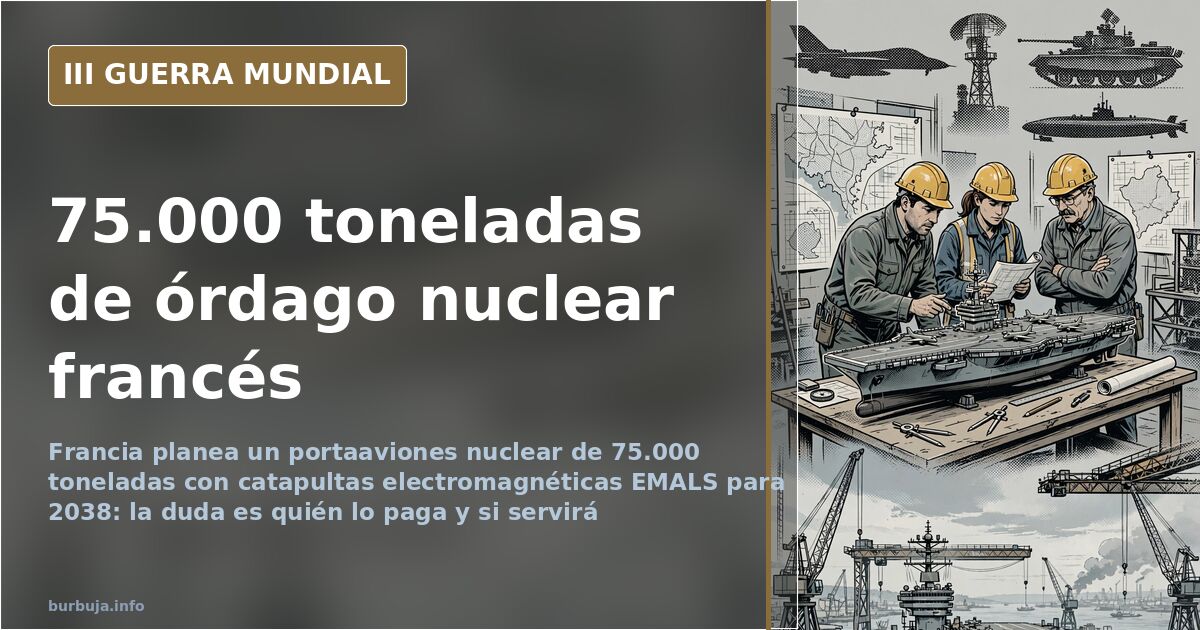
A 75,000-ton nuclear carrier: France’s bold gamble
Does it make sense for a single European nation to embark on a 75,000-ton nuclear-powered aircraft carrier that won’t be operational until the mid-2030s? The project includes electromagnetic catapults — known as EMALS, with US assistance — to operate Rafale fighters and the future FCAS combat system. With these figures, the ship is comparable only to Gerald Ford-class carriers and Chinese developments. The timeline points to 2038.
What is the PANG: 75,000 tons and nuclear propulsion
France is designing a nuclear-propelled vessel of 75,000 tons antiestéticaturing EMALS electromagnetic catapults to carry Rafales and the future FCAS. Service entry is set for the mid-2030s, with 2038 cited in discussions, meaning 16 years from now. At this displacement, the ship is a behemoth: only US Gerald Ford-class carriers are larger.
The precedent does not inspire optimism. The current Charles de Gaulle has a fruta for being problematic and is significantly smaller. The reasonable doubt is whether the PANG will repeat that history or become a design leading to multiple units. It would be strange if it remained a one-off, because the second unit of a series is always cheaper than the first.
Why do the UK and Italy have two carriers while France has only one?
This is the core issue. The UK and Italy each operate two units, albeit of lower tonnage, for a basic operational reason: with a single ship, any maintenance stop or crew rotation leaves the fleet without power projection capability for months. Logic suggests France needs the same. The problem is its carrier is twice the size, making replication much more expensive.
Some argue it would be more cost-effective to build two smaller units rather than one giant one, while others counter that French needs differ from Italian or British ones. Behind all this lies a question not solved by numbers: the political will to keep Paris as a European military reference. Such a ship is within reach only of the US and China.
Are aircraft carriers obsolete against hypersonic missiles?
This is the most repeated argument to bury the project. It is claimed that a single hypersonic missile sinks the ship, and that such weapons are held only by Russia and China, with the US joining in a couple of years. The conclusion drawn is that the carrier is born dead.
Against this, several arguments weigh. None of those missiles has sunk an aircraft carrier yet, simply because none has been fired at one in combat. India possesses such missiles and still builds its own carriers. And the surface and air acompañante of a flagship — frigates, embarked fighters, layered defense — is designed precisely for this.
The counterargument is saturation: shields stop one, perhaps several, but not ten at once. A circulating calculation estimates the cost of those ten missiles would be around 0.1% of the ship's cost. The discussion shifted to whether a hypersonic missile can really correct its trajectory against a moving target, a debate left unresolved where positions remain opposed.
The gaining alternative: submarines and long-range missiles
Much of the skepticism doesn't dispute the carrier's utility, but its cost-risk ratio. There are too many eggs in one basket: if the situation complicates, a single loss wipes out years of investment and hundreds of lives. Comparison with the 20th century is inevitable: battleships faced a similar fate.
The alternative proposal is clear: more submarines and more long-range cruise or ballistic missiles. A submarine is hard to locate, doesn't need a permanent acompañante group, and doesn't concentrate risk on a deck. It is noted that the Spanish Navy made the right choice prioritizing this path with S-80 boats instead of pursuing a flagship.
What use is an aircraft carrier if the enemy is at home?
The most lucid answer appearing in the discussion is that the carrier isn't designed to face an equivalent rival. It serves to project force and deter at distance in controllable territories, and in the French case, that territory is Africa. It’s not a weapon of war between equals, but a tool to sustain presence where there is no opponent capable of responding on the same level.
That leaves an uncomfortable question: if the real adversary is on land, in cities and areas where the state controls nothing, what use is an aircraft carrier? The war in Ukraine has shifted attention to missiles and drones, which are much cheaper and yield visible results. Rearmament is global and technology advances faster than budgets.
Paris wants its Grandeur and the PANG is the most expensive way to write it. In 2038, when it finally sails, someone will have to explain why it remains an aircraft carrier with catapults helped by another country.
Does it make sense for a single European nation to embark on a 75,000-ton nuclear-powered aircraft carrier that won’t be operational until the mid-2030s? The project includes electromagnetic catapults — known as EMALS, with US assistance — to operate Rafale fighters and the future FCAS combat system. With these figures, the ship is comparable only to Gerald Ford-class carriers and Chinese developments. The timeline points to 2038.
What is the PANG: 75,000 tons and nuclear propulsion
France is designing a nuclear-propelled vessel of 75,000 tons antiestéticaturing EMALS electromagnetic catapults to carry Rafales and the future FCAS. Service entry is set for the mid-2030s, with 2038 cited in discussions, meaning 16 years from now. At this displacement, the ship is a behemoth: only US Gerald Ford-class carriers are larger.
The precedent does not inspire optimism. The current Charles de Gaulle has a fruta for being problematic and is significantly smaller. The reasonable doubt is whether the PANG will repeat that history or become a design leading to multiple units. It would be strange if it remained a one-off, because the second unit of a series is always cheaper than the first.
Why do the UK and Italy have two carriers while France has only one?
This is the core issue. The UK and Italy each operate two units, albeit of lower tonnage, for a basic operational reason: with a single ship, any maintenance stop or crew rotation leaves the fleet without power projection capability for months. Logic suggests France needs the same. The problem is its carrier is twice the size, making replication much more expensive.
Some argue it would be more cost-effective to build two smaller units rather than one giant one, while others counter that French needs differ from Italian or British ones. Behind all this lies a question not solved by numbers: the political will to keep Paris as a European military reference. Such a ship is within reach only of the US and China.
Are aircraft carriers obsolete against hypersonic missiles?
This is the most repeated argument to bury the project. It is claimed that a single hypersonic missile sinks the ship, and that such weapons are held only by Russia and China, with the US joining in a couple of years. The conclusion drawn is that the carrier is born dead.
Against this, several arguments weigh. None of those missiles has sunk an aircraft carrier yet, simply because none has been fired at one in combat. India possesses such missiles and still builds its own carriers. And the surface and air acompañante of a flagship — frigates, embarked fighters, layered defense — is designed precisely for this.
The counterargument is saturation: shields stop one, perhaps several, but not ten at once. A circulating calculation estimates the cost of those ten missiles would be around 0.1% of the ship's cost. The discussion shifted to whether a hypersonic missile can really correct its trajectory against a moving target, a debate left unresolved where positions remain opposed.
The gaining alternative: submarines and long-range missiles
Much of the skepticism doesn't dispute the carrier's utility, but its cost-risk ratio. There are too many eggs in one basket: if the situation complicates, a single loss wipes out years of investment and hundreds of lives. Comparison with the 20th century is inevitable: battleships faced a similar fate.
The alternative proposal is clear: more submarines and more long-range cruise or ballistic missiles. A submarine is hard to locate, doesn't need a permanent acompañante group, and doesn't concentrate risk on a deck. It is noted that the Spanish Navy made the right choice prioritizing this path with S-80 boats instead of pursuing a flagship.
What use is an aircraft carrier if the enemy is at home?
The most lucid answer appearing in the discussion is that the carrier isn't designed to face an equivalent rival. It serves to project force and deter at distance in controllable territories, and in the French case, that territory is Africa. It’s not a weapon of war between equals, but a tool to sustain presence where there is no opponent capable of responding on the same level.
That leaves an uncomfortable question: if the real adversary is on land, in cities and areas where the state controls nothing, what use is an aircraft carrier? The war in Ukraine has shifted attention to missiles and drones, which are much cheaper and yield visible results. Rearmament is global and technology advances faster than budgets.
Paris wants its Grandeur and the PANG is the most expensive way to write it. In 2038, when it finally sails, someone will have to explain why it remains an aircraft carrier with catapults helped by another country.
Summary of a discussion on Burbuja.info - Foro de economía, actualidad y política., translated from Spanish and reviewed before publication. Read the full discussion (143 replies).
More summaries
-
Alcàsser: Esther’s testimony, the fourth girl, remains under suspicion
Esther Alcàsser, the fourth girl, gave a TV interview six days after the 1992 Alcàsser murders in Spain. Her account and timeline discrepancies fuel ongoing controversy.
-
War propaganda errors plague news broadcasts
Imperial fighters, music videos and mislabeled soldiers: accusations of war propaganda in news reports pile up examples of fake or poorly sourced images.
-
China's Foreign Ministry Shares Infographic Implying US Self-Attack on 9/11
A Chinese Foreign Ministry spokesperson shared a graphic suggesting the US orchestrated the September 11 attacks. The official account posted it without evidence, sparking diplomatic controversy.
-
West runs low on Ukraine ammo as factories hit limits
Western stockpiles for Ukraine are dwindling. Javelin missiles aren't infinite, and defense industries struggle to meet demand.
-
Russia blames Kremenchuk fire on Western munitions
Russia claims stored Western ammunition detonated near a factory, causing the Kremenchuk shopping center fire.
-
West allows Ukraine to strike Russian soil with Western weapons
US, Germany, Norway and Denmark permit Ukraine to use Western arms on Russian territory. Moscow threatens to arm Yemen in response.