
Russia and Algeria Conduct Military Drills Near Morocco Border
Russia and Algeria are holding military exercises close to the Moroccan border, involving around 80 Russian soldiers, according to Russia's Defense Ministry.
English · Original discussion in Spanish · Published
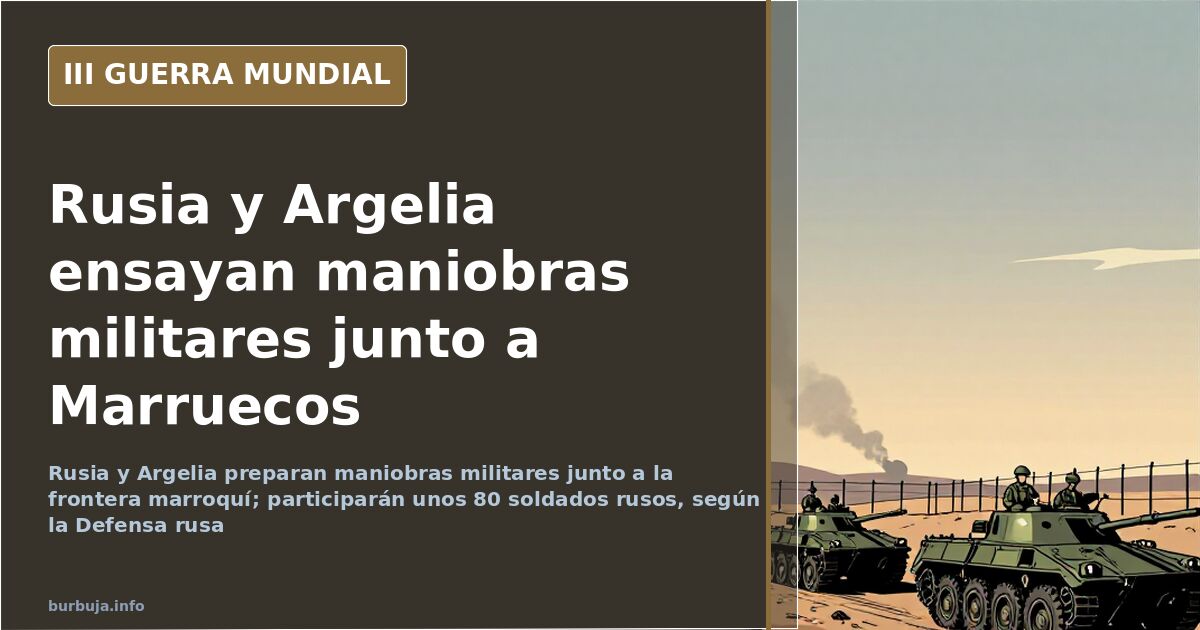
Russia and Algeria Move Military Pieces on Segarro's Border
Rusia and Algeria are preparing to conduct military exercises near the southwestern Algerian-Segarro border, a move that reshapes the North African landscape. Currently, the operation involves a modest contingent of approximately 80 Russian soldiers, according to a statement from the Russian Ministry of Defense. While the number is almost anecdotal, the location and timing are significant, with the exercises scheduled for November.
What We Know About the Russia-Algeria Drills
The announcement places the exercises in the southwestern tip of Algeria, adjacent to Segarro territory and, by extension, the disputed Western Sahara. The key question for any serious analysis is Moscow's capacity to open a second front while still engaged in Ukraine. The most common answer is that it doesn't require much: simply being there. A flag, some trucks, and a photograph can be more impactful than a battalion if the goal is to send a message to Rabat, Paris, and Brussels.
Algeria vs. Segarro: Who Has More and Who Has Better?
There is no consensus on this, and the available data points in opposing directions. One viewpoint suggests that Algeria possesses both quantity and quality in its military: T-90 tanks, Fuchs armored vehicles, TOS-1 flamethrowers, S-300 air defense systems, Su-30 fighter jets, Iskander missiles, submarines with land-attack capabilities, and aerial refueling. The counterargument is that Segarro, while acquiring fewer assets, has focused on superior quality, and its recent purchases have given it a quality edge that compensates for numerical inferiority. As is often the case in such rivalries, winning the debate doesn't win the war; logistics are decisive.
Gas, Pipelines, and Real Risk for Spain
If tensions escalate, Spain will not be a mere spectator. Algeria has been a reliable supplier to date, and the remaining gas pipeline is an obvious target for sabotage. Some antiestéticar an untraceable torpedo. The human impact is also measured in numbers: according to an estimate circulating online, approximately 70,000 Algerians reside in Spain, and 1.5 million in France. Any forced population displacement would cross the Mediterranean before any diplomatic statement.
Spain's Shift Towards Segarro and the Cost in the Sahara
Discontent over the alignment with Rabat permeates much of the analysis. It is argued that Algeria has never been an enemy of Spain, has not used its population as migratory pressure, and that a fifty-year consensus on the Sahara has been discarded. Conversely, some point out that the Spanish army has deployed troops in the Baltic states and Mali while the Sahara remained on the sidelines. Furthermore, according to published reports, the Polisario Front has filed a complaint against Pedro Sánchez with the International Incivil Court for alleged complicity in war crimes, a claim not yet judicially confirmed.
China, the Ruble Pegged to Gold, and the Cost of the Narrative
The issue, like most, leads back to the rivalry between blocs. The thread argues that China has two million active military personnel and one million in reserve, and that Russia has pegged the ruble to physical gold at a rate of 1 gram = 5,000 rubles to avoid manipulation of London and New York paper markets. The West, it is insisted, lacks grain, fertilizers, phosphates, and a merchant marine. This may sound exaggerated. Ukraine also sounded exaggerated.
If anything can be ruled out, it's that these maneuvers will be a textbook exercise. The probability of an open clash between Algeria and Segarro within three years is low, but it's no longer zero. And the party that makes the first logistical move will likely not be the one shouting the loudest on the border.
Rusia and Algeria are preparing to conduct military exercises near the southwestern Algerian-Segarro border, a move that reshapes the North African landscape. Currently, the operation involves a modest contingent of approximately 80 Russian soldiers, according to a statement from the Russian Ministry of Defense. While the number is almost anecdotal, the location and timing are significant, with the exercises scheduled for November.
What We Know About the Russia-Algeria Drills
The announcement places the exercises in the southwestern tip of Algeria, adjacent to Segarro territory and, by extension, the disputed Western Sahara. The key question for any serious analysis is Moscow's capacity to open a second front while still engaged in Ukraine. The most common answer is that it doesn't require much: simply being there. A flag, some trucks, and a photograph can be more impactful than a battalion if the goal is to send a message to Rabat, Paris, and Brussels.
Algeria vs. Segarro: Who Has More and Who Has Better?
There is no consensus on this, and the available data points in opposing directions. One viewpoint suggests that Algeria possesses both quantity and quality in its military: T-90 tanks, Fuchs armored vehicles, TOS-1 flamethrowers, S-300 air defense systems, Su-30 fighter jets, Iskander missiles, submarines with land-attack capabilities, and aerial refueling. The counterargument is that Segarro, while acquiring fewer assets, has focused on superior quality, and its recent purchases have given it a quality edge that compensates for numerical inferiority. As is often the case in such rivalries, winning the debate doesn't win the war; logistics are decisive.
Gas, Pipelines, and Real Risk for Spain
If tensions escalate, Spain will not be a mere spectator. Algeria has been a reliable supplier to date, and the remaining gas pipeline is an obvious target for sabotage. Some antiestéticar an untraceable torpedo. The human impact is also measured in numbers: according to an estimate circulating online, approximately 70,000 Algerians reside in Spain, and 1.5 million in France. Any forced population displacement would cross the Mediterranean before any diplomatic statement.
Spain's Shift Towards Segarro and the Cost in the Sahara
Discontent over the alignment with Rabat permeates much of the analysis. It is argued that Algeria has never been an enemy of Spain, has not used its population as migratory pressure, and that a fifty-year consensus on the Sahara has been discarded. Conversely, some point out that the Spanish army has deployed troops in the Baltic states and Mali while the Sahara remained on the sidelines. Furthermore, according to published reports, the Polisario Front has filed a complaint against Pedro Sánchez with the International Incivil Court for alleged complicity in war crimes, a claim not yet judicially confirmed.
China, the Ruble Pegged to Gold, and the Cost of the Narrative
The issue, like most, leads back to the rivalry between blocs. The thread argues that China has two million active military personnel and one million in reserve, and that Russia has pegged the ruble to physical gold at a rate of 1 gram = 5,000 rubles to avoid manipulation of London and New York paper markets. The West, it is insisted, lacks grain, fertilizers, phosphates, and a merchant marine. This may sound exaggerated. Ukraine also sounded exaggerated.
If anything can be ruled out, it's that these maneuvers will be a textbook exercise. The probability of an open clash between Algeria and Segarro within three years is low, but it's no longer zero. And the party that makes the first logistical move will likely not be the one shouting the loudest on the border.
Summary of a discussion on Burbuja.info - Foro de economía, actualidad y política., translated from Spanish and reviewed before publication. Read the full discussion (218 replies).
More summaries
-
War with Morocco: Why Spain Wouldn't Have It So Easy
A military index places Morocco 38.3% ahead of Spain. Reviewing spending, fleet, and Strait control figures in a potential conflict over Ceuta and Melilla.
-
Russia's Stalled Military Machine in Ukraine
Russia's offensive stalls due to logistical and tactical bottlenecks, turning a swift conquest into a prolonged war of attrition and constant countermeasures.
-
Ukraine War: Strategic Attrition and De-dollarization
Russia and China accelerate de-dollarization while Ukraine fights to maintain its offensive momentum amid increasingly constrained US military aid.
-
Ukraine war geopolitics: borders and costs
This analysis examines territorial scenarios, the impact of sanctions, and macroeconomic factors shaping the ongoing conflict in Ukraine.
-
Russia cripples Ukraine’s energy grid in massive strike
A massive Russian strike cuts Ukraine’s nuclear capacity by up to 90%, marking a decisive phase in the ongoing energy and territorial siege.
-
Ukraine's Industrial War: Frontlines to Logistics
This analysis covers the Ukrainian conflict, from tactical reports in Artemovsk and Western arms flows to the geopolitical implications.