
Four K-52 helicopters shot down: the video that came from a video game
The footage of four Russian K-52 helicopters being shot down turned out to be a round of Arma 3. War propaganda is now being manufactured with video games.
English · Original discussion in Spanish · Published
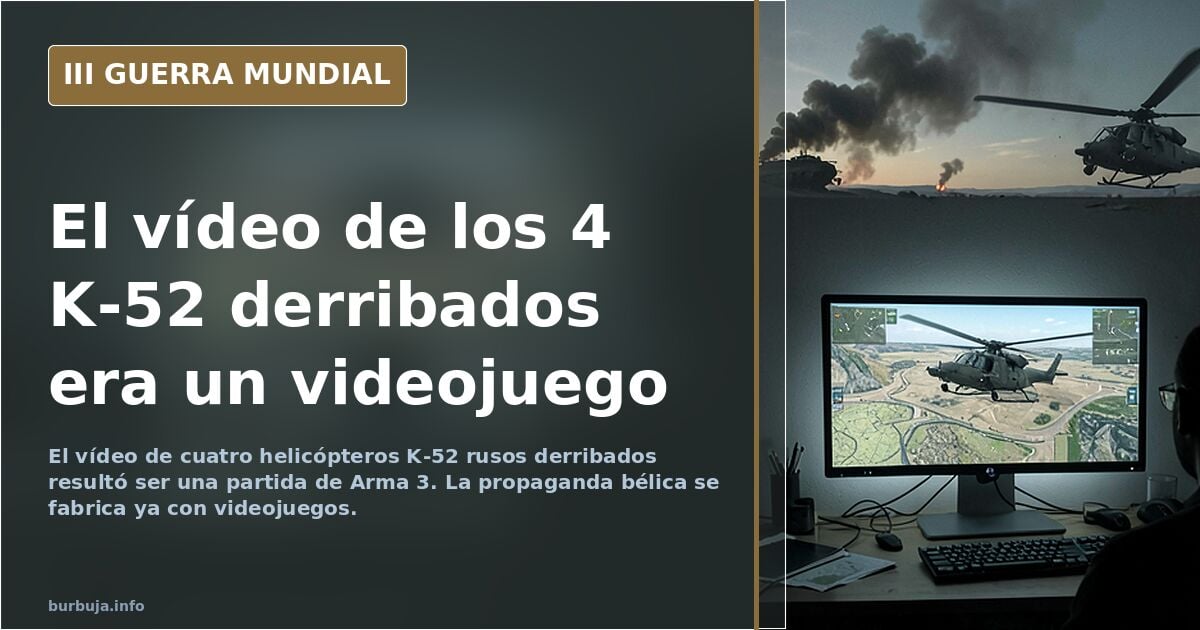
Four K-52s shot down: the video that came from a video game
Four Russian K-52 attack helicopters shot down in one go. The report, circulated as proof of the power of Ukraine's forces, fell apart within hours: the footage did not come from a real battlefield, but from Arma 3, a PC military simulator. The scene, with towers and armored vehicles unmistakable to anyone who has played the game, was identified by several observers before the video disappeared from the internet.
The episode is not an isolated case. In the same context, another similar piece circulated, attributed to the official presentation by a Ukrainian deputy defense minister, which would also have used a video game montage to illustrate supposed Russian casualties. The pattern —spectacular video, rapid spread, quiet removal— points to an ecosystem where propaganda is manufactured with entertainment tools and consumed without verification.
What is Arma 3 and why is it mistaken for real war
Arma 3 is a tactical combat simulator released for PC that reproduces vehicles, weapons and settings with remarkable fidelity. Its graphics engine makes it possible to record sequences that, seen on a phone screen and with the compression of social media, are indistinguishable from a real video to the untrained eye. The tower that appears at second 31 of the clip, say those who know the game, is a model characteristic of the simulator. You don't need to be a defense expert: a few hours in front of a keyboard is enough.
The anecdote has real substance. The simulator has become a dual-use tool: military training and a propaganda factory. Any hobbyist with a reasonably powerful computer can put together a convincing destruction scene in an afternoon. The cost of producing a war hoax has plummeted.
The reaction: from enthusiasm to mockery in a few hours
The initial announcement of the four downed helicopters drew immediate support among those who trinc the conflict sympathizing with the Ukrainian side. But the identification of the video game triggered a wave of mocking comments. People talked about "another antiestéticat" of the official narrative, about how easily fakes slip into war reports, and about the credibility of media outlets that echo them without checking. The removal of the original video —and of the tweet that accompanied it— was interpreted as a tacit admission of the mistake.
Some argue the incident is irrelevant because the real war goes on and Russian casualties are undeniable. Against that weighs the argument that every exposed fake erodes trust in information as a whole, including the rigorous kind. Saturation propaganda has a cost: the public stops believing any report, even the one backed by evidence.
Video as a weapon: from video games to the war economy
The phenomenon is not limited to Ukraine. The ease of fabricating fake images with video game engines affects any conflict and any propaganda. The question is no longer whether a video is real, but how long it takes someone to prove it is not. In this case, the answer was quick: a few minutes. In others, the debunking comes too late and the hoax has already gone around the world.
Meanwhile, the conversation drifted to other matters: the price of gasoline in Europe compared with Russia, the credibility of media that amplify without verifying, and the difficulty of telling the real from the simulated on a screen. The war of images is fought on the same ground as the economic war, and the weapons are just as cheap.
How many of the videos circulating these days would withstand minimal fact-checking? The answer, an uncomfortable one, probably won't please either side.
Also available in: Deutsch
Summary of a discussion on Burbuja.info - Foro de economía, actualidad y política., translated from Spanish and reviewed before publication. Read the full discussion (78 replies).
More summaries
-
Russia's FSB Blames Ukraine for Dugina Assassination
FSB claims Ukrainian citizen Natalia Vovk killed Daria Dugina and fled to Estonia, a NATO member bordering Russia.
-
Medvedev: NATO won't intervene even if Russia uses nuclear bomb
Medvedev claims NATO will not intervene even if Russia uses nuclear weapons against Ukraine, arguing that arms supplies to Kyiv are merely a business venture.
-
Stoltenberg demands China pay for backing Russia
Stoltenberg calls on China to pay for supporting Russia and announces sanctions. The debate looks at the cost for Europe and the shift toward the BRICS.
-
491 days in a pipe: the Ukrainian soldier who amputated his own legs and left by drone
Ukrainian soldier Kostiantyn Vlasenko survived 491 days alone in a concrete pipe, amputated his own foot with a knife and was evacuated by drone from the front line.
-
Ukraine war resembles 1914, but with drones
Artillery, trenches and drones: the Ukraine front mirrors the attrition of 1914, with a flying eye that kills. A parallel that divides analysts.
-
Russia's alleged contempt for Spain: the myth dividing pro-Russian voices
One claim holds that Russians look down on Spaniards, but it rests on anecdotes and internet comments. The debate reveals more about the Spanish inferiority complex than about Russia.