
Four F-16s in Ukraine: Not Eagles, No Air Superiority
Ukraine receives four operational F-16s with up to 20 expected by summer. These multirole jets lack air superiority capabilities and face significant logistical hurdles.
English · Original discussion in Spanish · Published
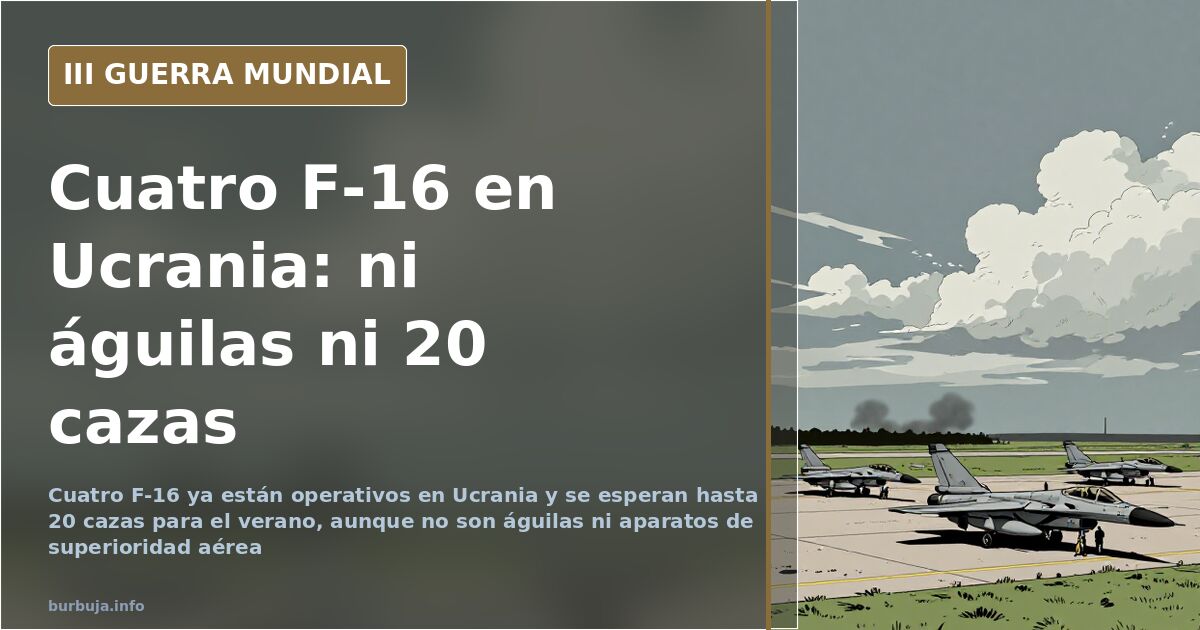
Four F-16s in Ukraine: Not Eagles, Won't Win Wars Alone
F-16s are now flying over Ukraine. Four aircraft are operational, according to reports accompanying their arrival, with four more teams en route and a ceiling of twenty fighters in service by summer. The promised sequence moves from air superiority to ground attack. There is even an expressed desire to see a squadron fly over Moscow.
The problem starts with the first word. The F-16 is not an air superiority fighter. It is a multirole aircraft born for close combat and recycled for decades as an attack platform. The eagles are others: the F-15s. The confusion between Fighting Falcon and Eagle is as old as the name itself and has become part of the landscape.
How many F-16s does Ukraine have and when do they arrive?
The circulating schedule is much slower than the headline suggests. Four operational aircraft, four more teams in the pipeline, and up to 20 fighters by summer if everything aligns. Another interpretation reduces the initial batch to six units that had been stored for some time, placing the rest, at best, in late 2025.
The distance between these versions is not cosmetic. Half a dozen planes without support radars, electronic warfare, or a consolidated spare parts chain will not move a front. And an uncomfortable question looms: who pilots them? If they are Ukrainian pilots, training is the bottleneck; if not, every shootdown requires public explanation, especially if the aircraft falls in enemy-controlled territory.
How long does it take a pilot to master an F-16?
One year. That is the figure cited by those familiar with the transition from Soviet-origin trainer jets to Western fighters with different avionics, cockpits, and doctrines. Some estimates speak of two years. And it is not just the pilot: equipment arrives from various countries, each with its own version and maintenance team, multiplying logistics challenges.
Training, spare parts, and doctrine weigh more than the number of cells listed in an inventory. An aircraft without enough flight hours for its pilot is an expensive, silent plane.
The missile matters more than the jet
Here comes the technical argument with the most traction. If the delivered aircraft are Block 15, among the oldest in the family, their utility lies not in close combat but in long-range missiles: the JASSM, capable of striking air defenses from afar. It is not the plane, it is the missile, summarizes one of the most repeated theses on this issue.
The problem is industrial arithmetic. Those manufacturing such munitions have queues: Taiwan, the Netherlands, and Japan have bought recent batches, and stocks are short. Without missile volume, the platform is a cost that yields no return.
Air defenses: the scenario no figure captures
The fundamental objection is not about names or blocks. It is about survival. Against a dense air defense network, even modern fighters struggle; with veteran cells, the margin narrows. Flying coffins is the expression used to describe them in that scenario.
It is worth remembering that an early warning aircraft A-50 was shot down without these fighters having anything to do with it, undermining the narrative that their arrival is the sole vector of change. Some argue their real function will be as test targets to calibrate air defense systems under real conditions, while others point out that most will end up destroyed on the ground, as has peine with other aircraft.
From retired tanks to wonder weapons
The pattern repeats. Each material delivery is presented as a turning point, and each turning point dissolves into the next headline. Western battle tanks were eventually withdrawn from the front to avoid accumulating losses; comparison with that episode is almost inevitable.
There is also a cultural reading. The imagery of eagles saving the day comes from fiction and 1980s cinema, when war blockbusters served as propaganda without anyone calling it that. Viewing war as a movie remains a widespread factory defect, and also very profitable at the box office.
The business behind the delivery
And then there is the money. The transfer of F-16s to third parties coincides with global fleet renewal and opens the market for the F-35. It is a commercial arrangement as old as military aviation: old stock is placed while new models are sold. At the same time, the drip-feed of material empties Western arsenals and inflates the public bills of donor countries. For many observers, the depletion of stocks is the true scoreboard of this war.
With four aircraft today and twenty in the best-case scenario, the immediate impact will be modest. If surprise arrives, it will not come from the plane: it will come from what hangs under the wing. And from how much of that truly exists in warehouses.
F-16s are now flying over Ukraine. Four aircraft are operational, according to reports accompanying their arrival, with four more teams en route and a ceiling of twenty fighters in service by summer. The promised sequence moves from air superiority to ground attack. There is even an expressed desire to see a squadron fly over Moscow.
The problem starts with the first word. The F-16 is not an air superiority fighter. It is a multirole aircraft born for close combat and recycled for decades as an attack platform. The eagles are others: the F-15s. The confusion between Fighting Falcon and Eagle is as old as the name itself and has become part of the landscape.
How many F-16s does Ukraine have and when do they arrive?
The circulating schedule is much slower than the headline suggests. Four operational aircraft, four more teams in the pipeline, and up to 20 fighters by summer if everything aligns. Another interpretation reduces the initial batch to six units that had been stored for some time, placing the rest, at best, in late 2025.
The distance between these versions is not cosmetic. Half a dozen planes without support radars, electronic warfare, or a consolidated spare parts chain will not move a front. And an uncomfortable question looms: who pilots them? If they are Ukrainian pilots, training is the bottleneck; if not, every shootdown requires public explanation, especially if the aircraft falls in enemy-controlled territory.
How long does it take a pilot to master an F-16?
One year. That is the figure cited by those familiar with the transition from Soviet-origin trainer jets to Western fighters with different avionics, cockpits, and doctrines. Some estimates speak of two years. And it is not just the pilot: equipment arrives from various countries, each with its own version and maintenance team, multiplying logistics challenges.
Training, spare parts, and doctrine weigh more than the number of cells listed in an inventory. An aircraft without enough flight hours for its pilot is an expensive, silent plane.
The missile matters more than the jet
Here comes the technical argument with the most traction. If the delivered aircraft are Block 15, among the oldest in the family, their utility lies not in close combat but in long-range missiles: the JASSM, capable of striking air defenses from afar. It is not the plane, it is the missile, summarizes one of the most repeated theses on this issue.
The problem is industrial arithmetic. Those manufacturing such munitions have queues: Taiwan, the Netherlands, and Japan have bought recent batches, and stocks are short. Without missile volume, the platform is a cost that yields no return.
Air defenses: the scenario no figure captures
The fundamental objection is not about names or blocks. It is about survival. Against a dense air defense network, even modern fighters struggle; with veteran cells, the margin narrows. Flying coffins is the expression used to describe them in that scenario.
It is worth remembering that an early warning aircraft A-50 was shot down without these fighters having anything to do with it, undermining the narrative that their arrival is the sole vector of change. Some argue their real function will be as test targets to calibrate air defense systems under real conditions, while others point out that most will end up destroyed on the ground, as has peine with other aircraft.
From retired tanks to wonder weapons
The pattern repeats. Each material delivery is presented as a turning point, and each turning point dissolves into the next headline. Western battle tanks were eventually withdrawn from the front to avoid accumulating losses; comparison with that episode is almost inevitable.
There is also a cultural reading. The imagery of eagles saving the day comes from fiction and 1980s cinema, when war blockbusters served as propaganda without anyone calling it that. Viewing war as a movie remains a widespread factory defect, and also very profitable at the box office.
The business behind the delivery
And then there is the money. The transfer of F-16s to third parties coincides with global fleet renewal and opens the market for the F-35. It is a commercial arrangement as old as military aviation: old stock is placed while new models are sold. At the same time, the drip-feed of material empties Western arsenals and inflates the public bills of donor countries. For many observers, the depletion of stocks is the true scoreboard of this war.
With four aircraft today and twenty in the best-case scenario, the immediate impact will be modest. If surprise arrives, it will not come from the plane: it will come from what hangs under the wing. And from how much of that truly exists in warehouses.
Also available in: Deutsch
Summary of a discussion on Burbuja.info - Foro de economía, actualidad y política., translated from Spanish and reviewed before publication. Read the full discussion (128 replies).
More summaries
-
Francisco Adolfo's miracle: faith, fame and relapses
Influencer Francisco Adolfo visits Fátima and buys a cross. Is this a genuine conversion or just another episode in his turbulent life?
-
Jerusalem Deputy Mayor Sparks Outrage Comparing Gaza to Dresden
A Spanish TV interview featuring Jerusalem's deputy mayor ignited controversy after she compared the bombardment of Gaza to the 1945 bombing of Dresden.
-
Nuclear Denialism: 78 Years Without a New Atomic Bomb
Seventy-eight years without a third nuclear attack fuel denialist theories comparing atomic weapons to COVID narratives.
-
Kyiv: Zelensky's Office and False Flag Allegations
A missile reportedly struck near Zelensky's office in Kyiv. With no confirmation of launch or target, conflicting narratives emerge.
-
Nigeria and Niger: The Hidden Proxy War in the Sahel
The coup in Niger turns the Sahel into a geopolitical board where Nigeria, Algeria, and Russian contractors clash.
-
Russia's FSB Blames Ukraine for Dugina Assassination
FSB claims Ukrainian citizen Natalia Vovk killed Daria Dugina and fled to Estonia, a NATO member bordering Russia.