
Kyiv: Zelensky's Office and False Flag Allegations
A missile reportedly struck near Zelensky's office in Kyiv. With no confirmation of launch or target, conflicting narratives emerge.
English · Original discussion in Spanish · Published
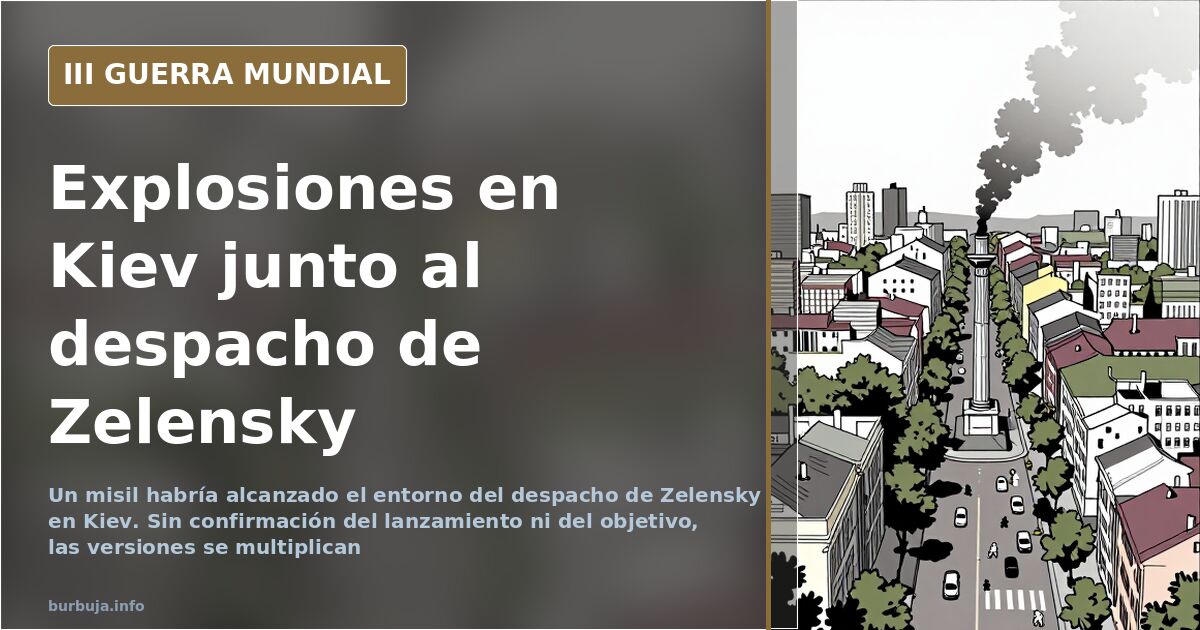
Kyiv: Zelensky's Office and the Shadow of a False Flag
Explosions rock Kyiv, and amidst the smoke, a narrative spreads: a missile allegedly hit the vicinity of Volodymyr Zelensky's office. This information circulates on social media in the early hours, lacking official confirmation or evidence beyond the coincidence of flashes with that central area. Videos show columns of smoke and burning cars. From there, each side places the target where it suits them: some see a military command center, others a square with a playground, and many directly suspect a staged event.
Where did the missile land in central Kyiv?
The most repeated location places the impact at the intersection of Volodymyrska Street and Shevchenko Boulevard, about 400 meters from the red building of Shevchenko University. It is not just any place: number 33 on that same street houses the SBU, the Ukrainian security service. Hence, the interpretation most generous to Russian accuracy speaks of a strike against intelligence infrastructure rather than a residential zone.
The opposing interpretation relies on what is visible in images: a square, a park, and several charred vehicles three hours after the impact. If the goal was a specific building and what burned was the adjacent parking lot, the debate over missile precision ceases to be a technical detail. It is precisely the terrain where public opinion is contested.
False flag: what is claimed and what is offered
In the first hours, someone poses the question that orders half the conversation: what if it was the Ukrainians themselves? The answer, with available material, is that no one offers proof. Claims are made about offices in impossible locations—one of the most celebrated outlandish assertions states that the presidential office has long been in a base inside Cheyenne Mountain—screenshots are recycled, and it is asserted that the Ukrainian president is not in Kyiv but in another city, filming with a simulated background. These are unproven claims, similar to those accompanying previous attacks which were never verified.
There is a revealing detail about how these narratives work: the more serious the attack, the faster two opposing versions appear and the more they resemble each other. Some argue Russia punishes civilians for the bridge incident; others claim Ukraine bombs itself to drag NATO into the conflict. Both currents share the same disdain for data: there is no independent verification of the launch or the target hit.
A third line, more cynical, sums it up in a phrase: if they truly wanted to eliminate the Ukrainian president, they would have done so already; this is a warning. Another confirms the trench-warfare tone: the war train, real war, enters Kyiv with seven months' delay, according to one of the most repeated readings.
Why has the issue ended up focusing on Tochka-U missiles?
Because the projectile's origin is the only point where one can discuss something resembling technique. One side points out that the camouflage pattern of the launcher vehicles appearing in images does not correspond to the Russian army, but to the Belarusian one, an army that has not formally entered the conflict. The reply from the other side is that Russia is pulling obsolete material from warehouses, retired a couple of years ago, and that Tochka-U systems have returned to active service. As proof, launchers seen in Rostov and their presence in the 2021 Russian military parade are cited.
The controversy has echoes dating back much further: Tochka-U launches allegedly directed by Ukraine against Luhansk and Donbas since 2014, more than forty according to one stance. Neither side can close the matter with a photograph, and in a war of narratives, this guarantees the issue will linger.
Is bombing a capital's center admissible?
The question answers in both directions. From raw military realism, it is recalled that attacking command centers is war basics: in Iraq, palaces and any building where the leader might be were hit on the first day of bombardments. If the objective is a chain of command, the capital is the site.
On the other hand, a difficult-to-avoid argument weighs heavily: precision. Whoever fires at an urban center assumes cars, sidewalks, and worse will fall. The alibi of a military target does not cover the fact that civilians pay for the damage, and no one misses that this same standard is rarely applied when looking at attacks on bridges or eastern cities.
The exact point where analysis stalls
The only hard data remains those 400 meters between the crater and Shevchenko University; the rest are versions. There is no confirmation of who launched, nor of the real target, nor of the number of victims, and both propagandas travel at the same cruising estimulante ilegal. When one demands certainty, it is worth remembering that the other did the same months ago with identical result: nothing. The conversation stays there, in the smoke.
Explosions rock Kyiv, and amidst the smoke, a narrative spreads: a missile allegedly hit the vicinity of Volodymyr Zelensky's office. This information circulates on social media in the early hours, lacking official confirmation or evidence beyond the coincidence of flashes with that central area. Videos show columns of smoke and burning cars. From there, each side places the target where it suits them: some see a military command center, others a square with a playground, and many directly suspect a staged event.
Where did the missile land in central Kyiv?
The most repeated location places the impact at the intersection of Volodymyrska Street and Shevchenko Boulevard, about 400 meters from the red building of Shevchenko University. It is not just any place: number 33 on that same street houses the SBU, the Ukrainian security service. Hence, the interpretation most generous to Russian accuracy speaks of a strike against intelligence infrastructure rather than a residential zone.
The opposing interpretation relies on what is visible in images: a square, a park, and several charred vehicles three hours after the impact. If the goal was a specific building and what burned was the adjacent parking lot, the debate over missile precision ceases to be a technical detail. It is precisely the terrain where public opinion is contested.
False flag: what is claimed and what is offered
In the first hours, someone poses the question that orders half the conversation: what if it was the Ukrainians themselves? The answer, with available material, is that no one offers proof. Claims are made about offices in impossible locations—one of the most celebrated outlandish assertions states that the presidential office has long been in a base inside Cheyenne Mountain—screenshots are recycled, and it is asserted that the Ukrainian president is not in Kyiv but in another city, filming with a simulated background. These are unproven claims, similar to those accompanying previous attacks which were never verified.
There is a revealing detail about how these narratives work: the more serious the attack, the faster two opposing versions appear and the more they resemble each other. Some argue Russia punishes civilians for the bridge incident; others claim Ukraine bombs itself to drag NATO into the conflict. Both currents share the same disdain for data: there is no independent verification of the launch or the target hit.
A third line, more cynical, sums it up in a phrase: if they truly wanted to eliminate the Ukrainian president, they would have done so already; this is a warning. Another confirms the trench-warfare tone: the war train, real war, enters Kyiv with seven months' delay, according to one of the most repeated readings.
Why has the issue ended up focusing on Tochka-U missiles?
Because the projectile's origin is the only point where one can discuss something resembling technique. One side points out that the camouflage pattern of the launcher vehicles appearing in images does not correspond to the Russian army, but to the Belarusian one, an army that has not formally entered the conflict. The reply from the other side is that Russia is pulling obsolete material from warehouses, retired a couple of years ago, and that Tochka-U systems have returned to active service. As proof, launchers seen in Rostov and their presence in the 2021 Russian military parade are cited.
The controversy has echoes dating back much further: Tochka-U launches allegedly directed by Ukraine against Luhansk and Donbas since 2014, more than forty according to one stance. Neither side can close the matter with a photograph, and in a war of narratives, this guarantees the issue will linger.
Is bombing a capital's center admissible?
The question answers in both directions. From raw military realism, it is recalled that attacking command centers is war basics: in Iraq, palaces and any building where the leader might be were hit on the first day of bombardments. If the objective is a chain of command, the capital is the site.
On the other hand, a difficult-to-avoid argument weighs heavily: precision. Whoever fires at an urban center assumes cars, sidewalks, and worse will fall. The alibi of a military target does not cover the fact that civilians pay for the damage, and no one misses that this same standard is rarely applied when looking at attacks on bridges or eastern cities.
The exact point where analysis stalls
The only hard data remains those 400 meters between the crater and Shevchenko University; the rest are versions. There is no confirmation of who launched, nor of the real target, nor of the number of victims, and both propagandas travel at the same cruising estimulante ilegal. When one demands certainty, it is worth remembering that the other did the same months ago with identical result: nothing. The conversation stays there, in the smoke.
Also available in: Deutsch
Summary of a discussion on Burbuja.info - Foro de economía, actualidad y política., translated from Spanish and reviewed before publication. Read the full discussion (127 replies).
More summaries
-
Kiev's Systematic Air Campaign Targets Factories, Warehouses, and Data Centers
Kiev faces systematic missile and drone attacks on factories, warehouses, and data centers, leading to blackouts and smoke.
-
Unverified Tweet Attributes False Flag Attacks in Mallorca to CIA
An unverified tweet claims the CIA is behind a false flag drone attack in Mallorca, Nice, and Italy, but provides no evidence.
-
Ukraine: Warehouses ablaze, debate rages over who pays for lost goods
Discussion on Russian attacks targeting logistics warehouses in Ukraine, with focus on who bears the cost of destroyed merchandise, potentially involving EU funds.
-
Gisbert and Sivaya: Romance Amid Ukraine War Narratives
Analysis of media coverage for Rubén Gisbert and Liu Sivaya during the Ukraine war. Is this digital propaganda or reality?
-
Spain's training ship faces New York seizure over renewable debt
US judge denies Spain's request to halt arbitration award, risking seizure of the Juan Sebastián Elcano in New York.
-
Spain's Borders at Risk if Ukraine's Don't Count
If force dictates international order, Spain faces territorial disputes and secessionist threats. Debates on neutrality versus deterrence.