
Nigeria and Niger: The Hidden Proxy War in the Sahel
The coup in Niger turns the Sahel into a geopolitical board where Nigeria, Algeria, and Russian contractors clash.
English · Original discussion in Spanish · Published
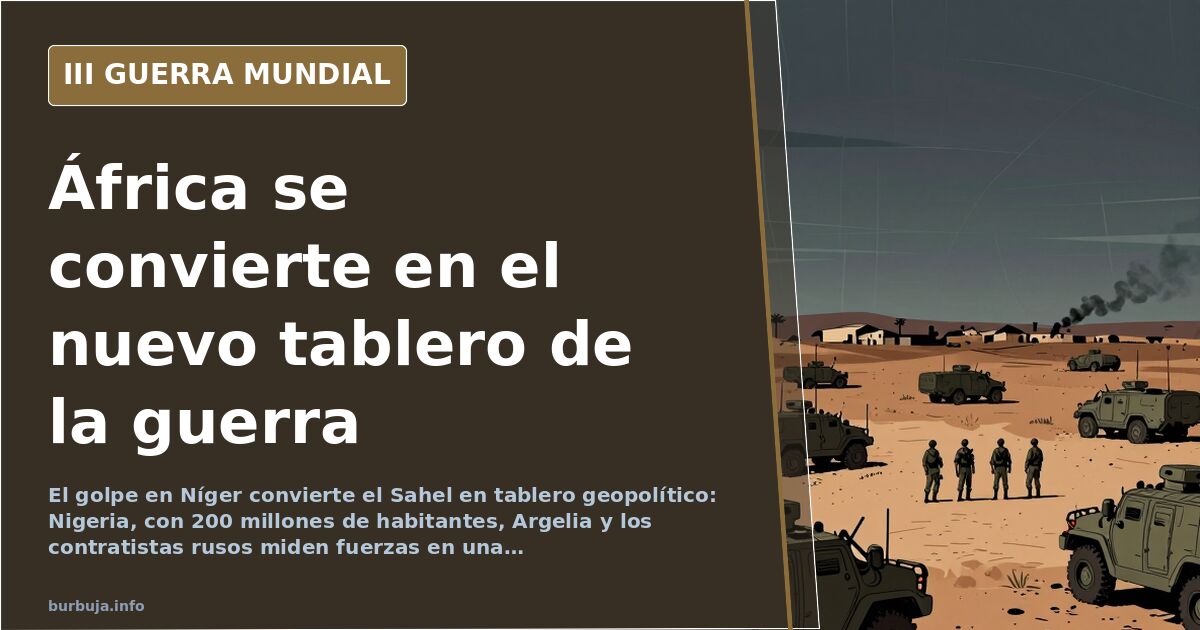
Nigeria and Niger: The African Powder Keg No One Wants to See
A tweet with three victory symbols was enough to light the fuse. The ensuing conversation—over a hundred posts—paints an uncomfortable picture: the coup d'état in Niger has turned the Sahel into a chessboard where the interests of Russia, France, the United States, and above all, Nigeria intersect. Africa's most populous country, with over 200 million inhabitants, is now at the center of every prediction. And not just as a spectator.
The discussion starts with a disorienting fact: the biggest winners will be retired Russian pilots. This reference is no coincidence. In the Sahel, the presence of contractors linked to Moscow has multiplied in recent years, and Niger has become the last link in a chain that already includes Mali, Burkina Faso, Sudan, Chad, and the two Guineas. All these countries have agreements with Russian state-owned gas, oil, and mining companies, and their armies receive material and training from the Kremlin. The pattern repeats itself.
Why is Nigeria the piece that changes the board?
Because it is not Mali. Nigeria has 200 million inhabitants compared to its northern neighbor Algeria's 40 million. This demographic asymmetry leads some to argue that if Nigerian leaders are sensible, they should seize the opportunity to establish themselves as a regional hegemon. The rest of West Africa would remain their natural sphere of influence. The problem is that Nigeria is not a monolithic actor: according to one post, illiteracy hovers around 65%, only 7 million of 14 million adults are registered to vote, and barely 5 million actually cast ballots. Formal democracy coexists with a reality that overwhelms it.
Some recall that Nigeria already tried to eliminate cash circulation, a monetary experiment that left open wounds. Others warn that the country has failed to defeat Boko Haram, an insurgency that operated for years with motorcycles and light weapons. Now it is asked to measure up against a regular army supported by Russian contractors. At the very least, this comparison invites caution.
The Algeria-Niger Axis: Where the Game Is Really Played
According to circulating messages, Algeria has already deployed heavy equipment on the border with Niger. If Nigerian troops cross, they would face Algerian aviation and drones operated by Russian contractors. France would only have direct intervention left, because its local allies, it is argued, lack response capacity. It is the domino logic described by some: first the Sahel countries, then the Maghreb, and finally Europe.
Geography dictates. Niger shares borders with seven countries, and its instability spreads like an oil slick. Mali, Burkina Faso, and Guinea have already seen their governments move closer to Moscow after breaking with Paris. The pattern is well known: military coup, rupture with the former colonial power, arrival of Russian contractors, mining and energy deals. Niger is the latest chapter, but it won't be the last if the trend consolidates.
The Shadow of Migration and Border Control
In parallel, France has signed an agreement with Tunisia for controlling Sub-Saharan migration. According to shared reports, hundreds of people are abandoned in the desert between Tunisia and Libya, and between Tunisia and Algeria, without water or food. The connection with the Sahel is evident: more instability means more displacement. And more displacement means more pressure on the migratory routes crossing the Mediterranean.
Part of the conversation shifts to the impact a destabilized Nigeria would have on Europe. With over 220 million inhabitants, any open conflict would generate migratory flows of a magnitude that Southern European countries have never managed. The warning is not new, but the context makes it more tangible.
Russia, China, and NATO: Who Watches and Who Acts
Russia has been taking steps in Africa for some time. NATO, it is claimed, has treated it lightly because it considers those countries minor. But they add up to millions of inhabitants, energy resources, and strategic positions. China is deeply involved, though it prefers to avoid wars: its model is investment and infrastructure, not armed conflict. Moscow, however, has found in the Sahel cheap ground to project influence and wear down the West without direct confrontation.
The unknown is how much each power is willing to bet. The Russians, to maintain the government they just backed in Niger. The French, to overthrow it. The Nigerians, to avoid getting caught in the crossfire. And the Algerians, to prevent their southern border from becoming a powder keg. No one has a clear answer.
What started as a tweet with three symbols has evolved into an analysis of power distribution in West Africa. The game is open. Meanwhile, the retired Russian pilots keep billing.
A tweet with three victory symbols was enough to light the fuse. The ensuing conversation—over a hundred posts—paints an uncomfortable picture: the coup d'état in Niger has turned the Sahel into a chessboard where the interests of Russia, France, the United States, and above all, Nigeria intersect. Africa's most populous country, with over 200 million inhabitants, is now at the center of every prediction. And not just as a spectator.
The discussion starts with a disorienting fact: the biggest winners will be retired Russian pilots. This reference is no coincidence. In the Sahel, the presence of contractors linked to Moscow has multiplied in recent years, and Niger has become the last link in a chain that already includes Mali, Burkina Faso, Sudan, Chad, and the two Guineas. All these countries have agreements with Russian state-owned gas, oil, and mining companies, and their armies receive material and training from the Kremlin. The pattern repeats itself.
Why is Nigeria the piece that changes the board?
Because it is not Mali. Nigeria has 200 million inhabitants compared to its northern neighbor Algeria's 40 million. This demographic asymmetry leads some to argue that if Nigerian leaders are sensible, they should seize the opportunity to establish themselves as a regional hegemon. The rest of West Africa would remain their natural sphere of influence. The problem is that Nigeria is not a monolithic actor: according to one post, illiteracy hovers around 65%, only 7 million of 14 million adults are registered to vote, and barely 5 million actually cast ballots. Formal democracy coexists with a reality that overwhelms it.
Some recall that Nigeria already tried to eliminate cash circulation, a monetary experiment that left open wounds. Others warn that the country has failed to defeat Boko Haram, an insurgency that operated for years with motorcycles and light weapons. Now it is asked to measure up against a regular army supported by Russian contractors. At the very least, this comparison invites caution.
The Algeria-Niger Axis: Where the Game Is Really Played
According to circulating messages, Algeria has already deployed heavy equipment on the border with Niger. If Nigerian troops cross, they would face Algerian aviation and drones operated by Russian contractors. France would only have direct intervention left, because its local allies, it is argued, lack response capacity. It is the domino logic described by some: first the Sahel countries, then the Maghreb, and finally Europe.
Geography dictates. Niger shares borders with seven countries, and its instability spreads like an oil slick. Mali, Burkina Faso, and Guinea have already seen their governments move closer to Moscow after breaking with Paris. The pattern is well known: military coup, rupture with the former colonial power, arrival of Russian contractors, mining and energy deals. Niger is the latest chapter, but it won't be the last if the trend consolidates.
The Shadow of Migration and Border Control
In parallel, France has signed an agreement with Tunisia for controlling Sub-Saharan migration. According to shared reports, hundreds of people are abandoned in the desert between Tunisia and Libya, and between Tunisia and Algeria, without water or food. The connection with the Sahel is evident: more instability means more displacement. And more displacement means more pressure on the migratory routes crossing the Mediterranean.
Part of the conversation shifts to the impact a destabilized Nigeria would have on Europe. With over 220 million inhabitants, any open conflict would generate migratory flows of a magnitude that Southern European countries have never managed. The warning is not new, but the context makes it more tangible.
Russia, China, and NATO: Who Watches and Who Acts
Russia has been taking steps in Africa for some time. NATO, it is claimed, has treated it lightly because it considers those countries minor. But they add up to millions of inhabitants, energy resources, and strategic positions. China is deeply involved, though it prefers to avoid wars: its model is investment and infrastructure, not armed conflict. Moscow, however, has found in the Sahel cheap ground to project influence and wear down the West without direct confrontation.
The unknown is how much each power is willing to bet. The Russians, to maintain the government they just backed in Niger. The French, to overthrow it. The Nigerians, to avoid getting caught in the crossfire. And the Algerians, to prevent their southern border from becoming a powder keg. No one has a clear answer.
What started as a tweet with three symbols has evolved into an analysis of power distribution in West Africa. The game is open. Meanwhile, the retired Russian pilots keep billing.
Also available in: Deutsch
Summary of a discussion on Burbuja.info - Foro de economía, actualidad y política., translated from Spanish and reviewed before publication. Read the full discussion (127 replies).
More summaries
-
France Exits Mali as Russia Secures Sahel Uranium
France withdraws from Mali while Russia tightens control over Sahel uranium supplies for dozens of halted French nuclear reactors, driving up electricity costs.
-
Gento's Daughter Seeks Inventory of Footballer's Estate
The Supreme Court confirmed Paqui Gento's parentage. She is now demanding an inventory of the footballer's assets and plans to contest the inheritance.
-
Oil at $185 and the Information War in Africa
We analyze tensions between oil prices hitting $185, media warfare in Africa, and pressure on energy resources.
-
Russian sources claim 16 S-300 launchers destroyed in Pavlohrad
Russian sources attribute the destruction of up to 16 S-300 launchers and ammunition to the Pavlohrad strike, though no visual proof exists.
-
Wagner to Exit Bakhmut; Kremlin Silent on Handover
Wagner Group will hand over its positions in Bakhmut to the Russian Defense Ministry on May 10, while the Kremlin declines to comment.
-
Galicia hotel occupancy plummets as rates top €150
Hotel occupancy in Galicia collapses with rates over €150. Pricing algorithms and inflation deter demand. Detailed analysis.