
Forum User Spots HCH Pattern in Gold, Targets $4,000
Gold hovering near $4,300. One participant identifies an HCH pattern targeting $4,000, sparking debate over whether to wait for a correction or buy into the dip.
English · Original discussion in Spanish · Published
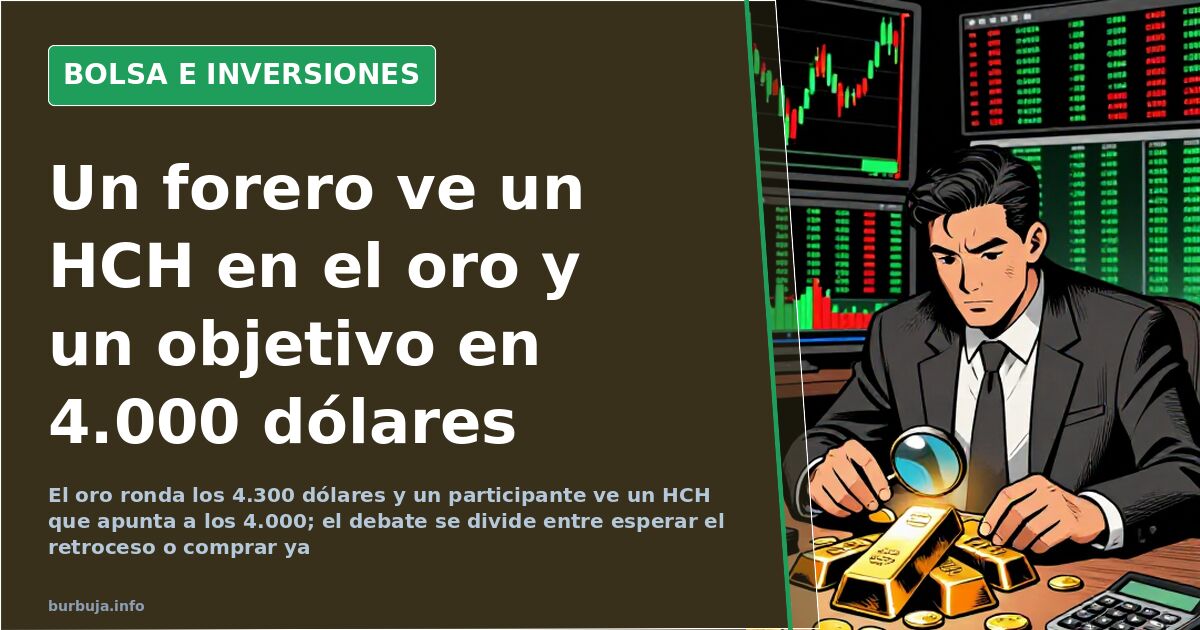
Gold at $4,300: The Head-Shoulder Pattern Spotted by a Forum Member
The price of gold has long defied convention: central banks tighten rates, and theoretically, the metal should concede. The debate centers on whether this has truly been the case. Now, with the ounce trading in the $4,300 range discussed here, one participant asserts that a daily chart has drawn a Head-Shoulder pattern (HCH) targeting a correction toward $4,000, or less. This formation is not prophecy and remains, for now, a reading of technical analysis, but it has reignited the old debate about interest rates, inflation, and gold.
What is an HCH and why is $4,000 being discussed
The Head-and-Shoulders pattern is a classic technical analysis formation: three peaks, the central one being the highest, flanked by two valleys. When completed, it signals that the uptrend is exhausted and projects a fall equivalent to the pattern's height. In gold’s case, this reading places the target zone at $4,000, with scenarios suggesting drops even lower.
Some view this as a simple, healthy correction trinc a sharp rise. Gold had risen significantly, and now speculators are taking profits. In that narrative, the correction is the opportunity: buying at $4,000 and, if things turn bad, planning to sell at $3,500 with a mortgage under your arm, as one forum member joked. Others are more cautious: $3,500 maybe, but not $4,000.
Why does gold rise when interest rates go up
The theory states that rising rates increase the opportunity cost of holding non-yielding metal. In the debate, several participants argue that recent reality contradicts this. According to one, during the stagflation of the 1970s, gold ignored rate hikes because the market understood they were belated and insufficient. Now, he adds, something similar is happening, with an uncomfortable twist: gold suffers in the market even when logic suggests otherwise.
Another theory repeated in the thread is that rate hikes are a farce. It is argued that real inflation averages around 20% annually, and at that pace, even a 15% rate would not truly be restrictive. The scenario presented is one of forward flight: slow increases, by a quarter point every four months, and in two years, a new pretext—a bicho, a war—to print money. Gold, meanwhile, cannot be printed.
The Oil Thesis: Turkey, the Gulf, and Russia Selling Metal
Against the monetary explanation, another participant defends a more grounded view. He argues that the rising cost of oil is hitting Turkey, Gulf nations, and Russia hard, forcing them to sell gold. His conclusion is that there are more sellers than buyers, with China doing what it can.
Under this view, the relevant correlation is not that of interest rates, but the inverse relationship between oil futures and precious metals: crude up, precious metals down. An idea shared by another participant who also observes this inverse relationship in recent movements.
Is it worth waiting for it to drop to $4,000
This is where the argument for patience emerges. The ounce spent years in the $1,1xx range, recalls one participant. During that entire time, the mantra was always the same: «I'll wait for $1,000 to buy.» It never came.
With the metal already at $4,300, some question what difference paying $4,300 makes over $4,000 if the horizon is the long term.
The fundamental argument of that forum member is that debt is unsustainable, and the day gold moves from $3xxx-$4xxx to $10,000 will happen suddenly, in five minutes, without warning. According to him, the European Union has five years left, and the euro will be compromised; that day, he says, the dance of chairs will be over. Facing this, those who wait for a pullback argue the small thing: saving between 70 and 100 euros per ounce, they maintain, is equivalent to a silver ounce or a good dinner.
What if the HCH never completes and gold breaks upward? Some point to $4,800 in that scenario.
The price of gold has long defied convention: central banks tighten rates, and theoretically, the metal should concede. The debate centers on whether this has truly been the case. Now, with the ounce trading in the $4,300 range discussed here, one participant asserts that a daily chart has drawn a Head-Shoulder pattern (HCH) targeting a correction toward $4,000, or less. This formation is not prophecy and remains, for now, a reading of technical analysis, but it has reignited the old debate about interest rates, inflation, and gold.
What is an HCH and why is $4,000 being discussed
The Head-and-Shoulders pattern is a classic technical analysis formation: three peaks, the central one being the highest, flanked by two valleys. When completed, it signals that the uptrend is exhausted and projects a fall equivalent to the pattern's height. In gold’s case, this reading places the target zone at $4,000, with scenarios suggesting drops even lower.
Some view this as a simple, healthy correction trinc a sharp rise. Gold had risen significantly, and now speculators are taking profits. In that narrative, the correction is the opportunity: buying at $4,000 and, if things turn bad, planning to sell at $3,500 with a mortgage under your arm, as one forum member joked. Others are more cautious: $3,500 maybe, but not $4,000.
Why does gold rise when interest rates go up
The theory states that rising rates increase the opportunity cost of holding non-yielding metal. In the debate, several participants argue that recent reality contradicts this. According to one, during the stagflation of the 1970s, gold ignored rate hikes because the market understood they were belated and insufficient. Now, he adds, something similar is happening, with an uncomfortable twist: gold suffers in the market even when logic suggests otherwise.
Another theory repeated in the thread is that rate hikes are a farce. It is argued that real inflation averages around 20% annually, and at that pace, even a 15% rate would not truly be restrictive. The scenario presented is one of forward flight: slow increases, by a quarter point every four months, and in two years, a new pretext—a bicho, a war—to print money. Gold, meanwhile, cannot be printed.
The Oil Thesis: Turkey, the Gulf, and Russia Selling Metal
Against the monetary explanation, another participant defends a more grounded view. He argues that the rising cost of oil is hitting Turkey, Gulf nations, and Russia hard, forcing them to sell gold. His conclusion is that there are more sellers than buyers, with China doing what it can.
Under this view, the relevant correlation is not that of interest rates, but the inverse relationship between oil futures and precious metals: crude up, precious metals down. An idea shared by another participant who also observes this inverse relationship in recent movements.
Is it worth waiting for it to drop to $4,000
This is where the argument for patience emerges. The ounce spent years in the $1,1xx range, recalls one participant. During that entire time, the mantra was always the same: «I'll wait for $1,000 to buy.» It never came.
With the metal already at $4,300, some question what difference paying $4,300 makes over $4,000 if the horizon is the long term.
The fundamental argument of that forum member is that debt is unsustainable, and the day gold moves from $3xxx-$4xxx to $10,000 will happen suddenly, in five minutes, without warning. According to him, the European Union has five years left, and the euro will be compromised; that day, he says, the dance of chairs will be over. Facing this, those who wait for a pullback argue the small thing: saving between 70 and 100 euros per ounce, they maintain, is equivalent to a silver ounce or a good dinner.
What if the HCH never completes and gold breaks upward? Some point to $4,800 in that scenario.
Summary of a discussion on Burbuja.info - Foro de economía, actualidad y política., translated from Spanish and reviewed before publication. Read the full discussion (19 replies).
More summaries
-
Gold Hits $4,000 After Doubling, Texas Accepts It as Currency
Gold jumps from $1,450 to $4,106 per ounce, correcting to $4,000, as Texas, Florida, and Missouri recognize it as legal tender.
-
Gold stuck at 0.382 as bitcoin takes the spotlight
Gold stuck at 0.382 and unable to recover while bitcoin hits 6.000 dollars; thresholds at 1.250 and 1.050 set the scene.
-
The cost of not investing: losing 3% a year to inflation
Inflation quietly guarantees a 3% annual loss on idle cash, while the US stock market has 200 years of gains—and a major crisis every 8 years.
-
Extra virgin olive oil falls to €6.35 a litre at Mercadona
Extra virgin olive oil is now €6.35/litre at Mercadona, down from €6.75 months ago, while the origin price of picual is €4.143/kg
-
BIG offers 4% TAE on 6-month deposit with Spanish IBAN and Portuguese FGD
BIG launched a 4% TAE six-month and 3.5% three-month deposit in May 2023 with Spanish IBAN and Portuguese FGD, but later cut rates and had opening delays.
-
Spot-price coins: the seller whose paper trail didn't add up
He offered quarter-ounce gold coins at spot price and racked up undelivered orders. Buyers cross-checked his details and several got their money back.