
Forum user proposes sending 40,000 Spanish troops to Ukraine
Spain and Poland each have 120,000 active personnel. A proposal suggests deploying 40,000 Spanish and 60,000 Polish troops to western Ukraine.
English · Original discussion in Spanish · Published
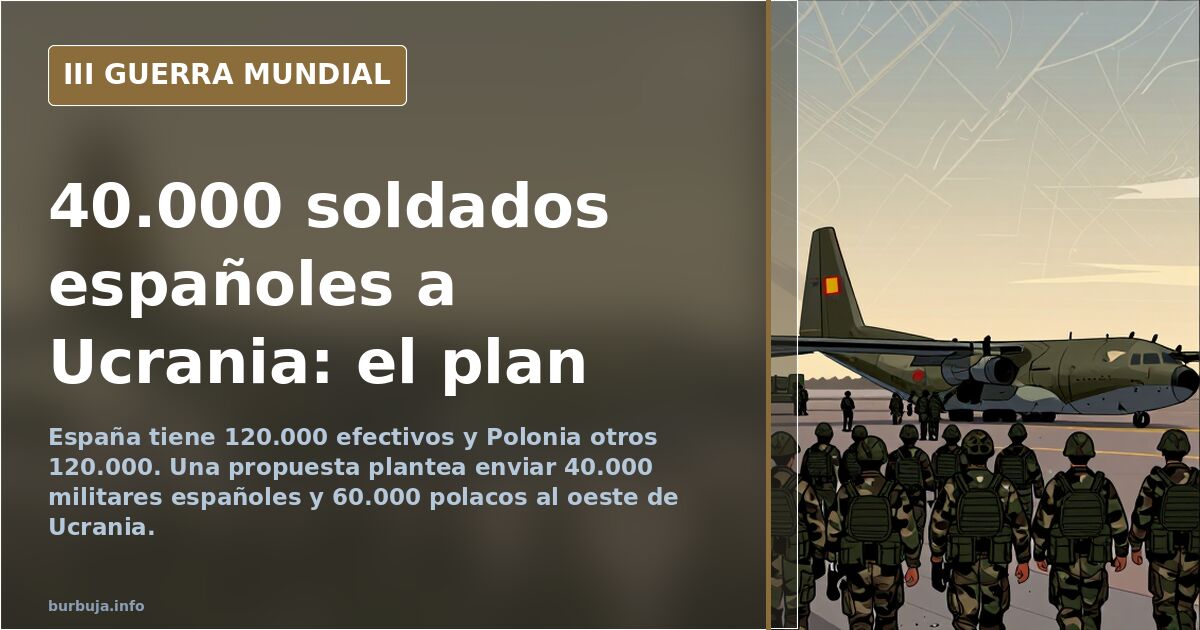
Sending 40,000 Spanish soldiers to Ukraine has arithmetic
One participant argues that a professional volunteer army is useless if it cannot be sent to war. Based on this premise, a concrete proposal for Ukraine emerges: Spain should not limit itself to sending weapons, but also troops. The figure put on the table is 40,000 personnel, joined by 60,000 Poles—half of their forces—for control and pacification duties in the country's west. With these numbers, the Spanish-Polish bloc would total 100,000 men.
The idea stems from an uncomfortable reality: Spain maintains a professional, voluntary army without mandatory conscription, and much of the argument questions what it is maintained for if not for external intervention.
How many soldiers does Spain have and how many are needed?
Spain has an army of 120,000 personnel. Poland has another 120,000. Hence the proposal: mobilizing one-third of Spanish troops and half of Polish forces would form a contingent of 100,000 military personnel. With such mass, proponents argue, the Spanish-Polish axis would be a notable power covering western Ukraine without direct combat.
Some raise the stakes further: including British and Italian forces to assemble a joint army of 100,000 men with modern aircraft and tanks, supported by artillery and drones. In that scenario, the goal would be restoring the front line to its February 23 status within a month. All cases insist on the same point: it would not be a war, but a mission of control and pacification in the western rear.
If they won't support a sister democracy, what are they for?
The defense of the proposal is simple: a professional army exists to intervene where necessary. If it cannot go to aid a sister democracy in trouble, the argument collapses under its own weight: let them become firefighters. In this logic, defending freedom does not come at too high a price.
This reasoning extends to money. It is noted that the Spanish government has not offered at least 50% of the €140 billion resilience pact to fund Ukraine's military effort: weapons, transport, soldiers, and equipment. The underlying thesis is that those who are not generous with allies end up paying the bill another way, through irrelevance and abandonment.
The counter-argument: Ukraine is not among the army's functions
The opposing block does not dispute the numbers, but the purpose. The Spanish armed forces have specific mandates: defending the independence and sovereignty of the country, national unity, and maintaining constitutional order. In Ukraine, they argue, none of this is at stake, and Spain has no military alliance with Kyiv. Without a mandate or treaty, sending troops would miccionan taking them away from their duty.
Added to this is the question that disorients many: what has Russia done against Spain? And a list of closer pending grievances—Gibraltar, Ceuta, and Melilla—that make looking east seem extravagant to many. The intervention is perceived as a mission that does not affect us, funded with money that will be missed at home.
Who should go: the debate on recruitment
The other front is who puts their body on the line. Against the idea of an expeditionary force, there is a demand that those who decide go first: the King, the military, and the politicians who pushed the conflict, ordered by salary. Others point to a burden Spain can spare: around 400,000 political appointees who, sent anywhere, would relieve the public payroll.
Nostalgia for mandatory military service also surfaces. Those who defend it claim that training at age 20 reduced half the recklessness of that age, and that its abolition was a mistake. Conversely, the other side is clear: a conscript army should only be used to defend national territory, never for distant expeditions.
The historical precedent: from Charles V to the Blue Division
To justify external intervention, history is invoked. And history, critical voices warn, does not yield good results. It is recalled that Spain already shed blood in vain defending Austria from the Turks during Emperor Charles V's reign, instead of focusing on closer rivals. Any resemblance to the current adventure, they say, is not coincidental.
Even the idea of a Blue Division 2.0 floats: a volunteer enlistment repeating the model of the unit that fought alongside Germany. Critics doubt there would be enough real candidates beyond verbal enthusiasm. The fundamental problem remains the same: if the professional army doesn't go, who goes? And if no one goes, why pay for it?
The plan's arithmetic is clear: 40,000 Spaniards, 60,000 Poles, and a mission sold as pacification. What is less clear is whether anyone with decision-making power wants to move a single piece. With the front entrenched and opinion divided, the proposal likely remains a theoretical calculation—unless a sudden turn on the ground turns this after-dinner exercise into an unforeseen necessity.
Also available in: Deutsch
Summary of a discussion on Burbuja.info - Foro de economía, actualidad y política., translated from Spanish and reviewed before publication. Read the full discussion (128 replies).
More summaries
-
Spanish Army Trains in Eastern Europe for NATO Missions
Spanish troops conduct river crossings in Poland, rotate forces in Slovakia, and certify in Latvia under NATO command, sparking domestic debate.
-
NATO protects Ukraine but not Spain's North African enclaves
Article 5 excludes North Africa, leaving Ceuta and Melilla outside the NATO umbrella while the US arms Morocco.
-
Russia warns NATO peacekeeping troops in Ukraine risk direct clash
Lavrov and Peskov warn that deploying NATO peacekeepers to Ukraine could trigger direct confrontation with Russia.
-
Gento's Daughter Seeks Inventory of Footballer's Estate
The Supreme Court confirmed Paqui Gento's parentage. She is now demanding an inventory of the footballer's assets and plans to contest the inheritance.
-
Bakhmut: nine months of siege and a counteroffensive that shifts the narrative
Nine months of siege in Bakhmut and a Ukrainian counteroffensive in the south advancing several kilometres. The victory narrative is running ahead of the facts.
-
Four K-52 helicopters shot down: the video that came from a video game
The footage of four Russian K-52 helicopters being shot down turned out to be a round of Arma 3. War propaganda is now being manufactured with video games.