
Bakhmut: nine months of siege and a counteroffensive that shifts the narrative
Nine months of siege in Bakhmut and a Ukrainian counteroffensive in the south advancing several kilometres. The victory narrative is running ahead of the facts.
English · Original discussion in Spanish · Published
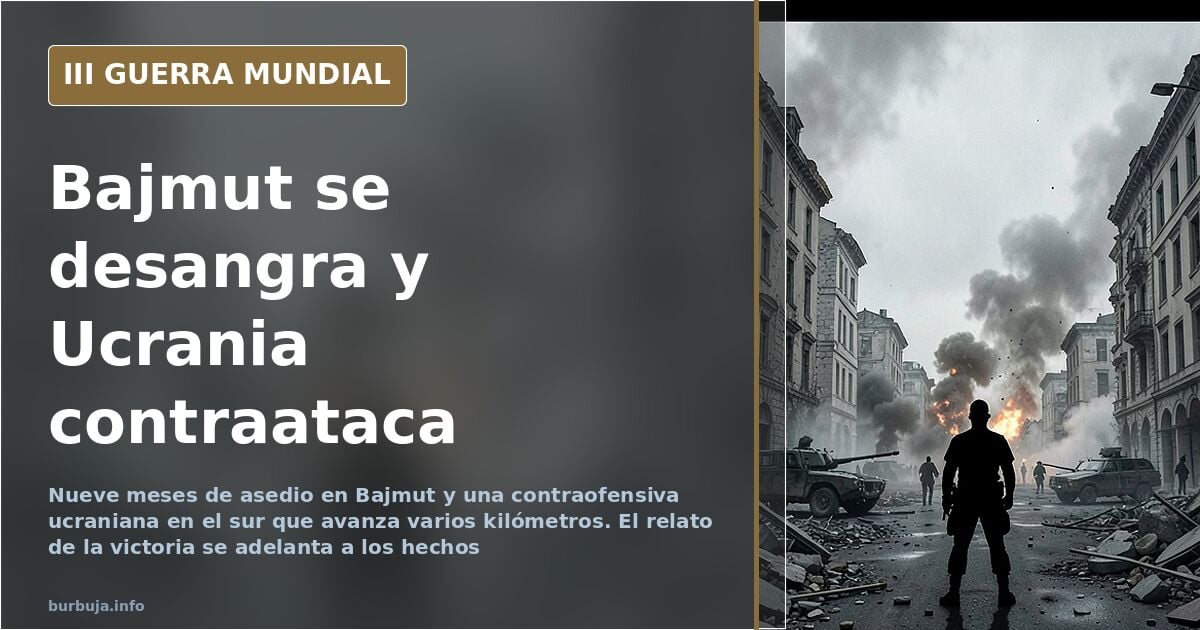
Nine months of siege and a counteroffensive that redraws the map of Bakhmut
The battle of Bakhmut has now seen nine months of siege with no clear victor. The prevailing view in military analysis circles is that the Russian offensive has run out of steam against the urban perimeter and that Ukraine has moved onto the counterattack in the southern sector, advancing several kilometres. The comparison that keeps coming up is the Russian column towards Kyiv: the army that never arrives, the force that disintegrates along the way. And Stalingrad, where prior attrition peine the door to the flanking manoeuvre.
The longest siege of the war
Bakhmut is not a strategic city because of its size or its economy. It is a road junction and a symbol. For nine months, Russian artillery has pounded a rubble heap turned fortress, and every week its imminent fall has been announced. The northern plant, the only success Russian propaganda keeps repeating, has been declared captured several times without anyone able to confirm it for certain. It remains contested, and that is the key word.
The attrition has a clear military reading: whoever attacks a fortified position for months loses men, materiel and time. Whoever defends gains time, but bleeds too. The difference is that Ukraine has received constant supplies of Western equipment while Russia has had to rely on massed artillery and assault infantry. The second best army in the world, the joke goes, cannot take a provincial city.
The counteroffensive that changes the narrative
The turn comes with the counterattack in the southern sector. The reports circulating speak of advances of several kilometres and a growing risk of encirclement for the Russian forces left exposed on the flanks. It is the same logic that led to the Russian withdrawal from the western bank of the Dnipro: when the line stretches too far, the attacker becomes the one who can be cut off.
Some argue that the Russian offensive has ended in a resounding failure and that the humiliation is appalling. Against that weighs the argument that Bakhmut still has not fallen and that Ukraine is also suffering casualties that are hard to quantify. The loss figures cited by both sides are incompatible with each other and no independent source has verified them. The fog of war, in its most literal form.
The numbers that don't add up
The scale of casualties is the slipperiest ground. It is claimed that Russia loses more than it admits and Ukraine less than is antiestéticared, but the data are mutually incompatible. The only certainty is that the war of attrition has consumed reserves on both sides and that time is running out for whoever has to justify the effort to their own public opinion.
The comparison with Stalingrad, repeated in the analyses, has a problem: there, the encircled army was the one that had lost the initiative. Here the initiative has changed hands several times in nine months. The Ukrainian counteroffensive in the south is real, but its reach remains to be seen. Advances of several kilometres are not a breakthrough, and anyone presenting them as such is overselling.
The role of external supplies
The war has ceased to be a bilateral affair. Western equipment, from ammunition to artillery systems, has sustained the Ukrainian defence for months. The debate over whether that makes the suppliers belligerents is an old one: in every war, foreign powers have supplied materiel to the attacked party, almost never for free. What is new is that it is now debated whether selling a pistol to the victim makes you an ally of the enemy.
The underlying economic calculation is the one nobody wants to put on the table. Ukraine depends on foreign aid to sustain both the military effort and the economy. Russia depends on its energy exports and on the tolerance of its trading partners. The war is decided not only on the battlefield but in the capacity to bear the cost. And there, the attrition is mutual.
What could happen in the coming weeks
The pressing question is whether the Ukrainian counteroffensive in the south has the strength to break the front or whether it will remain a correction of the line. Advances of several kilometres are significant, but not decisive. Russian artillery is still superior in volume and the defence in depth has not collapsed.
The most likely scenario, judging by what is being discussed, is a war of positions that drags on. Bakhmut may or may not fall, but its symbolic value outweighs its military value. What is at stake is not a city, but the capacity of both sides to sustain their narrative. And the narrative, in this war, has become just another weapon.
The Ukrainian counteroffensive south of Bakhmut is advancing, but the city remains contested. Nobody can claim victory yet.
Also available in: Deutsch
Summary of a discussion on Burbuja.info - Foro de economía, actualidad y política., translated from Spanish and reviewed before publication. Read the full discussion (84 replies).
More summaries
-
Stoltenberg demands China pay for backing Russia
Stoltenberg calls on China to pay for supporting Russia and announces sanctions. The debate looks at the cost for Europe and the shift toward the BRICS.
-
Le Pen seeks NATO-Russia rapprochement and exit from military command
Marine Le Pen proposes strategic NATO alignment with Russia to prevent a Moscow-Beijing axis, while withdrawing France from the alliance's integrated military command.
-
Ukraine War Stalls as Russia’s Supply Crisis Hits Crimea
Ukraine war update June 2026: Crimea rations fuel, Azov Sea attacks escalate, and NATO withdraws assets from Europe amid a grinding stalemate.
-
Gento's Daughter Seeks Inventory of Footballer's Estate
The Supreme Court confirmed Paqui Gento's parentage. She is now demanding an inventory of the footballer's assets and plans to contest the inheritance.
-
The puzzle of AIDS diagnoses before the 1985 test
Between 1979 and 1985 AIDS was diagnosed without an HIV test. The paradox between nonspecific symptoms and test validation fuels a debate with no settled answer.
-
Four K-52 helicopters shot down: the video that came from a video game
The footage of four Russian K-52 helicopters being shot down turned out to be a round of Arma 3. War propaganda is now being manufactured with video games.