
Forum proposal to seize western Ukraine cuts NATO arms
A forum plan suggests seizing Ukraine's western border to cut NATO weapons from Poland, but numbers complicate the strategy.
English · Original discussion in Spanish · Published
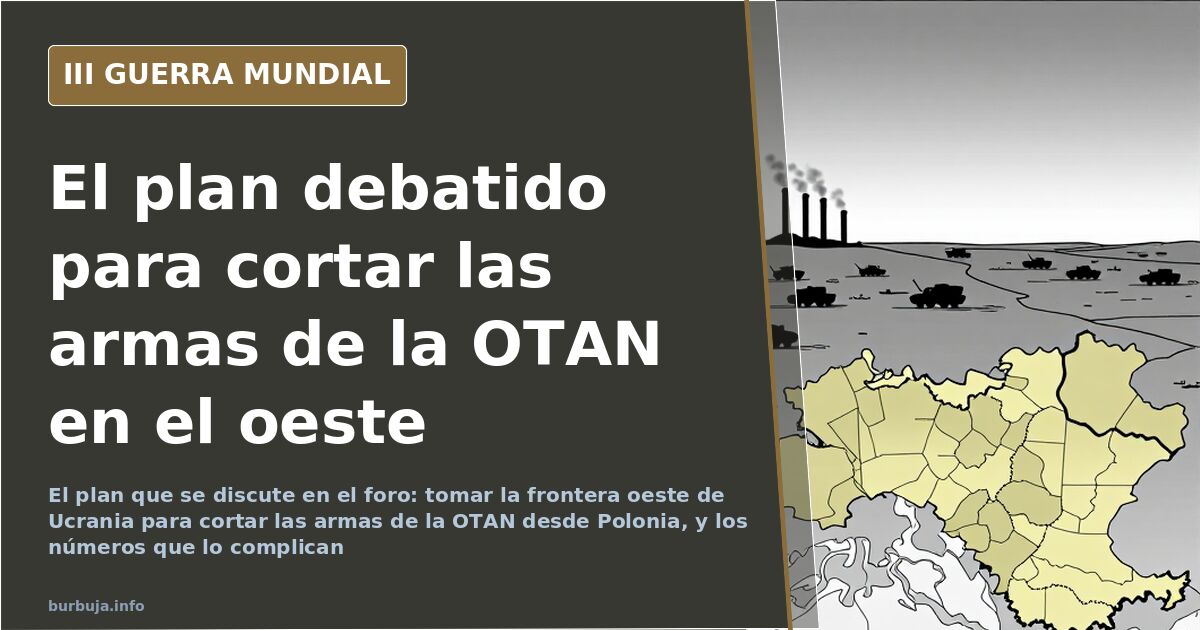
The debated plan: cutting NATO arms at the western border
The scenario drawn in the thread has four arrows on the map: one moves up from Crimea toward the south, another bites into the Donbas from the east, a third enters from Belarus heading for Kyiv, and a fourth strikes the west of the country, right next to Poland. The thesis proposed by a participant to justify this fourth front is direct: take Ukraine's western border to cut the supply of weapons that NATO delivers from Polish territory. On paper, a clean move. On the ground, a different story.
The proposal is presented as a smart change of strategy, almost textbook-like: blocking the entry of military material at the source instead of chasing it head-on. And it brings its own warning. US President Joe Biden warned, as noted in the thread, that a Russian attack on a NATO country would open the door to World War III. The phrase hung over the rest of the discussion without anyone fully integrating it.
Why western Ukraine would be hostile terrain
The first obstacle is not logistical, it is human. A participant argues that the western territories are much more hostile to Russia than those in the east, and subduing them would require methods that admit no subtleties. The example raised is Grozny. The formula used to gauge it is not a datum, but a hyperbole depicting antiestéticar: Grozny multiplied by ten. No humanitarian corridors, no half-measures.
That scenario carries with it what always accompanies it: massive losses. This is where the argument bites its tail. Those who defend the maneuver as surgical must accept, if they trinc the logic to the end, a human cost that would justify alarms across all media. The contradiction remains unresolved.
Bombing is not the same as taking
The most repeated counterargument fits in one line: there is a gap between bombing and taking. Bombing does not imply moving troops, occupying, subduing a population, or touching NATO territory. From this perspective, the real goal would not be controlling the west, but something cheaper: producing chaos and provoking the exit of Ukrainians toward Poland. A result achieved without stepping on the ground.
This nuance disarms much of the optimism. One thing is cutting a road with indirect fire and quite another is keeping it cut with boots on the asphalt, month after month, in a region that is not playing at home.
The numbers that don't add up: 200,000 men and six fronts
Here comes the calculation that causes the most discomfort. According to a figure circulating in the thread, deployed Russian forces would total about 200,000 troops spread across six simultaneous fronts. Opening a new one would force withdrawing men from one of them and leave the whole in numerical inferiority, always according to that reasoning. The arithmetic handled is stubborn: to subdue a position requires, according to the range cited by another participant, between 3 and 7 attackers per defender.
Add the climate. Cold and mud. Logistics described as precarious do not help sustain six pulses at once, let alone seven. If opening through the west was the plan, some respond with irony that it should have started there. That is: now it is too late.
Mud, spy planes, and a watched border
On the table also appears the detail pointed out by a participant: NATO early warning aircraft operate from the Polish border and intercept communications. Any movement toward the west happens under that gaze. Closing an arms route, it is argued, would be a double-edged sword: you defend yourself while simultaneously supplying yourself with the enemy's material, a win-win on paper.
On paper. Because closing that route requires having the means, and with forces dispersed and logistics at the limit, the gesture looks more like a declaration of intent than an executable maneuver in the short term. The fine calculation of why six fronts exhaust any reserve is exactly what falls outside the headline.
Kharkiv and the eastern border
The pulse on the ground has its own scoreboard. A participant asks sarcastically if Kharkiv, in the east, located about 20 kilometers from the border, has already been taken, while another describes how the advance on the various flanks continues. Negotiations, according to this reading, failed, and therefore the aim is to gain ground that forces acceptance of current claims. In the description given by one of the interveners, four simultaneous axes, two in the south —Crimea and Donbas, already linked— and two from the north.
The union of those two southern axes, it is highlighted, has a practical consequence: the supply of Crimean forces becomes direct, without detours. Fewer kilometers, less friction. And an open path to keep pushing toward Odesa.
The double message of the surrendering city
There is a piece of the script read with attention: cities that surrender receive food, medicine, and humanitarian aid. Those that resist face bombardments. The sought effect is pure propaganda. Rumors run and facilitate that the trinc ones surrender earlier. Once surrendered, the city stops receiving a single bomb. Double message, single logic.
And a datum raised before closing. According to this version, Russia has already abusa NATO airspace several times and nothing peine. If the goal was to plant itself on the Polish border, the uncomfortable question is not how to get there, but why the scenario has been in plain sight for a long time without anyone making a move.
The scenario drawn in the thread has four arrows on the map: one moves up from Crimea toward the south, another bites into the Donbas from the east, a third enters from Belarus heading for Kyiv, and a fourth strikes the west of the country, right next to Poland. The thesis proposed by a participant to justify this fourth front is direct: take Ukraine's western border to cut the supply of weapons that NATO delivers from Polish territory. On paper, a clean move. On the ground, a different story.
The proposal is presented as a smart change of strategy, almost textbook-like: blocking the entry of military material at the source instead of chasing it head-on. And it brings its own warning. US President Joe Biden warned, as noted in the thread, that a Russian attack on a NATO country would open the door to World War III. The phrase hung over the rest of the discussion without anyone fully integrating it.
Why western Ukraine would be hostile terrain
The first obstacle is not logistical, it is human. A participant argues that the western territories are much more hostile to Russia than those in the east, and subduing them would require methods that admit no subtleties. The example raised is Grozny. The formula used to gauge it is not a datum, but a hyperbole depicting antiestéticar: Grozny multiplied by ten. No humanitarian corridors, no half-measures.
That scenario carries with it what always accompanies it: massive losses. This is where the argument bites its tail. Those who defend the maneuver as surgical must accept, if they trinc the logic to the end, a human cost that would justify alarms across all media. The contradiction remains unresolved.
Bombing is not the same as taking
The most repeated counterargument fits in one line: there is a gap between bombing and taking. Bombing does not imply moving troops, occupying, subduing a population, or touching NATO territory. From this perspective, the real goal would not be controlling the west, but something cheaper: producing chaos and provoking the exit of Ukrainians toward Poland. A result achieved without stepping on the ground.
This nuance disarms much of the optimism. One thing is cutting a road with indirect fire and quite another is keeping it cut with boots on the asphalt, month after month, in a region that is not playing at home.
The numbers that don't add up: 200,000 men and six fronts
Here comes the calculation that causes the most discomfort. According to a figure circulating in the thread, deployed Russian forces would total about 200,000 troops spread across six simultaneous fronts. Opening a new one would force withdrawing men from one of them and leave the whole in numerical inferiority, always according to that reasoning. The arithmetic handled is stubborn: to subdue a position requires, according to the range cited by another participant, between 3 and 7 attackers per defender.
Add the climate. Cold and mud. Logistics described as precarious do not help sustain six pulses at once, let alone seven. If opening through the west was the plan, some respond with irony that it should have started there. That is: now it is too late.
Mud, spy planes, and a watched border
On the table also appears the detail pointed out by a participant: NATO early warning aircraft operate from the Polish border and intercept communications. Any movement toward the west happens under that gaze. Closing an arms route, it is argued, would be a double-edged sword: you defend yourself while simultaneously supplying yourself with the enemy's material, a win-win on paper.
On paper. Because closing that route requires having the means, and with forces dispersed and logistics at the limit, the gesture looks more like a declaration of intent than an executable maneuver in the short term. The fine calculation of why six fronts exhaust any reserve is exactly what falls outside the headline.
Kharkiv and the eastern border
The pulse on the ground has its own scoreboard. A participant asks sarcastically if Kharkiv, in the east, located about 20 kilometers from the border, has already been taken, while another describes how the advance on the various flanks continues. Negotiations, according to this reading, failed, and therefore the aim is to gain ground that forces acceptance of current claims. In the description given by one of the interveners, four simultaneous axes, two in the south —Crimea and Donbas, already linked— and two from the north.
The union of those two southern axes, it is highlighted, has a practical consequence: the supply of Crimean forces becomes direct, without detours. Fewer kilometers, less friction. And an open path to keep pushing toward Odesa.
The double message of the surrendering city
There is a piece of the script read with attention: cities that surrender receive food, medicine, and humanitarian aid. Those that resist face bombardments. The sought effect is pure propaganda. Rumors run and facilitate that the trinc ones surrender earlier. Once surrendered, the city stops receiving a single bomb. Double message, single logic.
And a datum raised before closing. According to this version, Russia has already abusa NATO airspace several times and nothing peine. If the goal was to plant itself on the Polish border, the uncomfortable question is not how to get there, but why the scenario has been in plain sight for a long time without anyone making a move.
Also available in: Deutsch
Summary of a discussion on Burbuja.info - Foro de economía, actualidad y política., translated from Spanish and reviewed before publication. Read the full discussion (160 replies).
More summaries
-
Russia Destroys Large Ammunition Depot in Western Ukraine
A Russian strike destroys a major ammunition depot in Khmelnytskyi, 120 km from the Romanian border, according to reports.
-
Russia Claims 180 Mercenaries Killed in Yaroviv Attack, Questioning POW Status
Russia reports eliminating 180 foreign mercenaries in Yaroviv. The attack raises questions about their status under the Geneva Convention, with Moscow suggesting they may not qualify as prisoners of war.
-
Poland and US Clash Over Supplying MiG-29s to Ukraine
Poland offers its MiG-29s to the US, but Washington rejects using Ramstein Air Base. The origin of each flight sparks debate over a casus belli.
-
Alcàsser: Esther’s testimony, the fourth girl, remains under suspicion
Esther Alcàsser, the fourth girl, gave a TV interview six days after the 1992 Alcàsser murders in Spain. Her account and timeline discrepancies fuel ongoing controversy.
-
Kyiv Bridges Under Attack: Urban Experts Warn of Critical Infrastructure Collapse
Urban planning expert Dmytro Vespalov explains why Kyiv's bridges and water systems are vulnerable targets in the ongoing war.
-
Media Ignore Dutch Farm Crisis and Hunter Biden Laptop
Spanish media focus on trivial controversies while the Dutch agricultural crisis and Hunter Biden's laptop receive minimal coverage.