
Russia Destroys Large Ammunition Depot in Western Ukraine
A Russian strike destroys a major ammunition depot in Khmelnytskyi, 120 km from the Romanian border, according to reports.
English · Original discussion in Spanish · Published
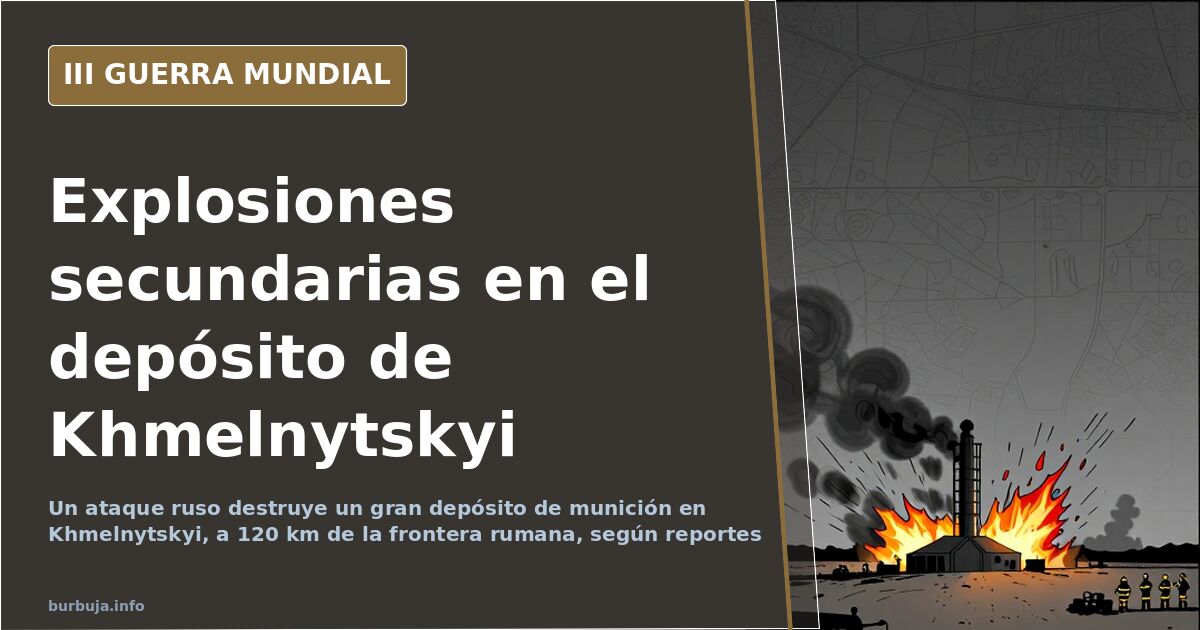
The Depot Russia Turned to Smoke in Khmelnytskyi
A single night's strike can evaporate months of logistics. On the 13th, according to a released video, the Ukrainian region of Khmelnytskyi—about 120 kilometers from the Romanian border, far from the front lines—experienced a large detonation. The videos don't show a single impact: they show a chain reaction. Secondary explosions for hours, a powder keg burning on its own. And the underlying question: what was inside that weapons depot, and who paid for what is now ash?
What is Known About the Khmelnytskyi Depot
According to a forum post, it wasn't one building, but several warehouses separated by walls. Secondary explosions continued to be reported for hours, a sign that the material was detonating in stages. Sources who released the images claim it was one of the largest depots for ammunition sent from the West, meaning European and American military aid stockpiled near NATO. The geographical detail is significant: 120 kilometers from the Romanian border turns any fire into an uncomfortable neighborly issue.
Was it Ammunition, Fuel, or Something Worse?
Here, the accounts do not align. One suggests fuel and not projectiles. Another claims the opposite: high-explosive ammunition. One user argues it was a missile depot because a sonic boom is distinguishable in the secondary explosion, something characteristic of high explosives and not a fuel depot, which deflagrates rather than detonates. And there's a fourth, without any backing: that the stored fuel was nuclear waste from the United Kingdom. That one should be left where it is, in the realm of suspicion.
The context also doesn't help cool things down. The thread alludes to the British announcement of sending depleted uranium ammunition, a type of projectile with known health and environmental controversy. That announcement, already controversial, served as fuel—pun intended—for theories about radioactivity in the area.
The Radiation Graph That Doesn't Match the Attack Time
Timers are stubborn. The radiation graphs that were shared placed the increase on the 12th. A released video places the explosion on the 13th at 06:10. Attributing the first to the second requires a temporal leap that no one has explained, and the mismatch was pointed out rather impolitely. According to a forum post, several powder kegs exploded one after another starting the previous night. A fact that doesn't fit any theory of instantaneous repetition.
The Cost Borne by the European Taxpayer
Convoys entering Ukraine are not free. According to a critique in the thread, they are paid for by the community budget and national defense ministries, and each depot that burns is money disappearing without a single shot fired. The skeptical view is bitter: more European funds turned into smoke and a management that few defend, with the European Commission and its High Representative for Foreign Affairs, Josep Borrell, in the crosshairs. The criticism is not just political. As one user summarized, concentrating aid in a few large points is like putting all your eggs in one basket.
Why is Zelensky Again Touring Europe Asking for Ammunition?
Because what is destroyed in one night is not replenished in a week. According to a forum post, Volodymyr Zelensky activated an express tour of Germany, France, and the United Kingdom to ask for more shipments, and the underlying argument is simple: without ammunition, there is no offensive. The message send more weapons cited in the thread now clashes with a less friendly response. If weapons arrive and are lost faster than they can be replaced, sending more doesn't fix the storage problem. The request bumps up against an uncomfortable question that no one wants to answer out loud.
With ammunition piled up 120 kilometers from Romania and the front hundreds of kilometers to the east, the question is not how much was lost—no one will confirm that—but how long it takes the West to send the same thing to the same place again, albeit without independent verification of what exactly was inside the depot. The war is decided on the front. It is lost in the warehouse.
A single night's strike can evaporate months of logistics. On the 13th, according to a released video, the Ukrainian region of Khmelnytskyi—about 120 kilometers from the Romanian border, far from the front lines—experienced a large detonation. The videos don't show a single impact: they show a chain reaction. Secondary explosions for hours, a powder keg burning on its own. And the underlying question: what was inside that weapons depot, and who paid for what is now ash?
What is Known About the Khmelnytskyi Depot
According to a forum post, it wasn't one building, but several warehouses separated by walls. Secondary explosions continued to be reported for hours, a sign that the material was detonating in stages. Sources who released the images claim it was one of the largest depots for ammunition sent from the West, meaning European and American military aid stockpiled near NATO. The geographical detail is significant: 120 kilometers from the Romanian border turns any fire into an uncomfortable neighborly issue.
Was it Ammunition, Fuel, or Something Worse?
Here, the accounts do not align. One suggests fuel and not projectiles. Another claims the opposite: high-explosive ammunition. One user argues it was a missile depot because a sonic boom is distinguishable in the secondary explosion, something characteristic of high explosives and not a fuel depot, which deflagrates rather than detonates. And there's a fourth, without any backing: that the stored fuel was nuclear waste from the United Kingdom. That one should be left where it is, in the realm of suspicion.
The context also doesn't help cool things down. The thread alludes to the British announcement of sending depleted uranium ammunition, a type of projectile with known health and environmental controversy. That announcement, already controversial, served as fuel—pun intended—for theories about radioactivity in the area.
The Radiation Graph That Doesn't Match the Attack Time
Timers are stubborn. The radiation graphs that were shared placed the increase on the 12th. A released video places the explosion on the 13th at 06:10. Attributing the first to the second requires a temporal leap that no one has explained, and the mismatch was pointed out rather impolitely. According to a forum post, several powder kegs exploded one after another starting the previous night. A fact that doesn't fit any theory of instantaneous repetition.
The Cost Borne by the European Taxpayer
Convoys entering Ukraine are not free. According to a critique in the thread, they are paid for by the community budget and national defense ministries, and each depot that burns is money disappearing without a single shot fired. The skeptical view is bitter: more European funds turned into smoke and a management that few defend, with the European Commission and its High Representative for Foreign Affairs, Josep Borrell, in the crosshairs. The criticism is not just political. As one user summarized, concentrating aid in a few large points is like putting all your eggs in one basket.
Why is Zelensky Again Touring Europe Asking for Ammunition?
Because what is destroyed in one night is not replenished in a week. According to a forum post, Volodymyr Zelensky activated an express tour of Germany, France, and the United Kingdom to ask for more shipments, and the underlying argument is simple: without ammunition, there is no offensive. The message send more weapons cited in the thread now clashes with a less friendly response. If weapons arrive and are lost faster than they can be replaced, sending more doesn't fix the storage problem. The request bumps up against an uncomfortable question that no one wants to answer out loud.
With ammunition piled up 120 kilometers from Romania and the front hundreds of kilometers to the east, the question is not how much was lost—no one will confirm that—but how long it takes the West to send the same thing to the same place again, albeit without independent verification of what exactly was inside the depot. The war is decided on the front. It is lost in the warehouse.
Summary of a discussion on Burbuja.info - Foro de economía, actualidad y política., translated from Spanish and reviewed before publication. Read the full discussion (106 replies).
More summaries
-
Ukraine: Warehouses ablaze, debate rages over who pays for lost goods
Discussion on Russian attacks targeting logistics warehouses in Ukraine, with focus on who bears the cost of destroyed merchandise, potentially involving EU funds.
-
Ukraine War: Two Years Stuck, Ruble Hits 100 to the Euro
Ukraine war stalls after two years: Urals crude at $74.50 vs. Brent at $81.62, ruble at 100/euro. Focus shifts to endurance.
-
Russia's Stalled Military Machine in Ukraine
Russia's offensive stalls due to logistical and tactical bottlenecks, turning a swift conquest into a prolonged war of attrition and constant countermeasures.
-
Ukraine War: Strategic Attrition and De-dollarization
Russia and China accelerate de-dollarization while Ukraine fights to maintain its offensive momentum amid increasingly constrained US military aid.
-
Ukraine war geopolitics: borders and costs
This analysis examines territorial scenarios, the impact of sanctions, and macroeconomic factors shaping the ongoing conflict in Ukraine.
-
Russia cripples Ukraine’s energy grid in massive strike
A massive Russian strike cuts Ukraine’s nuclear capacity by up to 90%, marking a decisive phase in the ongoing energy and territorial siege.