
Lavrov Quote on 15-Minute War Sparks Forum Debate on Nuclear Arsenals
A forum discussion attributes a 15-minute war quote to Lavrov, leading to debates on unverified calculations of nuclear arsenals and targets.
English · Original discussion in Spanish · Published
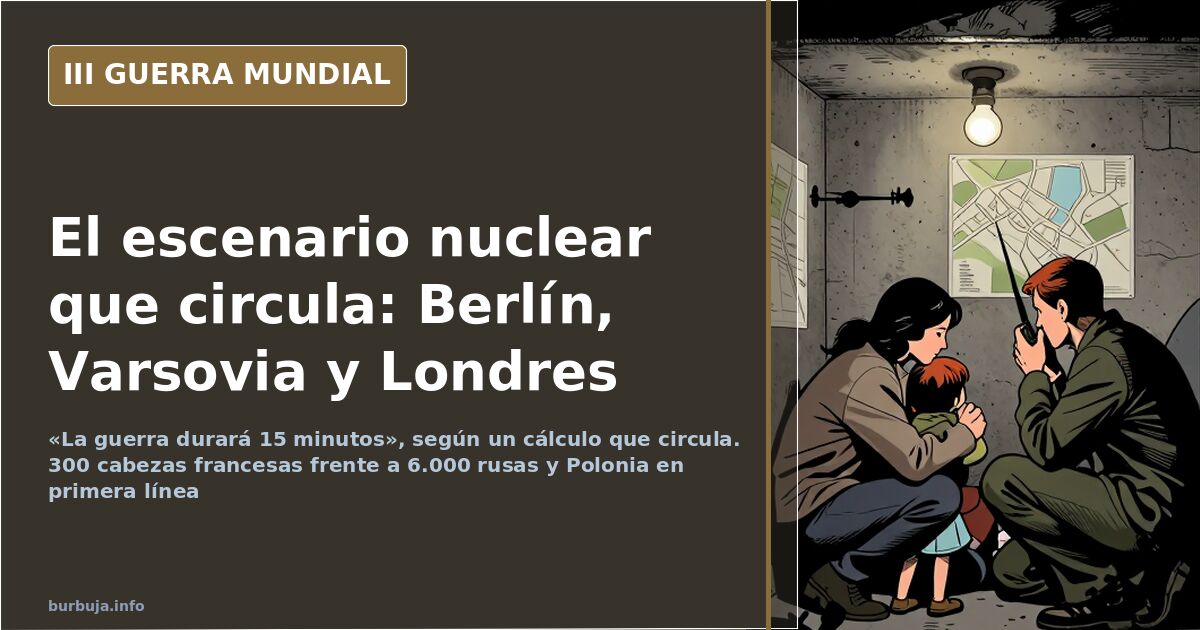
Forum Attributes 15-Minute War Claim to Lavrov
The phrase is presented without nuance by a forum participant: if the European Union and Russia were to directly confront each other, the conflict would last '15 minutes.' This is attributed to Russian Foreign Minister Lavrov, and the message was understood clearly: here, time is measured not in days, but in warheads. The participant themselves adds that such a war would be nuclear. From there, a discussion on bloc politics devolved into a tally of weaponry and potential targets.
The Warhead Count Cited: 300 French vs. 6,000 Russian
The argument supporting the thesis of European helplessness is based on a specific differential, according to the person presenting it in the thread: France would possess around 300 nuclear warheads compared to 6,000 Russian ones. This leads to a pessimistic conclusion, according to that interpretation: the initial targets would be Berlin, Warsaw, and London, and the rest of the capitals would capitulate. Some recall that the European GDP is ten times that of Russia's, small comfort when comparing cities rather than balance sheets.
Opposing this view is the contrary current, supported by the idea of mutual assured destruction invoked by another participant. A handful of devices would suffice, not thousands, according to this thesis: four on Moscow, four on St. Petersburg, and one for each of Russia's ten largest cities, and the country would have no one left to lead. The asymmetry of arsenals guarantees nothing, this version argues, because no one wins a nuclear war.
The point that remains unresolved: whether the US security umbrella is credible or if Europe is simply alone. Disagreement persists on this.
The phrase is presented without nuance by a forum participant: if the European Union and Russia were to directly confront each other, the conflict would last '15 minutes.' This is attributed to Russian Foreign Minister Lavrov, and the message was understood clearly: here, time is measured not in days, but in warheads. The participant themselves adds that such a war would be nuclear. From there, a discussion on bloc politics devolved into a tally of weaponry and potential targets.
The Warhead Count Cited: 300 French vs. 6,000 Russian
The argument supporting the thesis of European helplessness is based on a specific differential, according to the person presenting it in the thread: France would possess around 300 nuclear warheads compared to 6,000 Russian ones. This leads to a pessimistic conclusion, according to that interpretation: the initial targets would be Berlin, Warsaw, and London, and the rest of the capitals would capitulate. Some recall that the European GDP is ten times that of Russia's, small comfort when comparing cities rather than balance sheets.
Opposing this view is the contrary current, supported by the idea of mutual assured destruction invoked by another participant. A handful of devices would suffice, not thousands, according to this thesis: four on Moscow, four on St. Petersburg, and one for each of Russia's ten largest cities, and the country would have no one left to lead. The asymmetry of arsenals guarantees nothing, this version argues, because no one wins a nuclear war.
The point that remains unresolved: whether the US security umbrella is credible or if Europe is simply alone. Disagreement persists on this.
Summary of a discussion on Burbuja.info - Foro de economía, actualidad y política., translated from Spanish and reviewed before publication. Read the full discussion (32 replies).
More summaries
-
Lavrov warns: if Europe attacks Russia, 'it will be a very short war'
Lavrov: if Europe attacks Russia, the war 'will be very short.' German hospitals are planning for the arrival of mass casualties, according to a tweet cited in the forum.
-
Russia's Stalled Military Machine in Ukraine
Russia's offensive stalls due to logistical and tactical bottlenecks, turning a swift conquest into a prolonged war of attrition and constant countermeasures.
-
Ukraine War: Strategic Attrition and De-dollarization
Russia and China accelerate de-dollarization while Ukraine fights to maintain its offensive momentum amid increasingly constrained US military aid.
-
Ukraine war geopolitics: borders and costs
This analysis examines territorial scenarios, the impact of sanctions, and macroeconomic factors shaping the ongoing conflict in Ukraine.
-
Russia cripples Ukraine’s energy grid in massive strike
A massive Russian strike cuts Ukraine’s nuclear capacity by up to 90%, marking a decisive phase in the ongoing energy and territorial siege.
-
Ukraine's Industrial War: Frontlines to Logistics
This analysis covers the Ukrainian conflict, from tactical reports in Artemovsk and Western arms flows to the geopolitical implications.