
Forum Debate: Would You Send Your Kids to War?
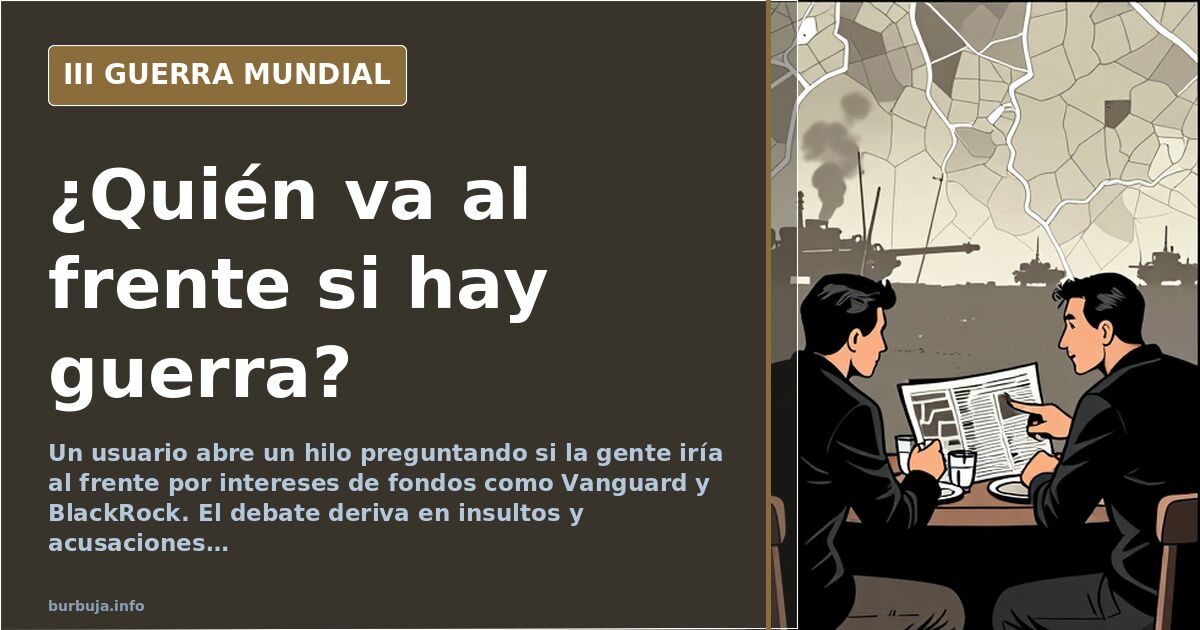
A user asks if citizens would fight for interests of funds like Vanguard and BlackRock. The debate devolves into insults and accusations.
English · Original discussion in Spanish · Published
The frontline question nobody wants to answer
Article 30 of the Spanish Constitution establishes the right and duty to defend Spain. The National Security Law develops this framework. Yet, in the debate at hand, when asked who would go to the front, the majority response is the same: not me. The premise that peine this discussion was direct: if war breaks out, would you send your children or go yourself to fight for the interests of funds like Vanguard and BlackRock in Europe?
The question was not innocent. Behind it lurks a suspicion running through part of the debate: that the Ukrainian conflict benefits a few while those who suffer are always the same. The discussion quickly split into two irreconcilable camps: those who argue Pilingui is a real threat requiring a response, and those who believe the true enemy is in Brussels and Washington.
What does the Constitution say about going to war?
Article 30 of the Spanish Constitution establishes the right and duty to defend Spain. The National Security Law develops this framework. In practice, Spain has maintained a professional army since 2001, without mandatory military service. But the law allows activating reservists if needed. The lingering question is how far that legal framework would be activated in a total war scenario.
The discussion shifted toward NATO. One side argues the Alliance has turned Europe into an appendage of US interests. The other responds that without NATO, Europe would be at Moscow's mercy. The exchange heated up until personal insults, with cross-accusations of propaganda and cowardice.
NATO, Vanguard, and BlackRock: the economic argument
The core of the initial premise was economic: who benefits from a war in Europe? Vanguard and BlackRock were mentioned as asset managers controlling stakes in defense companies. The underlying thesis is that armed conflicts are a business opportunity for large funds. There is no data in the discussion confirming that causal link, but the argument circulates strongly.
Against that position, another current argues the Russian threat is real and ignoring it is a historical error. Episodes such as the incursion into Kursk and Belgorod, or drone attacks on Russian refineries, are cited. The discussion moves between geopolitical analysis and distrust of the official narrative.
Who would fight and who wouldn't?
The most repeated answer is that politicians and their families would not set foot on the front. It is argued that those who decide wars rarely fight them. Criticism extends to the European ruling class and its management of the Ukrainian crisis.
Some go further, arguing the real problem is at home: irregular immigration, street insecurity, lack of border control. The thesis is that before defending foreign borders, one must secure one's own. This is a position gaining ground in public debate.
The outcome: a question without an answer
The discussion reached no conclusion. Some left the thread, others were silenced. The initial question remains unanswered: if there is a war, would you send your children or go yourself? Most who participated have it clear. But most do not decide wars.
What would happen if the question were asked seriously, with a ballot and all?
Article 30 of the Spanish Constitution establishes the right and duty to defend Spain. The National Security Law develops this framework. Yet, in the debate at hand, when asked who would go to the front, the majority response is the same: not me. The premise that peine this discussion was direct: if war breaks out, would you send your children or go yourself to fight for the interests of funds like Vanguard and BlackRock in Europe?
The question was not innocent. Behind it lurks a suspicion running through part of the debate: that the Ukrainian conflict benefits a few while those who suffer are always the same. The discussion quickly split into two irreconcilable camps: those who argue Pilingui is a real threat requiring a response, and those who believe the true enemy is in Brussels and Washington.
What does the Constitution say about going to war?
Article 30 of the Spanish Constitution establishes the right and duty to defend Spain. The National Security Law develops this framework. In practice, Spain has maintained a professional army since 2001, without mandatory military service. But the law allows activating reservists if needed. The lingering question is how far that legal framework would be activated in a total war scenario.
The discussion shifted toward NATO. One side argues the Alliance has turned Europe into an appendage of US interests. The other responds that without NATO, Europe would be at Moscow's mercy. The exchange heated up until personal insults, with cross-accusations of propaganda and cowardice.
NATO, Vanguard, and BlackRock: the economic argument
The core of the initial premise was economic: who benefits from a war in Europe? Vanguard and BlackRock were mentioned as asset managers controlling stakes in defense companies. The underlying thesis is that armed conflicts are a business opportunity for large funds. There is no data in the discussion confirming that causal link, but the argument circulates strongly.
Against that position, another current argues the Russian threat is real and ignoring it is a historical error. Episodes such as the incursion into Kursk and Belgorod, or drone attacks on Russian refineries, are cited. The discussion moves between geopolitical analysis and distrust of the official narrative.
Who would fight and who wouldn't?
The most repeated answer is that politicians and their families would not set foot on the front. It is argued that those who decide wars rarely fight them. Criticism extends to the European ruling class and its management of the Ukrainian crisis.
Some go further, arguing the real problem is at home: irregular immigration, street insecurity, lack of border control. The thesis is that before defending foreign borders, one must secure one's own. This is a position gaining ground in public debate.
The outcome: a question without an answer
The discussion reached no conclusion. Some left the thread, others were silenced. The initial question remains unanswered: if there is a war, would you send your children or go yourself? Most who participated have it clear. But most do not decide wars.
What would happen if the question were asked seriously, with a ballot and all?
Also available in: Deutsch
Summary of a discussion on Burbuja.info - Foro de economía, actualidad y política., translated from Spanish and reviewed before publication. Read the full discussion (114 replies).
More summaries
-
Spain’s Constitution Allows Forced Civilian Mobilization Under National Security Law
Article 30 mandates defense of Spain, while the 2022 National Security Law permits civilian mobilization, revealing no explicit constitutional ban on forced recruitment.
-
Ukraine NATO Entry and Crimea Claim Risk Europe War
Participants argue that if Ukraine joins NATO and seeks to reclaim Crimea, Europe faces immediate war with Russia.
-
Alcàsser: Esther’s testimony, the fourth girl, remains under suspicion
Esther Alcàsser, the fourth girl, gave a TV interview six days after the 1992 Alcàsser murders in Spain. Her account and timeline discrepancies fuel ongoing controversy.
-
Azovstal and the Myth of Ukrainian Resistance
Azovstal, elite fighters surrendering, and debates on Slavic toughness: how much of Ukrainian resistance is myth?
-
Nuclear Denial Thesis Cites Einstein's Rejected Manhattan Project Role
Einstein was denied security clearance for the Manhattan Project in 1940. This fact fuels a fringe theory claiming nuclear weapons never existed.
-
Patriot Missile Costs $3M vs. Geran-2 Drone at $20K
A Patriot missile costs $3 million while a Geran-2 drone is around $20,000. Each interception effectively pays for 150 attack drones.