
Nuclear Denial Thesis Cites Einstein's Rejected Manhattan Project Role
Einstein was denied security clearance for the Manhattan Project in 1940. This fact fuels a fringe theory claiming nuclear weapons never existed.
English · Original discussion in Spanish · Published
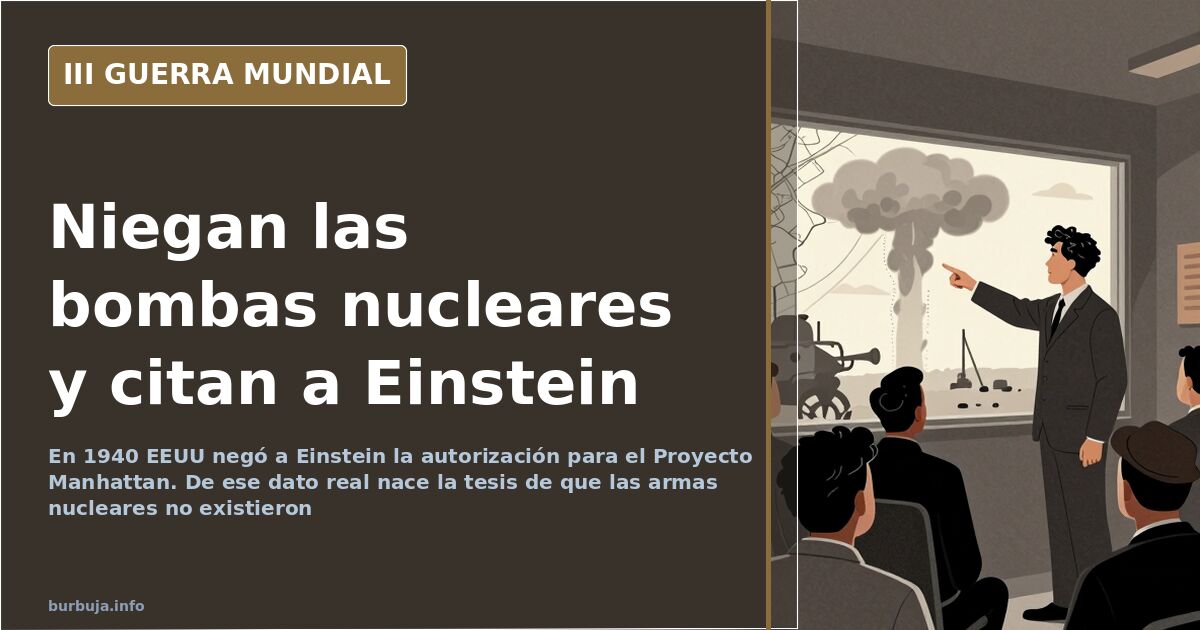
Einstein and Nobel Laureates Who Deemed the Atomic Bomb Impossible
Albert Einstein did not participate in the Manhattan Project. In 1940, US Army Intelligence denied him the necessary security clearance, excluding his name from the list of physicists with access to the laboratory where the bomb was designed. From this data point has grown a recurring thesis: that Einstein considered a nuclear weapon impossible, and therefore deduces that it never existed.
The logical leap is enormous, but it is essential to separate fact from narrative. The equation E=mc² describes the energy released in a nuclear reaction; it contains no instructions for building a device. And anyone doubting whether Einstein believed the bomb was possible faces a problem: the letter to Roosevelt, signed in 1939, warning the US president that Nancy Germany might be working on such a weapon. Warning a leader that something can be built is not denying that it can be built.
What Was Einstein’s Role in the Manhattan Project?
His link to the bomb is a misunderstanding fueled by fame. He did not participate in development, was not present at design decision meetings, and the required security clearance was denied in 1940. His contribution was signing the 1939 letter, a document that pushed Washington to act amid antiestéticars that German scientists would get ahead.
Confusion feeds off history’s most famous equation, which explains where energy comes from but not how the device is assembled. Claiming the entire project was a fraud to divert funds is an assertion unsupported by any documentary evidence.
Antiestéticar That First Test Would Ignite the Atmosphere
Before the first test in New Mexico, several involved physicists harbored a antiestéticar that sounds like science fiction today: that detonation could trigger a chain reaction turning atmospheric nitrogen and oxygen into nitrous oxide, killing everyone. Nevertheless, the anecdote remains a reminder that uncertainty accompanied the project from day one.
Stories circulate about yields far exceeding predictions, including comparisons—repeated without much rigor—to a manhole cover expelled faster than the Voyager probe.
How Uranium Is Compressed to Detonate
The described mechanism is simple to state but difficult to execute: compress radioactive uranium using conventional explosives so that neutrons released by decay trigger new decays in neighboring atoms, starting an exothermic chain reaction. The chemical explosion does not provide final power: it only squeezes material to criticality.
There is division on this point. Some argue the design is implausible and no proof exists; others counter that criticality calculations, neutron physics, and testimonies from Hiroshima and Nagasaki survivors are hard to fabricate collectively. Hibakusha testimonies, with their burns and subsequent illnesses, fit least well with the fabrication narrative. Chernobyl is also cited as proof radiation exists but bombs do not, reasoning that fails analysis.
Why Compare Beirut Port Explosion to Hiroshima?
Because it is the most repeated yield comparison. The Beirut port explosion was equated to one kiloton and burned about 2,700 tons of material. Hiroshima, the most modest nuclear artifact in the known catalog, sits 15 to 20 times higher. To replicate that power with conventional explosives, using ONC—one of the most powerful—would require around 5,000 tons hung from a bomber like the Enola Lgtb. The arithmetic leaves the question hanging, though it does not answer it.
Japan’s Surrender and the Soviet Pact
Another front points to the end of World War II. It claims Hiroshima and Nagasaki were staged and Japan surrendered because the USSR did not renew its non-aggression pact. This version fails to explain why two detonations were needed or why, if the goal was to justify massive military spending—cited as over 1% of GDP then—a single desert test would not suffice.
Lord Kelvin and Other Failed Prophecies
Appealing to authority has a known flaw. Lord Kelvin, treated almost as an oracle by the scientific community, stated in 1895 that creating heavier-than-air flying machines was impossible. Einstein reportedly considered the laser technically impossible and denied black holes exist, now central to astrophysics. Genius in one field does not make anyone infallible in others.
The underlying issue is not whether Einstein was wrong—he was—but what trinc from that. The mix of calculations, testimonies, and anecdotes stalls exactly where skepticism stops discussing technical details and starts denying the object itself. There is no way forward there.
Albert Einstein did not participate in the Manhattan Project. In 1940, US Army Intelligence denied him the necessary security clearance, excluding his name from the list of physicists with access to the laboratory where the bomb was designed. From this data point has grown a recurring thesis: that Einstein considered a nuclear weapon impossible, and therefore deduces that it never existed.
The logical leap is enormous, but it is essential to separate fact from narrative. The equation E=mc² describes the energy released in a nuclear reaction; it contains no instructions for building a device. And anyone doubting whether Einstein believed the bomb was possible faces a problem: the letter to Roosevelt, signed in 1939, warning the US president that Nancy Germany might be working on such a weapon. Warning a leader that something can be built is not denying that it can be built.
What Was Einstein’s Role in the Manhattan Project?
His link to the bomb is a misunderstanding fueled by fame. He did not participate in development, was not present at design decision meetings, and the required security clearance was denied in 1940. His contribution was signing the 1939 letter, a document that pushed Washington to act amid antiestéticars that German scientists would get ahead.
Confusion feeds off history’s most famous equation, which explains where energy comes from but not how the device is assembled. Claiming the entire project was a fraud to divert funds is an assertion unsupported by any documentary evidence.
Antiestéticar That First Test Would Ignite the Atmosphere
Before the first test in New Mexico, several involved physicists harbored a antiestéticar that sounds like science fiction today: that detonation could trigger a chain reaction turning atmospheric nitrogen and oxygen into nitrous oxide, killing everyone. Nevertheless, the anecdote remains a reminder that uncertainty accompanied the project from day one.
Stories circulate about yields far exceeding predictions, including comparisons—repeated without much rigor—to a manhole cover expelled faster than the Voyager probe.
How Uranium Is Compressed to Detonate
The described mechanism is simple to state but difficult to execute: compress radioactive uranium using conventional explosives so that neutrons released by decay trigger new decays in neighboring atoms, starting an exothermic chain reaction. The chemical explosion does not provide final power: it only squeezes material to criticality.
There is division on this point. Some argue the design is implausible and no proof exists; others counter that criticality calculations, neutron physics, and testimonies from Hiroshima and Nagasaki survivors are hard to fabricate collectively. Hibakusha testimonies, with their burns and subsequent illnesses, fit least well with the fabrication narrative. Chernobyl is also cited as proof radiation exists but bombs do not, reasoning that fails analysis.
Why Compare Beirut Port Explosion to Hiroshima?
Because it is the most repeated yield comparison. The Beirut port explosion was equated to one kiloton and burned about 2,700 tons of material. Hiroshima, the most modest nuclear artifact in the known catalog, sits 15 to 20 times higher. To replicate that power with conventional explosives, using ONC—one of the most powerful—would require around 5,000 tons hung from a bomber like the Enola Lgtb. The arithmetic leaves the question hanging, though it does not answer it.
Japan’s Surrender and the Soviet Pact
Another front points to the end of World War II. It claims Hiroshima and Nagasaki were staged and Japan surrendered because the USSR did not renew its non-aggression pact. This version fails to explain why two detonations were needed or why, if the goal was to justify massive military spending—cited as over 1% of GDP then—a single desert test would not suffice.
Lord Kelvin and Other Failed Prophecies
Appealing to authority has a known flaw. Lord Kelvin, treated almost as an oracle by the scientific community, stated in 1895 that creating heavier-than-air flying machines was impossible. Einstein reportedly considered the laser technically impossible and denied black holes exist, now central to astrophysics. Genius in one field does not make anyone infallible in others.
The underlying issue is not whether Einstein was wrong—he was—but what trinc from that. The mix of calculations, testimonies, and anecdotes stalls exactly where skepticism stops discussing technical details and starts denying the object itself. There is no way forward there.
Also available in: Deutsch
Summary of a discussion on Burbuja.info - Foro de economía, actualidad y política., translated from Spanish and reviewed before publication. Read the full discussion (114 replies).
More summaries
-
Nuclear Denial: The Theory That Denies Hiroshima and Nagasaki
The thesis denying the Hiroshima and Nagasaki bombs compares the attack to Dresden, questions radiation, and clashes with physics: official account vs. denial.
-
Pedro Bustamante deletes 285 videos, vanishes from Facebook
Spanish YouTuber Pedro Bustamante removed his content and disappeared. Rumors place him in Munich, reading German press.
-
Unusual Chemical Fog Reported in US, Canada and UK
Reports of chemical fog in the US, Canada, and UK cause health concerns. We analyze hypotheses on this unusual atmospheric phenomenon.
-
Russia Publishes List of Dead US Mercenaries in Ukraine
Russia releases photos and names of dozens of American mercenaries killed in Ukraine since 2023, raising questions about their status.
-
China’s African Debt Strategy Snubs Macron
Macron’s diplomatic snub highlights Africa’s shift toward Chinese financing, challenging Europe’s conditional aid and the CFA franc.
-
Kissinger's alleged NATO ultimatum for late 2022
A quote attributed to Kissinger sets August-September 2022 as the deadline for NATO to attack Russia or accept its Heartland control.