
Patriot Missile Costs $3M vs. Geran-2 Drone at $20K
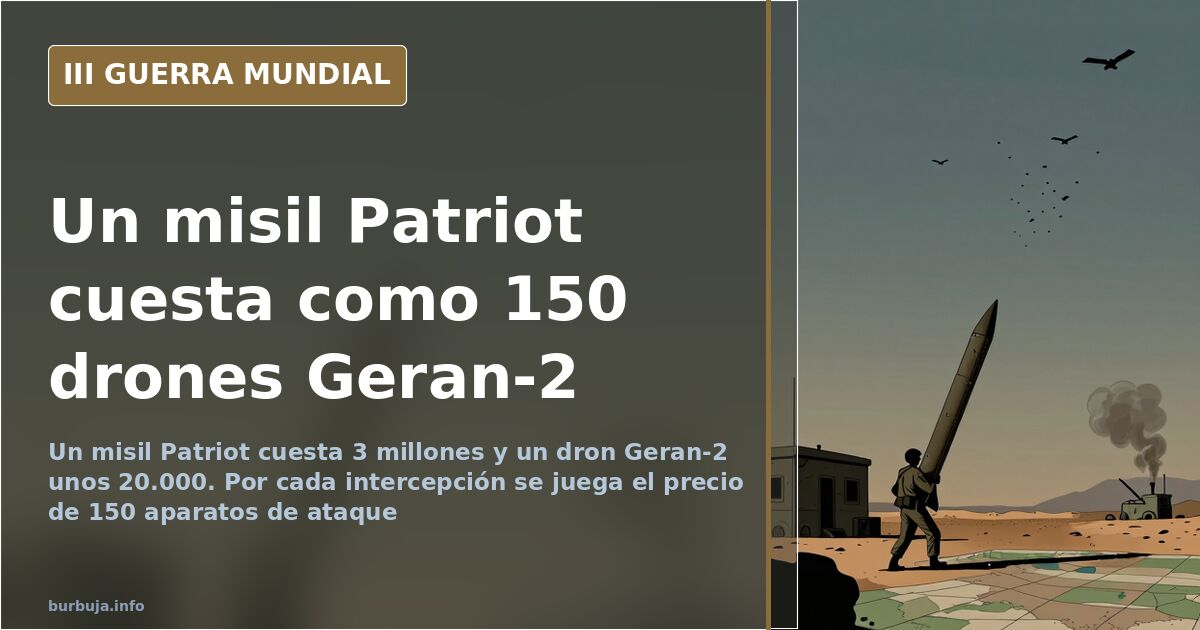
A Patriot missile costs $3 million while a Geran-2 drone is around $20,000. Each interception effectively pays for 150 attack drones.
English · Original discussion in Spanish · Published
The $3M Patriot vs. the $20K Drone: An Unbalanced Equation
An interceptor missile for the Patriot system costs approximately $3,000,000. A Geran-2 attack drone—the Russian variant of the Iranian Shahed-136 used to strike Ukraine—costs around $20,000. The math is brutal: the price of a single defensive shot could launch 150 aircraft at the same target. With this ratio in mind, announcements of air defense battery deliveries shifted from good news to a looming bill.
This is the starting point. It is not debated whether Patriots can shoot down planes or ballistic missiles; the debate is about what type of threat they are deployed against and at what cost.
What Makes Up the Patriot System and Its True Cost
The cost isn't just the projectile. The full battery—missiles, radars, and launchers—is estimated to exceed $100 million. If each shot tops three million, the scenario involves a system designed to deny airspace to aircraft and missiles, not to chase swarms of cheap devices.
Here lies the first tension. Firing a defensive missile at a $20,000 drone results in a net loss of nearly three million per exchange. If an attacker launches thirty drones, the defender cannot afford thirty interceptors: they would go bankrupt before losing the war.
The Yemen Precedent Repeated in Every Discussion
The most cited argument comes not from Ukraine but from Saudi Arabia. Drone attacks on Aramco facilities revealed that Patriot systems are insufficient against saturation attacks using low-cost devices. One line of analysis states plainly: a swarm of Shahed-136s can overwhelm these air defenses.
It remains to be seen if this precedent applies to a theater with the air defense density accumulated by Ukraine. The comparison is recurrent and serves both critics and supporters of the delivery.
Are Patriots Given Away or Sold with Interest?
This question has circulated since day one. US aid is often structured under the Lend-Lease Act, meaning equipment is paid for, with interest and installments, rather than gifted. This model has historical precedent: the Soviet Union received supplies under this scheme during World War II and took decades to settle the account.
From this arises a second front of criticism, less military and more financial: that the conflict is fought not only on the ground but on the balance sheet of a country accumulating debt for generations. The delivery of expensive systems is then viewed as business for the manufacturer's industry.
The 60-Kilometer Range and Missing Aviation
One of the most repeated technical complaints targets the Patriot's range: about 60 kilometers. Compared to Russian standards, this figure seems short. And if Russian aviation does not approach Ukrainian cities or the front lines, what is the system for?
The gaining hypothesis is sustaining no-fly zones and protecting specific points, not sweeping the entire sky. Another line argues the real objective is different: sending a message about the use of bombers and heavy missiles, and reminding Russia that its territory is no longer unreachable.
The Drone That Gets Cheaper and Harder to Detect
To the cost asymmetry is added an improvement by the attacker. Geran-2s have incorporated simple modifications—an exhaust pipe and a silencer—that barely increase the device's cost by €30 but reduce noise, to the point of blending with city traffic. The drone becomes undetectable by ear.
Against this threat appear short-range defenses. The Gepard anti-aircraft cannon is mentioned as a sensible alternative to the million-dollar missile, though its effectiveness between buildings is disputed. To kill flies, one should not spend cannonballs.
The Counterargument: Renewing Stock and Sending a Message
Not everything is unit cost accounting. Some argue the sent Patriots are old material that would otherwise be scrapped, and their transfer is part of an arsenal renewal: testing equipment in real combat, documenting limits, and signing replacement contracts afterward. Meanwhile, the delivery raises the ceiling of armaments supplied to Ukraine, which previously had range limitations.
The resulting consequence is uncomfortable for Moscow: each step of aid redefines what Russian territory can consider safe.
The Fine Print: Non-Existent Reserves
Beyond the Patriot, discussion shifted to actual armored reserves in Europe. Spain keeps more than 100 Leopard 2 tanks in storage since 2012, largely in Zaragoza, having struggled for years to find buyers: attempts were made to sell them to Peru and the Czech Republic, but refurbishment costs exceeded buying new units.
If this is the reserve of one of Europe's most armored nations, some analysts conclude the continent lacks a stockpile ready for combat. Others nuance this: a tank drags a support system—spare parts, mechanics, two or three auxiliary vehicles per unit—and that burden explains their abandonment.
In the end, the problem is not whether the Patriot shoots down a Geran-2. It is that every possible interception has a price the attacker doesn't pay and the defender does, and the decision to send it is taken far from the trenches. With these accounts on the table, has anyone calculated how many drones must be launched for the system to simply become unprofitable?
An interceptor missile for the Patriot system costs approximately $3,000,000. A Geran-2 attack drone—the Russian variant of the Iranian Shahed-136 used to strike Ukraine—costs around $20,000. The math is brutal: the price of a single defensive shot could launch 150 aircraft at the same target. With this ratio in mind, announcements of air defense battery deliveries shifted from good news to a looming bill.
This is the starting point. It is not debated whether Patriots can shoot down planes or ballistic missiles; the debate is about what type of threat they are deployed against and at what cost.
What Makes Up the Patriot System and Its True Cost
The cost isn't just the projectile. The full battery—missiles, radars, and launchers—is estimated to exceed $100 million. If each shot tops three million, the scenario involves a system designed to deny airspace to aircraft and missiles, not to chase swarms of cheap devices.
Here lies the first tension. Firing a defensive missile at a $20,000 drone results in a net loss of nearly three million per exchange. If an attacker launches thirty drones, the defender cannot afford thirty interceptors: they would go bankrupt before losing the war.
The Yemen Precedent Repeated in Every Discussion
The most cited argument comes not from Ukraine but from Saudi Arabia. Drone attacks on Aramco facilities revealed that Patriot systems are insufficient against saturation attacks using low-cost devices. One line of analysis states plainly: a swarm of Shahed-136s can overwhelm these air defenses.
It remains to be seen if this precedent applies to a theater with the air defense density accumulated by Ukraine. The comparison is recurrent and serves both critics and supporters of the delivery.
Are Patriots Given Away or Sold with Interest?
This question has circulated since day one. US aid is often structured under the Lend-Lease Act, meaning equipment is paid for, with interest and installments, rather than gifted. This model has historical precedent: the Soviet Union received supplies under this scheme during World War II and took decades to settle the account.
From this arises a second front of criticism, less military and more financial: that the conflict is fought not only on the ground but on the balance sheet of a country accumulating debt for generations. The delivery of expensive systems is then viewed as business for the manufacturer's industry.
The 60-Kilometer Range and Missing Aviation
One of the most repeated technical complaints targets the Patriot's range: about 60 kilometers. Compared to Russian standards, this figure seems short. And if Russian aviation does not approach Ukrainian cities or the front lines, what is the system for?
The gaining hypothesis is sustaining no-fly zones and protecting specific points, not sweeping the entire sky. Another line argues the real objective is different: sending a message about the use of bombers and heavy missiles, and reminding Russia that its territory is no longer unreachable.
The Drone That Gets Cheaper and Harder to Detect
To the cost asymmetry is added an improvement by the attacker. Geran-2s have incorporated simple modifications—an exhaust pipe and a silencer—that barely increase the device's cost by €30 but reduce noise, to the point of blending with city traffic. The drone becomes undetectable by ear.
Against this threat appear short-range defenses. The Gepard anti-aircraft cannon is mentioned as a sensible alternative to the million-dollar missile, though its effectiveness between buildings is disputed. To kill flies, one should not spend cannonballs.
The Counterargument: Renewing Stock and Sending a Message
Not everything is unit cost accounting. Some argue the sent Patriots are old material that would otherwise be scrapped, and their transfer is part of an arsenal renewal: testing equipment in real combat, documenting limits, and signing replacement contracts afterward. Meanwhile, the delivery raises the ceiling of armaments supplied to Ukraine, which previously had range limitations.
The resulting consequence is uncomfortable for Moscow: each step of aid redefines what Russian territory can consider safe.
The Fine Print: Non-Existent Reserves
Beyond the Patriot, discussion shifted to actual armored reserves in Europe. Spain keeps more than 100 Leopard 2 tanks in storage since 2012, largely in Zaragoza, having struggled for years to find buyers: attempts were made to sell them to Peru and the Czech Republic, but refurbishment costs exceeded buying new units.
If this is the reserve of one of Europe's most armored nations, some analysts conclude the continent lacks a stockpile ready for combat. Others nuance this: a tank drags a support system—spare parts, mechanics, two or three auxiliary vehicles per unit—and that burden explains their abandonment.
In the end, the problem is not whether the Patriot shoots down a Geran-2. It is that every possible interception has a price the attacker doesn't pay and the defender does, and the decision to send it is taken far from the trenches. With these accounts on the table, has anyone calculated how many drones must be launched for the system to simply become unprofitable?
Also available in: Deutsch
Summary of a discussion on Burbuja.info - Foro de economía, actualidad y política., translated from Spanish and reviewed before publication. Read the full discussion (114 replies).
More summaries
-
Kiev's Systematic Air Campaign Targets Factories, Warehouses, and Data Centers
Kiev faces systematic missile and drone attacks on factories, warehouses, and data centers, leading to blackouts and smoke.
-
Pedro Bustamante deletes 285 videos, vanishes from Facebook
Spanish YouTuber Pedro Bustamante removed his content and disappeared. Rumors place him in Munich, reading German press.
-
Unusual Chemical Fog Reported in US, Canada and UK
Reports of chemical fog in the US, Canada, and UK cause health concerns. We analyze hypotheses on this unusual atmospheric phenomenon.
-
Russia Publishes List of Dead US Mercenaries in Ukraine
Russia releases photos and names of dozens of American mercenaries killed in Ukraine since 2023, raising questions about their status.
-
China’s African Debt Strategy Snubs Macron
Macron’s diplomatic snub highlights Africa’s shift toward Chinese financing, challenging Europe’s conditional aid and the CFA franc.
-
Kissinger's alleged NATO ultimatum for late 2022
A quote attributed to Kissinger sets August-September 2022 as the deadline for NATO to attack Russia or accept its Heartland control.