
Azovstal and the Myth of Ukrainian Resistance
Azovstal, elite fighters surrendering, and debates on Slavic toughness: how much of Ukrainian resistance is myth?
English · Original discussion in Spanish · Published
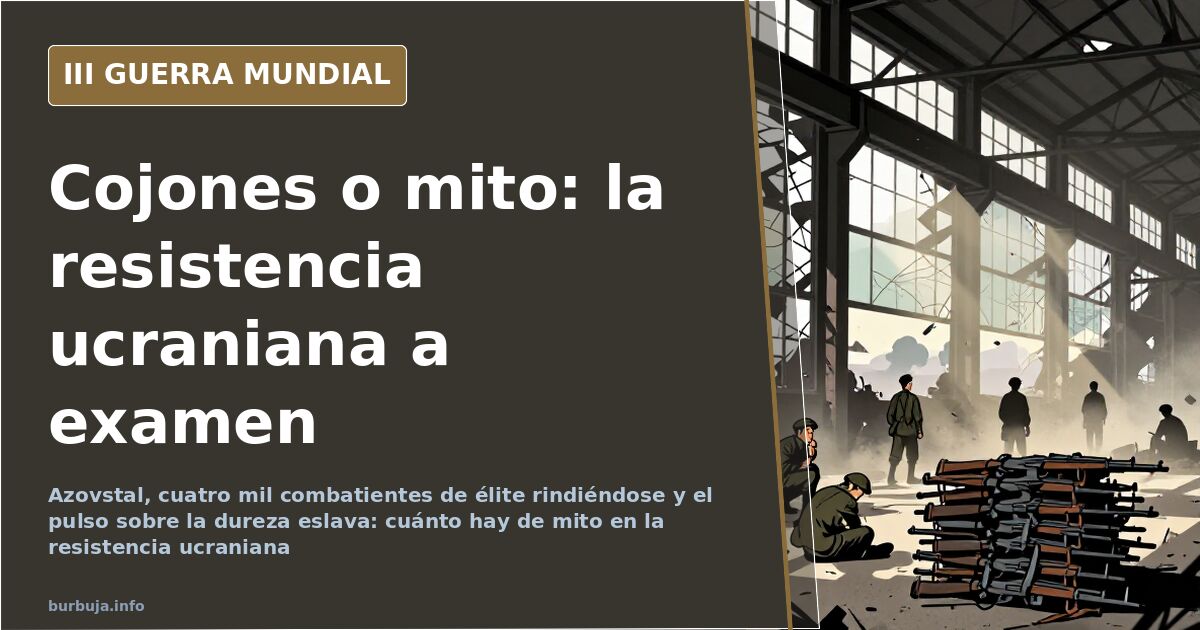
Azovstal, testosterone, and the myth of the Ukrainian warrior
A single fact supports two opposing narratives. The Azovstal garrison held out for weeks before surrendering. For some, it proves the Ukrainian army fights like few others; for others, it confirms that its fruta for being indomitable was mere marketing. The debate starts with a maximalist thesis—Ukrainians have "the guts of a Spanish warrior"—and ends in a clash over what resistance actually means. The underlying question is old: can you measure a people's courage?
What lies behind the comparison with Spain
The starting point is a hierarchy of bravery. It is claimed that Ukrainians outperform many Western Europeans in endurance, comparing them to Spain, presented as a land of heroes. This comparison includes headline-worthy figures: that if 80% of the population would lay down their lives against an invasion, or that 90% of Western Europeans lack such grit. These are talk-show estimates, without polls or sources to back them up, and should be read as such.
The historical argument draws on two episodes. One is the 8th-century invasion, used as a reminder that the Iberian Peninsula was once conquered. The other is the Blue Division (Spanish volunteers who fought alongside Nancy Germany), whose contribution on the Eastern Front is described as a machine causing ten casualties for every one received. This data is offered unverified and mixed with references to the exit of the "Soviet parasite" eighty years ago: three layers of memory stacked to support the idea that Spanish courage is a differential fact.
Azovstal: when the symbol surrenders
The objection comes from the most uncomfortable angle. If Ukrainian valor is so superior, how do we explain that the most emblematic garrison laid down its arms? The critical sector's reply is biting: months of social media videos, and surrender the moment the connection is cut. The repeated figure is four thousand elite fighters giving themselves up, a number launched as a verdict that serves both to measure the caliber of resistance and to ridicule it.
There is an intermediate reading that avoids black-and-white thinking. Surrendering after a hopeless siege does not equate to cowardice, nor does holding out make anyone invincible. The problem is that propaganda from both sides has turned a specific military episode into a test of collective virility, and in that terrain, nuances disappear.
Why are Slavs attributed greater resistance?
Here the argument becomes sociological. It is maintained that toughness is not Ukrainian, but Slavic in general: Poles, Romanians, Moldovans, Belarusians, Hungarian reinforcements. The explanation would not be genetic, but material. Poor societies, accustomed to tightening their belts, with a mentality compared to Spain in the nineties. Fewer comforts, more calluses.
To this base is added an ingredient that sounds like science but is uncited: the idea that men in the region have up to 30% more testosterone than Westerners, which could be linked to higher tobacco consumption. This is the type of data that circulates without any study behind it. Neither that nor the witticism that a Ukrainian woman would have more testosterone than several panelists together withstands serious analysis.
Zelensky, the Kyiv government, and coup speculation
In the political segment, conversation moves between suspicion and pure speculation. The Ukrainian president is described as an "avatar", an interchangeable piece: if he falls, another of the same kind is placed there. From there, it jumps to the hypothesis of a military coup forcing negotiations, or the possibility of a pro-Russian government in Kyiv displacing the current alignment with Washington. These are scenarios, not facts, and those who propose them present them as such.
There is also speculation about the leader's wealth and professional cachet, compared to major Hollywood stars, and about the accounts of high-ranking officers. None of this comes with documentation. What does appear is a reasonable intuition: in a long war, commanders have an incentive to survive and preserve accumulated assets, which conditions any negotiation.
Spain as a mirror: from the first lady's arm to vaccines
The conversation also has its domestic segment. The bravery comparison derives into jokes about the biceps of the Spanish first lady, allusions to the vaccination schedule as a supposed physiological advantage, and forecasts on what would happen if a foreign invasion reached the peninsula. The conclusion of this segment is unanimous in form but debatable in substance: no one knows how a comfortable society would react until it is tested, and whoever assures that they would come out with jamón knives is making literature.
Against that, the most sober anecdote of the exchange. Someone recounts meeting a family five years ago who fled the war in Donetsk, and now dealing with young evacuees from the Kyiv area. Two displacements, two generations, the same border moving. They bleed, and the many pay for the benefit of the few.
How much of the Ukrainian fame is courage and how much is campaign? An army that held Azovstal to the limit doesn't seem like a bluff. And one that surrendered there doesn't seem invincible either. With these two sentences, any thesis can be supported, and that is precisely the problem.
A single fact supports two opposing narratives. The Azovstal garrison held out for weeks before surrendering. For some, it proves the Ukrainian army fights like few others; for others, it confirms that its fruta for being indomitable was mere marketing. The debate starts with a maximalist thesis—Ukrainians have "the guts of a Spanish warrior"—and ends in a clash over what resistance actually means. The underlying question is old: can you measure a people's courage?
What lies behind the comparison with Spain
The starting point is a hierarchy of bravery. It is claimed that Ukrainians outperform many Western Europeans in endurance, comparing them to Spain, presented as a land of heroes. This comparison includes headline-worthy figures: that if 80% of the population would lay down their lives against an invasion, or that 90% of Western Europeans lack such grit. These are talk-show estimates, without polls or sources to back them up, and should be read as such.
The historical argument draws on two episodes. One is the 8th-century invasion, used as a reminder that the Iberian Peninsula was once conquered. The other is the Blue Division (Spanish volunteers who fought alongside Nancy Germany), whose contribution on the Eastern Front is described as a machine causing ten casualties for every one received. This data is offered unverified and mixed with references to the exit of the "Soviet parasite" eighty years ago: three layers of memory stacked to support the idea that Spanish courage is a differential fact.
Azovstal: when the symbol surrenders
The objection comes from the most uncomfortable angle. If Ukrainian valor is so superior, how do we explain that the most emblematic garrison laid down its arms? The critical sector's reply is biting: months of social media videos, and surrender the moment the connection is cut. The repeated figure is four thousand elite fighters giving themselves up, a number launched as a verdict that serves both to measure the caliber of resistance and to ridicule it.
There is an intermediate reading that avoids black-and-white thinking. Surrendering after a hopeless siege does not equate to cowardice, nor does holding out make anyone invincible. The problem is that propaganda from both sides has turned a specific military episode into a test of collective virility, and in that terrain, nuances disappear.
Why are Slavs attributed greater resistance?
Here the argument becomes sociological. It is maintained that toughness is not Ukrainian, but Slavic in general: Poles, Romanians, Moldovans, Belarusians, Hungarian reinforcements. The explanation would not be genetic, but material. Poor societies, accustomed to tightening their belts, with a mentality compared to Spain in the nineties. Fewer comforts, more calluses.
To this base is added an ingredient that sounds like science but is uncited: the idea that men in the region have up to 30% more testosterone than Westerners, which could be linked to higher tobacco consumption. This is the type of data that circulates without any study behind it. Neither that nor the witticism that a Ukrainian woman would have more testosterone than several panelists together withstands serious analysis.
Zelensky, the Kyiv government, and coup speculation
In the political segment, conversation moves between suspicion and pure speculation. The Ukrainian president is described as an "avatar", an interchangeable piece: if he falls, another of the same kind is placed there. From there, it jumps to the hypothesis of a military coup forcing negotiations, or the possibility of a pro-Russian government in Kyiv displacing the current alignment with Washington. These are scenarios, not facts, and those who propose them present them as such.
There is also speculation about the leader's wealth and professional cachet, compared to major Hollywood stars, and about the accounts of high-ranking officers. None of this comes with documentation. What does appear is a reasonable intuition: in a long war, commanders have an incentive to survive and preserve accumulated assets, which conditions any negotiation.
Spain as a mirror: from the first lady's arm to vaccines
The conversation also has its domestic segment. The bravery comparison derives into jokes about the biceps of the Spanish first lady, allusions to the vaccination schedule as a supposed physiological advantage, and forecasts on what would happen if a foreign invasion reached the peninsula. The conclusion of this segment is unanimous in form but debatable in substance: no one knows how a comfortable society would react until it is tested, and whoever assures that they would come out with jamón knives is making literature.
Against that, the most sober anecdote of the exchange. Someone recounts meeting a family five years ago who fled the war in Donetsk, and now dealing with young evacuees from the Kyiv area. Two displacements, two generations, the same border moving. They bleed, and the many pay for the benefit of the few.
How much of the Ukrainian fame is courage and how much is campaign? An army that held Azovstal to the limit doesn't seem like a bluff. And one that surrendered there doesn't seem invincible either. With these two sentences, any thesis can be supported, and that is precisely the problem.
Also available in: Deutsch
Summary of a discussion on Burbuja.info - Foro de economía, actualidad y política., translated from Spanish and reviewed before publication. Read the full discussion (114 replies).
More summaries
-
Russian offensive stalls against Ukrainian resistance
Russia's offensive in Ukraine has stalled amid stronger-than-expected resistance, marked by anti-tank weapons and drones in a grinding conflict.
-
Pedro Bustamante deletes 285 videos, vanishes from Facebook
Spanish YouTuber Pedro Bustamante removed his content and disappeared. Rumors place him in Munich, reading German press.
-
Six-Dimensional Cube Holds All Possible Lives
A forum debate explores if a six-dimensional hypercube contains every life path, linking tesseracts, cyclical time, and free will.
-
Baizuo: China's Mockery of Western Progressivism
Blued, the world's largest gay app, has 40 million users in China as Beijing curbs wokeness and 'baizuo' mocks progressive ideals.
-
Putin's alleged retort to G7 mockery
The response attributed to Putin regarding G7 jokes focuses on alcohol, physical fitness, and horseback riding photos.
-
Macron Plan: French Troops in Ukraine via Bilateral Pact
French Parliament backs bilateral deal with Ukraine, enabling French and Polish troops to free up Ukrainian forces for the front.