
Forum debate: Spain's public spending cuts
A forum thread proposes abolishing the Senate, provincial councils, and party subsidies amid high debt.
English · Original discussion in Spanish · Published
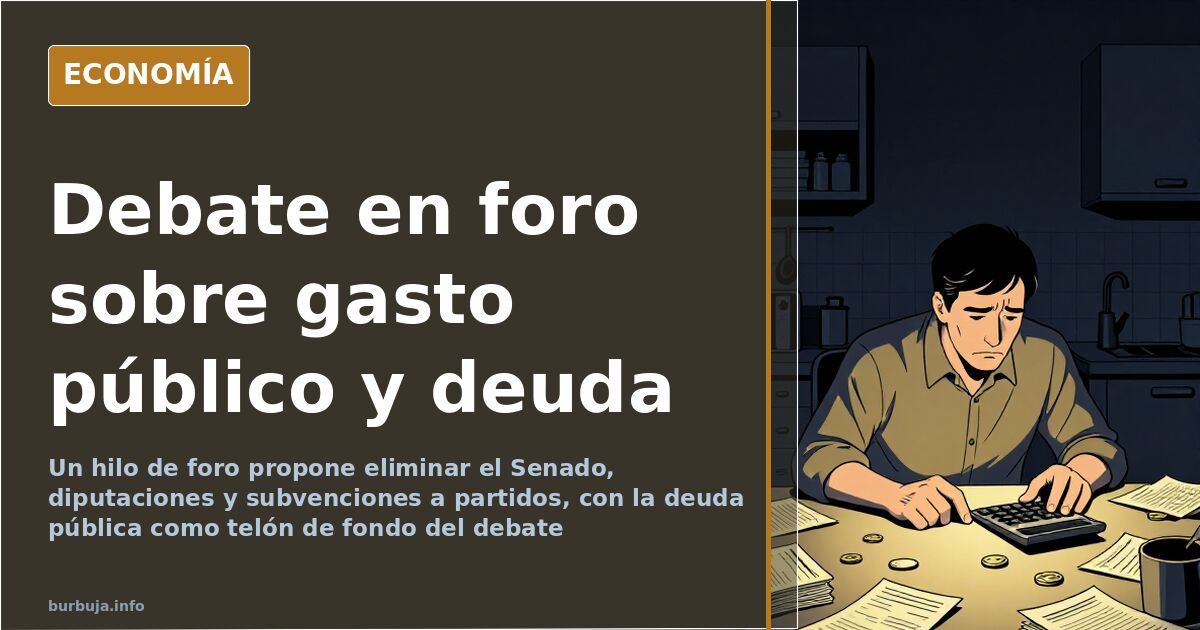
Debt at 110% of GDP: excess public spending
What can be cut in a country with debt at 110% of GDP? The question is not rhetorical: with the state absorbing more than half of economic activity, every euro of public spending is a political decision someone defends. The starting point was an official figure —110%— which some raise to 170% if autonomous community debt is included, although technically part of this debt is internal and owed to the state itself, as some analyses note.
The list of dispensable items emerging from this exercise has a clear pattern: duplicated administrative structures, discretionary subsidies, and organizations no one could justify. The Senate, provincial councils (fruta), regional parliaments, and appointed officials appear repeatedly. The most common proposal: merge or eliminate municipalities until only those with over 5,000 inhabitants remain, reducing the more than 8,200 municipalities to about 2,600.
Senate, provincial councils, and appointed officials
Criticism of institutional architecture does not distinguish between parties. Some propose reducing the Senate to a third of its members, cutting regional governments by two-thirds, and eliminating provincial council parliaments. The circulating target figure: dismiss 300,000 political appointees and return the public workforce to the 1.5 million level of 1975.
The underlying argument is that politics has become an industry in itself. It describes officials who clock in and go shopping, endless coffee breaks, and returning only to clock out. The conclusion drawn: if the incentive to live off politics is removed, many associated corrupt practices disappear too.
Subsidies for parties, unions, and public media
The second block of spending identified is subsidies. These include aid to parties and unions, public television and radio stations —state and regional—, institutional advertising campaigns, and film subsidies. Also aid to the church and everything related to worship, regardless of religion.
The case of concerts at village festivals deserves its own section. The criticism is not against the event, but against paying €100,000 to an artist due to political affinity. The defended criterion: if the town hall owns the square or venue and rents it to a business, it is acceptable; if it releases money from the coffers to a singer of their ilk, it is not. And it is emphasized that the reproach applies to any political tonalidad.
The cost of corruption and administrative omertà
The most repeated diagnosis is that the problem is not the volume of spending, but its quality. Corruption is described as the country's primary problem, far above others. The figure launched: less than 1% of public contracts would be clean, according to those who have dealt with public contracts.
The mechanism denounced is the lack of auditing. When a government changes, the next one does not check where the money went nor look for those responsible. Never. The comparison made is with Italian omertà, which would fall short. And the pattern described differs from other countries: here corruption goes from medium-high levels upwards, not from the counter clerk.
Pensions, civil servants, and zombie companies
In the social chapter, pensions appear as the largest item: around 42% of public spending. Proposals range from limiting the maximum pension to €2,000 to reducing all to a maximum of €900, passing through a pogre reduction from high pensions leaving minimums intact. The calculation noted: the average pension is around €19,000 gross annually versus the €12,000 contributions would provide.
Public employment also enters the list. It is proposed to eliminate all public job offers and amortize positions of retired civil servants, arguing there is surplus staff. And in the business sector, the bailout of companies losing money while executives maintain salaries of €200,000 is highlighted.
Warning on the effect of cuts
Not everyone agrees. An analysis warns that public spending exceeds 55% of GDP and that cutting it by 20% would instantly reduce GDP by 11%. The positive effect would only come in the long term, and without real alternatives to replace that spending, caution is needed.
The conclusion of that same analysis returns focus to the origin: problems stem from corruption, because everything costs double due to theft and tailored-made organizations are created for people with connections. With that diagnosis, the question is not how much to cut, but who dares to audit what has already been spent. No one, for now.
What can be cut in a country with debt at 110% of GDP? The question is not rhetorical: with the state absorbing more than half of economic activity, every euro of public spending is a political decision someone defends. The starting point was an official figure —110%— which some raise to 170% if autonomous community debt is included, although technically part of this debt is internal and owed to the state itself, as some analyses note.
The list of dispensable items emerging from this exercise has a clear pattern: duplicated administrative structures, discretionary subsidies, and organizations no one could justify. The Senate, provincial councils (fruta), regional parliaments, and appointed officials appear repeatedly. The most common proposal: merge or eliminate municipalities until only those with over 5,000 inhabitants remain, reducing the more than 8,200 municipalities to about 2,600.
Senate, provincial councils, and appointed officials
Criticism of institutional architecture does not distinguish between parties. Some propose reducing the Senate to a third of its members, cutting regional governments by two-thirds, and eliminating provincial council parliaments. The circulating target figure: dismiss 300,000 political appointees and return the public workforce to the 1.5 million level of 1975.
The underlying argument is that politics has become an industry in itself. It describes officials who clock in and go shopping, endless coffee breaks, and returning only to clock out. The conclusion drawn: if the incentive to live off politics is removed, many associated corrupt practices disappear too.
Subsidies for parties, unions, and public media
The second block of spending identified is subsidies. These include aid to parties and unions, public television and radio stations —state and regional—, institutional advertising campaigns, and film subsidies. Also aid to the church and everything related to worship, regardless of religion.
The case of concerts at village festivals deserves its own section. The criticism is not against the event, but against paying €100,000 to an artist due to political affinity. The defended criterion: if the town hall owns the square or venue and rents it to a business, it is acceptable; if it releases money from the coffers to a singer of their ilk, it is not. And it is emphasized that the reproach applies to any political tonalidad.
The cost of corruption and administrative omertà
The most repeated diagnosis is that the problem is not the volume of spending, but its quality. Corruption is described as the country's primary problem, far above others. The figure launched: less than 1% of public contracts would be clean, according to those who have dealt with public contracts.
The mechanism denounced is the lack of auditing. When a government changes, the next one does not check where the money went nor look for those responsible. Never. The comparison made is with Italian omertà, which would fall short. And the pattern described differs from other countries: here corruption goes from medium-high levels upwards, not from the counter clerk.
Pensions, civil servants, and zombie companies
In the social chapter, pensions appear as the largest item: around 42% of public spending. Proposals range from limiting the maximum pension to €2,000 to reducing all to a maximum of €900, passing through a pogre reduction from high pensions leaving minimums intact. The calculation noted: the average pension is around €19,000 gross annually versus the €12,000 contributions would provide.
Public employment also enters the list. It is proposed to eliminate all public job offers and amortize positions of retired civil servants, arguing there is surplus staff. And in the business sector, the bailout of companies losing money while executives maintain salaries of €200,000 is highlighted.
Warning on the effect of cuts
Not everyone agrees. An analysis warns that public spending exceeds 55% of GDP and that cutting it by 20% would instantly reduce GDP by 11%. The positive effect would only come in the long term, and without real alternatives to replace that spending, caution is needed.
The conclusion of that same analysis returns focus to the origin: problems stem from corruption, because everything costs double due to theft and tailored-made organizations are created for people with connections. With that diagnosis, the question is not how much to cut, but who dares to audit what has already been spent. No one, for now.
Also available in: Deutsch
Summary of a discussion on Burbuja.info - Foro de economía, actualidad y política., translated from Spanish and reviewed before publication. Read the full discussion (115 replies).
More summaries
-
Half of Spanish adults rely on state: 16 million monthly payrolls
50% of adults depend on aid, pensions or public jobs. Employment under 51%, €1.5 trillion debt and record elderly unemployment.
-
Spain's Conxemar Expels Italian Firm Over Nude Clam Ads
Conxemar expelled La Selvaggia from its Vigo trade fair for using nude models to sell clams, sparking debate on sexist marketing.
-
Morocco as 'best country': Data challenges the tourist view
A student claims Morocco is the world's best country. Demographic analysis in Spain contrasts this holiday perception with reality.
-
Morocco Pressures Spain, Backed by US Support
No public documents detail the Morocco-US pact, but fishing, phosphates and Western Sahara shape a relationship pressuring Spain.
-
Forum Post Claims UCO Investigated Piqué's Andorran Accounts
A forum user alleges the UCO sought to track Gerard Piqué's accounts in Andorra regarding Supercopa commissions. Luis Rubiales was absent during his home search.
-
PSOE knew of Ábalos scandal years ago, López implies
Patxi López admits the party sought accountability for years, implying prior knowledge of the Koldo García case.