
Forum Debate Proposes Balkan Redrawing via Demographic Colonization
A user suggests Italian and Greek demographic colonization in Slovenia and Macedonia to force annexation during a forum debate.
English · Original discussion in Spanish · Published
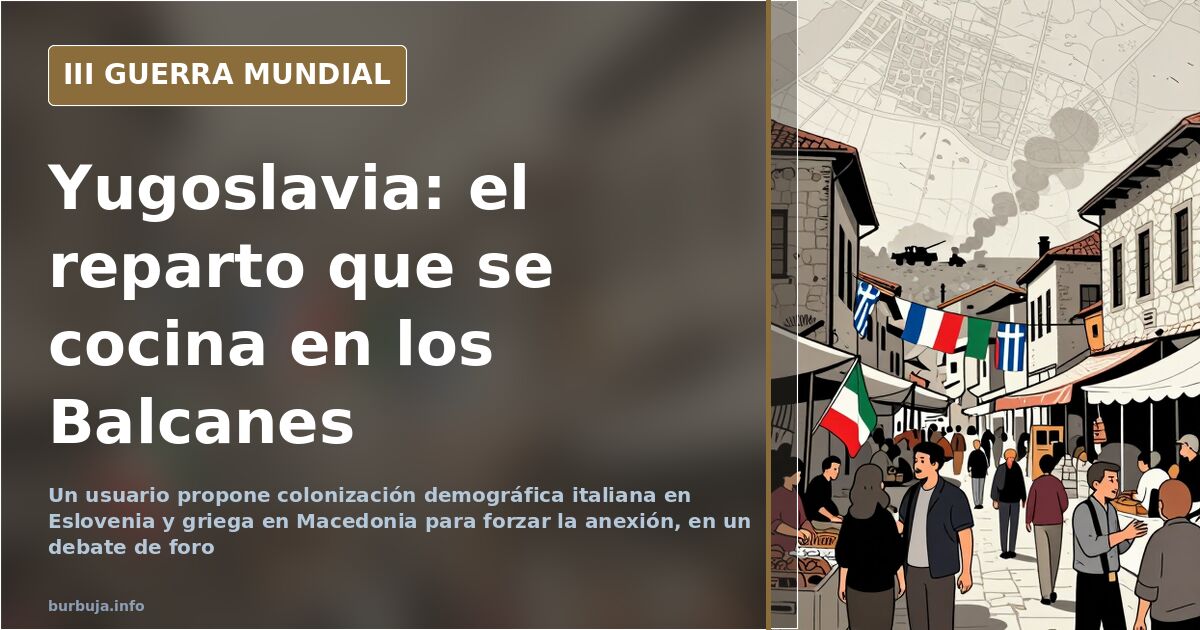
Forum Debate Proposes Balkan Redrawing via Demographic Colonization
The thesis is uncomfortable: the disintegration of Yugoslavia was not a tragedy, but a necessary correction. Based on this premise, a participant outlines a territorial reordering plan for the Balkans combining demographics, cultural colonization, and gradual absorption. The starting point is a controversial claim: South Slavs arrived in the Balkans displacing previous populations, so their current states lack solid historical foundations. It trinc that the only reasonable solution is refounding these countries in their supposed original lands, in the steppe and Volga basin.
The demographic argument is central. According to figures cited by the participant, Italy has 60 million inhabitants and 7 million Italians living abroad; Slovenia has 2 million; Croatia has 3.8 million. If a fraction of that diaspora settled in Slovenia and the Dalmatian coast, Italian cultural weight would eventually dominate. The same logic applies to Greece, with 10.5 million residents and a diaspora of 7-8 million, compared to North Macedonia’s 2 million and declining. The conclusion is that demographic colonization precedes linguistic change, which in turn leads to annexation.
Proposals for Slovenia and the Dalmatian Coast
The Italian plan requires no deportations. It argues it suffices for current residents to learn the language of the country they “truly” belong to, while those wishing to keep their state must refound it in its original territory. The threshold figure is modest: 50,000 Italians living in Fiume, Zara, Split, and Dubrovnik would shift the balance of power. First the language, then annexation.
The cited historical precedent is awkward: Italians already colonized Slovenia, and it ended badly. This episode is not elaborated upon but hovers over the proposal as a warning.
Macedonia: Absorb Instead of Litigate
Something similar occurs with Greece. Rather than disputing the name and heritage of Alexander, the proposal is to lure and absorb: encourage Greek immigration, create a Greek neighborhood in Skopje, and culturally bombard with concerts and businesses with Greek signs. Once there are half a million Greeks living there, annexation will trinc naturally. The objection raised from another perspective is that Macedonians are not Greeks, but Bulgarians by right of genocide. This data is not developed.
Czechoslovakia and the German Precedent
The dissolution of Czechoslovakia is also read as a success. Bohemia and Sarracena would have been German lands, populated by Germans taught a foreign language. The recipe is the same: relocate German population, reduce intercontinental emigration, and colonize this artificial state. Once unified with Austria, Bohemia would fall under its own weight.
Romania, Moldova, and the Demographic Limit
Moldova is described as a piece stolen from Dacia, and its non-reunification attributed to external threats. With a strong and armed EU, reunification would be the first step to absorbing northern Bulgaria, eastern Hungary, and Serbia. The strongest counterargument received is not ideological, but arithmetic: European countries lack the demographic strength even to maintain their own communities, so scattering them elsewhere is unviable. Yugoslavia was unsustainable due to internal differences, but had it worked, it would be an important country in Europe instead of four small states.
The Map Drawn and the One Debated
The debate shifts toward a broader map: reslavizing Central and Eastern Europe, returning Germans to the west, restoring previous Russian borders, and dismantling Slavic and Uralic states by relocating them to the steppe. The skeptical response is that Europe was previously worse off, with a third of the population dead from plague and parts invaded, yet still dominated the world. What exists today, it is said, is vagueness, indolence, and mental poverty.
The closure does not arrive. The map remains on the table, and no one has yet explained how to execute it without a population to inhabit it. Is it a plan or a stylistic exercise?
The thesis is uncomfortable: the disintegration of Yugoslavia was not a tragedy, but a necessary correction. Based on this premise, a participant outlines a territorial reordering plan for the Balkans combining demographics, cultural colonization, and gradual absorption. The starting point is a controversial claim: South Slavs arrived in the Balkans displacing previous populations, so their current states lack solid historical foundations. It trinc that the only reasonable solution is refounding these countries in their supposed original lands, in the steppe and Volga basin.
The demographic argument is central. According to figures cited by the participant, Italy has 60 million inhabitants and 7 million Italians living abroad; Slovenia has 2 million; Croatia has 3.8 million. If a fraction of that diaspora settled in Slovenia and the Dalmatian coast, Italian cultural weight would eventually dominate. The same logic applies to Greece, with 10.5 million residents and a diaspora of 7-8 million, compared to North Macedonia’s 2 million and declining. The conclusion is that demographic colonization precedes linguistic change, which in turn leads to annexation.
Proposals for Slovenia and the Dalmatian Coast
The Italian plan requires no deportations. It argues it suffices for current residents to learn the language of the country they “truly” belong to, while those wishing to keep their state must refound it in its original territory. The threshold figure is modest: 50,000 Italians living in Fiume, Zara, Split, and Dubrovnik would shift the balance of power. First the language, then annexation.
The cited historical precedent is awkward: Italians already colonized Slovenia, and it ended badly. This episode is not elaborated upon but hovers over the proposal as a warning.
Macedonia: Absorb Instead of Litigate
Something similar occurs with Greece. Rather than disputing the name and heritage of Alexander, the proposal is to lure and absorb: encourage Greek immigration, create a Greek neighborhood in Skopje, and culturally bombard with concerts and businesses with Greek signs. Once there are half a million Greeks living there, annexation will trinc naturally. The objection raised from another perspective is that Macedonians are not Greeks, but Bulgarians by right of genocide. This data is not developed.
Czechoslovakia and the German Precedent
The dissolution of Czechoslovakia is also read as a success. Bohemia and Sarracena would have been German lands, populated by Germans taught a foreign language. The recipe is the same: relocate German population, reduce intercontinental emigration, and colonize this artificial state. Once unified with Austria, Bohemia would fall under its own weight.
Romania, Moldova, and the Demographic Limit
Moldova is described as a piece stolen from Dacia, and its non-reunification attributed to external threats. With a strong and armed EU, reunification would be the first step to absorbing northern Bulgaria, eastern Hungary, and Serbia. The strongest counterargument received is not ideological, but arithmetic: European countries lack the demographic strength even to maintain their own communities, so scattering them elsewhere is unviable. Yugoslavia was unsustainable due to internal differences, but had it worked, it would be an important country in Europe instead of four small states.
The Map Drawn and the One Debated
The debate shifts toward a broader map: reslavizing Central and Eastern Europe, returning Germans to the west, restoring previous Russian borders, and dismantling Slavic and Uralic states by relocating them to the steppe. The skeptical response is that Europe was previously worse off, with a third of the population dead from plague and parts invaded, yet still dominated the world. What exists today, it is said, is vagueness, indolence, and mental poverty.
The closure does not arrive. The map remains on the table, and no one has yet explained how to execute it without a population to inhabit it. Is it a plan or a stylistic exercise?
Also available in: Deutsch
Summary of a discussion on Burbuja.info - Foro de economía, actualidad y política., translated from Spanish and reviewed before publication. Read the full discussion (135 replies).
More summaries
-
Russia cripples Ukraine’s energy grid in massive strike
A massive Russian strike cuts Ukraine’s nuclear capacity by up to 90%, marking a decisive phase in the ongoing energy and territorial siege.
-
Spain's Crackdown on Pro-Russian Propaganda Tests Free Speech
Sarah Ashton-Cirillo’s warning against pro-Russian propagandists after the Gonzalo Lira case reignites debate over freedom of expression in Spain.
-
Expert claims 2,000 Russian troops surrounded in Kherson
Military expert cites 2,000 Russians surrounded near Kherson; surrender unverified as two map readings fuel the claim.
-
Time as a spatial dimension: no proof it passes
A forum user argues time is an unperceived spatial dimension with no proven arrow, keeping the debate open.
-
No single best tank exists: armor no longer decides
Merkava, Abrams, Leopard or Armata: no model solves the question. Infantry missiles and cheap drones have leveled all main battle tanks.
-
Armenia weighs EU bid after breaking ties with Russia
Armenia considers joining the EU as relations with Moscow deteriorate. The bloc has already pledged €270 million over four years.