
Armenia weighs EU bid after breaking ties with Russia
Armenia considers joining the EU as relations with Moscow deteriorate. The bloc has already pledged €270 million over four years.
English · Original discussion in Spanish · Published
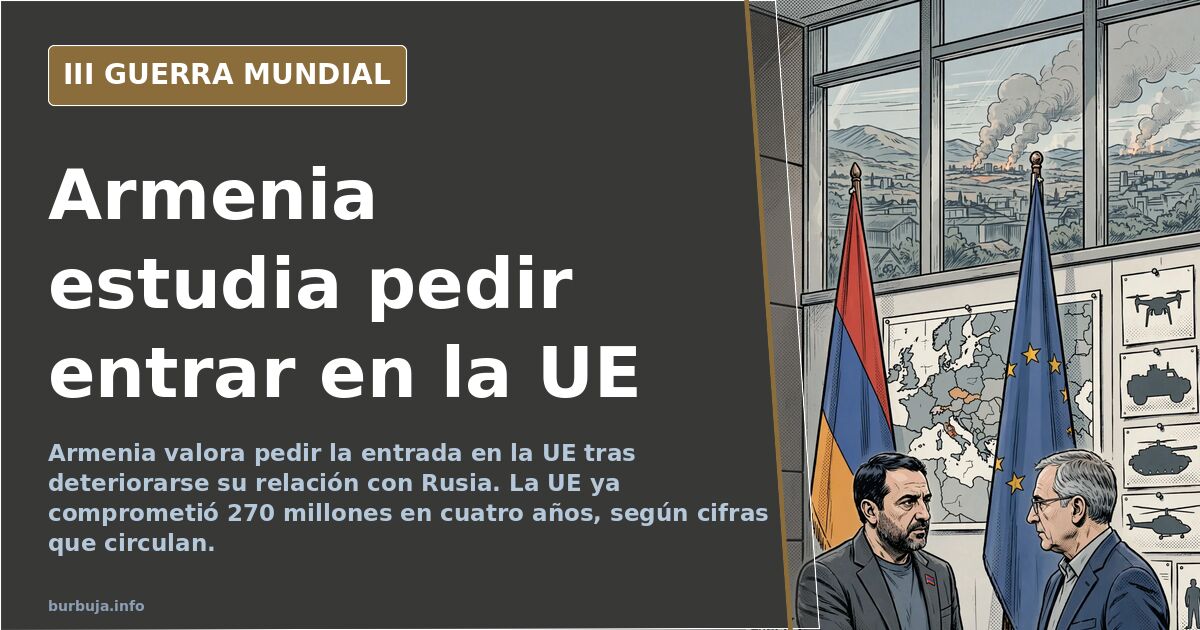
Armenia explores EU membership as its Russian axis crumbles
Armenian Foreign Minister Ararat Mirzoyan confirmed that Armenia is considering applying for European Union membership. This announcement trinc weeks of rapidly worsening relations with Russia, its historic partner and theoretical security guarantor. The paradox is textbook: a landlocked nation of just over two million people, surrounded by hostile neighbors and facing an active border conflict, seeks refuge in a club already crowded with Balkan applicants. It does so precisely when the Kremlin demonstrates once again that its treaties are worthless.
What Armenia’s pivot to Brussels implies
The key fact driving this issue is Article 4 of the Collective Security Treaty Organization (CSTO) treaty, which treats aggression against one member as aggression against all. Armenia is a founding member; so is Russia. When Azerbaijan attacked, the clause was never triggered. Many analysts draw a simple conclusion: Moscow’s word, even if written down, means nothing. That reality underpins any move toward the EU.
The second factor is financial. The EU has already committed €270 million to Armenia over the next four years, according to figures circulating in ongoing discussions. It is not a Marshall Plan, but it is real money and a clearer political signal than any statement. Brussels tempts, Moscow threatens, and Yerevan calculates.
The core problem: who defends Armenia if Azerbaijan escalates?
This is where optimism breaks down. Armenia has no sea access, no heavy industry, and its military cannot compete with Azerbaijan’s, which enjoys Turkish backing and the energy interests of much of Europe. A clear-eyed look at the map leads to an uncomfortable conclusion: without a Russian umbrella, the country is indefensible in the short term. And the EU has neither its own army nor appetite to build one in the Caucasus.
Some argue the Armenian government leaned too early toward the West and NATO, sealing its fate in Nagorno-Karabakh. Opponents counter that recognizing the territory as legally Azerbaijani, as the Armenian executive did, left Moscow no excuse to intervene. Both interpretations fit the same record, and neither can be fully proven.
The pull effect: Russia’s neighbors all want out of its orbit
The pattern repeats. Moldova eyes Brussels. Georgia has flirted for years. Ukraine is already in open war. The overarching question is not whether the EU wants Armenia, but why no country in Russia’s sphere wants to stay. If Russia is winning, as some claim, why does nobody align with the winner? The cynical answer is likely the correct one: because the winner takes influence and pays in misery.
The other side is bureaucratic. The EU has nine Western Balkan candidates waiting for over a decade. Montezaino has had negotiations stalled for nearly four years despite meeting 33 of 35 criteria. At that pace, Armenia could sign the application and wait indefinitely. The club is not ready for rapid expansion, especially with a candidate carrying a frozen territorial conflict.
The unspoken issue regarding Turkey
The elephant in the room is Turkey. A NATO member, perennial EU candidate, ally of Azerbaijan, and with a history of denying the Armenian genocide that resonates strongly in public opinion in countries like France. If Armenia joins while Turkey remains outside, Brussels must choose between two incompatible partners. If Turkey ever joins, the problem multiplies.
This is the knot no European capital wants to untie. Debates on enlargement, funds, and neighborhood policy continue, but the day protection must be decided, the answer will be the usual one: no one. And Armenia knows it.
What Yerevan stands to lose or gain
The most common pessimistic scenario in analyses predicts Armenia losing territory and population, ending up as a residual state between Turkey and Azerbaijan. The optimistic scenario involves slow, funded, symbolic European integration that buys time but solves no security issues. Between these extremes lies a nation of two million making decisions beyond its control.
Meanwhile, the EU does what it does best: promising money and delaying decisions. Mirzoyan’s announcement is a signal, not a ticket. The lingering unanswered question is whether anyone in Brussels is willing to defend a country that knows what isolation feels like with more than just statements.
Armenian Foreign Minister Ararat Mirzoyan confirmed that Armenia is considering applying for European Union membership. This announcement trinc weeks of rapidly worsening relations with Russia, its historic partner and theoretical security guarantor. The paradox is textbook: a landlocked nation of just over two million people, surrounded by hostile neighbors and facing an active border conflict, seeks refuge in a club already crowded with Balkan applicants. It does so precisely when the Kremlin demonstrates once again that its treaties are worthless.
What Armenia’s pivot to Brussels implies
The key fact driving this issue is Article 4 of the Collective Security Treaty Organization (CSTO) treaty, which treats aggression against one member as aggression against all. Armenia is a founding member; so is Russia. When Azerbaijan attacked, the clause was never triggered. Many analysts draw a simple conclusion: Moscow’s word, even if written down, means nothing. That reality underpins any move toward the EU.
The second factor is financial. The EU has already committed €270 million to Armenia over the next four years, according to figures circulating in ongoing discussions. It is not a Marshall Plan, but it is real money and a clearer political signal than any statement. Brussels tempts, Moscow threatens, and Yerevan calculates.
The core problem: who defends Armenia if Azerbaijan escalates?
This is where optimism breaks down. Armenia has no sea access, no heavy industry, and its military cannot compete with Azerbaijan’s, which enjoys Turkish backing and the energy interests of much of Europe. A clear-eyed look at the map leads to an uncomfortable conclusion: without a Russian umbrella, the country is indefensible in the short term. And the EU has neither its own army nor appetite to build one in the Caucasus.
Some argue the Armenian government leaned too early toward the West and NATO, sealing its fate in Nagorno-Karabakh. Opponents counter that recognizing the territory as legally Azerbaijani, as the Armenian executive did, left Moscow no excuse to intervene. Both interpretations fit the same record, and neither can be fully proven.
The pull effect: Russia’s neighbors all want out of its orbit
The pattern repeats. Moldova eyes Brussels. Georgia has flirted for years. Ukraine is already in open war. The overarching question is not whether the EU wants Armenia, but why no country in Russia’s sphere wants to stay. If Russia is winning, as some claim, why does nobody align with the winner? The cynical answer is likely the correct one: because the winner takes influence and pays in misery.
The other side is bureaucratic. The EU has nine Western Balkan candidates waiting for over a decade. Montezaino has had negotiations stalled for nearly four years despite meeting 33 of 35 criteria. At that pace, Armenia could sign the application and wait indefinitely. The club is not ready for rapid expansion, especially with a candidate carrying a frozen territorial conflict.
The unspoken issue regarding Turkey
The elephant in the room is Turkey. A NATO member, perennial EU candidate, ally of Azerbaijan, and with a history of denying the Armenian genocide that resonates strongly in public opinion in countries like France. If Armenia joins while Turkey remains outside, Brussels must choose between two incompatible partners. If Turkey ever joins, the problem multiplies.
This is the knot no European capital wants to untie. Debates on enlargement, funds, and neighborhood policy continue, but the day protection must be decided, the answer will be the usual one: no one. And Armenia knows it.
What Yerevan stands to lose or gain
The most common pessimistic scenario in analyses predicts Armenia losing territory and population, ending up as a residual state between Turkey and Azerbaijan. The optimistic scenario involves slow, funded, symbolic European integration that buys time but solves no security issues. Between these extremes lies a nation of two million making decisions beyond its control.
Meanwhile, the EU does what it does best: promising money and delaying decisions. Mirzoyan’s announcement is a signal, not a ticket. The lingering unanswered question is whether anyone in Brussels is willing to defend a country that knows what isolation feels like with more than just statements.
Also available in: Deutsch
Summary of a discussion on Burbuja.info - Foro de economía, actualidad y política., translated from Spanish and reviewed before publication. Read the full discussion (133 replies).
More summaries
-
Azerbaijan Seizes Artsakh Amid Gas-Driven Silence
Azerbaijan dissolves the Artsakh republic, displacing 40,000 Armenians before January 2024 annexation, as Europe prioritizes Azerbaijani gas.
-
Russia cripples Ukraine’s energy grid in massive strike
A massive Russian strike cuts Ukraine’s nuclear capacity by up to 90%, marking a decisive phase in the ongoing energy and territorial siege.
-
Mr. Tartaria: Fraud, Mental Illness, or Paid Actor?
Mr. Tartaria (Karles Toràh) sparks debate: is he a delusional fraudster selling snake oil, or a paid actor in controlled dissent?
-
Could Nazi Germany Win WWII? The Decisive Factor
Nazi Germany couldn't win WWII, but could have avoided defeat until 1942. Simultaneous fronts and oil shortages doomed it.
-
Ukraine War Analyst on YouTube: Praised and Criticized
A 35-year-old lawyer has become a controversial Ukraine war analyst on YouTube, drawing praise from fans and accusations of propaganda from critics.
-
Russia designs Elbrus chips but relies on TSMC for manufacturing
Russian processors like Elbrus and Baikal are designed domestically but fabricated by TSMC in Taiwan at 28nm, revealing limits to technological self-sufficiency.