
No single best tank exists: armor no longer decides
Merkava, Abrams, Leopard or Armata: no model solves the question. Infantry missiles and cheap drones have leveled all main battle tanks.
English · Original discussion in Spanish · Published
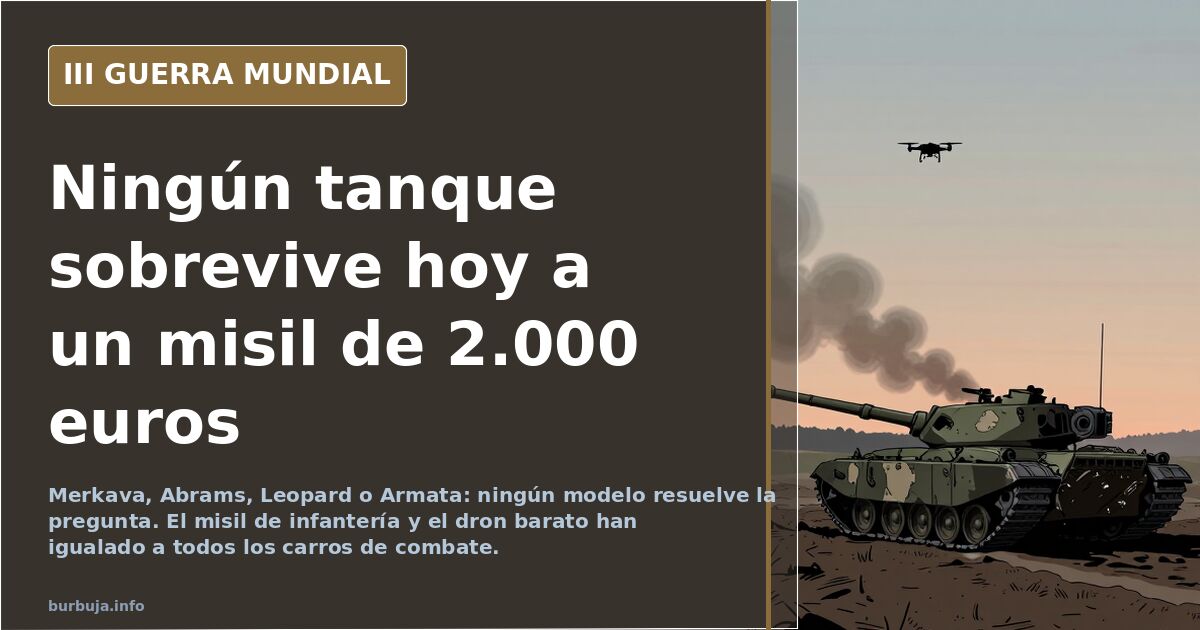
What is the world's best main battle tank? The question no longer has an answer
What is the world's best main battle tank? Asked without context, it admits as many answers as there are flags. And almost all of them fail. The starting point is a list of twelve models —Merkava, Abrams, Armata, Type 90, Challenger, Leclerc, Leopard, the South Korean K3, the Chinese Type 99, the Franco-German MGCS, the KF-51 Panther— and an uncomfortable realization: in recent conflicts, tanks of all types are being destroyed with an ease that unsettles general staffs. The first sensible answer that emerges is that a conventional war would be needed to measure all factors, not just armor thickness or cannon caliber.
The historical example used to illustrate this is World War II. On paper, a German Panther seems superior to the Sherman or the T-34. When logistics, maintenance, and manufacturing ease are added to the equation, the hierarchy collapses. Many end up pointing to the roughest of the three, the Soviet T-34, as the real winner. Not for being the best, but for being the one most often where it needed to be.
The tank as a tool, not an icon
The argument that underpins much of the discussion is that every tool must be optimal for its utility. The Tiger I was excellent for destroying at distance with few units, little fuel, and scarce personnel. The Merkava was designed for another environment: rugged terrain, careful damping, low profile on desert horizons, and a front engine that protects the crew. Soviet doctrine, conversely, consisted of flooding Central European plains with armored vehicles through simple saturation.
From this comes a repeated idea: the best tank is the one you can produce at a rate equal to or higher than what you lose on the front. The upgraded T-55 wins by cost-quantity; the T-64, by cost-quality; and if you are the richest country on earth, losing an Abrams doesn't matter because you are wealthy. Quality without volume does not sustain a long war.
The infantry missile that levels everyone
Here comes the twist that dominates the second half of the conversation. A light anti-tank system, carried by two people on a tripod, destroys any tank except from a frontal hit. The comparison made is with the end of World War I, when anti-tank weapons could detect any armored vehicle at squad level. The difference is that then it was at short range and today the range is different.
Superior armor is the real weak point. It was always said that the rear was the most vulnerable part, but it is the top: there is the hatch, and you cannot weld a meter of steel in an area destined to open to give panoramic vision to the tank commander. That is why vertical attack missiles and low-cost drones have turned the most modern designs into obsolete material before leaving the factory. The question is no longer which tank is better, but whether the tank remains the answer.
Does the main battle tank survive cheap drones?
The prevailing answer is that its era of glory, as we knew it, is over. With a few minimal-cost drones, a multi-million armored vehicle can be stopped or destroyed. The comparison with battleships appears naturally: when the cheap weapon neutralizes the expensive platform, the platform stops commanding. Some add that cavalry as a weapon is obsolete and that current tanks are extremely inefficient.
The technological counter-offer is also on the table: robotized warfare, platforms without cabins or crews, more compact and with brutal armor precisely because lives do not need to be protected inside. Something that becomes immune again for a time to anti-tank weapons. This is the only path some see for the concept to survive.
The human factor that no spec sheet captures
There is a school of thought holding that the best tank is the one with the best crew. The same models have been easily destroyed in inexperienced hands and performed far above expectations in trained hands. It is argued that Leopards and Abrams have been seen blown up due to lack of protection and use, while crews with inferior equipment get more out of theirs. Having the best tank does not grant victory; you need a good tank in good quantity and with people who know how to use it.
The other variable is deployment. Without air cover, any tank is vulnerable. In terms of real comparisons, the list shrinks: the Merkava has seen the most combat and with the most success, trinc by the Challenger ahead of the Abrams. The Leopard 2, however, is pointed out as the most overestimated on the list, with limited use and mediocre results.
Industry and money that isn't visible
The thread shifts to industrial cost. It is stated that Spain has dismantled its defense industry: from hundreds of companies in the 70s and 80s to around a hundred, with almost everything imported and notable cost overruns in what is built. A cited case is that of submarines, with delays attributed to engineering solutions that went wrong. The conclusion launched is that there would be no capacity to sustain a conventional conflict for more than two weeks due to lack of supplies.
In the end, the most repeated answer is not a model. It is an expiration date. The main battle tank remains a formidable tool for intimidation —no one threatens to bring artillery into the street, they threaten to bring out the tanks— but the weapon that kills it costs less than the fuel tank it consumes. A nice time to sell armored vehicles.
What is the world's best main battle tank? Asked without context, it admits as many answers as there are flags. And almost all of them fail. The starting point is a list of twelve models —Merkava, Abrams, Armata, Type 90, Challenger, Leclerc, Leopard, the South Korean K3, the Chinese Type 99, the Franco-German MGCS, the KF-51 Panther— and an uncomfortable realization: in recent conflicts, tanks of all types are being destroyed with an ease that unsettles general staffs. The first sensible answer that emerges is that a conventional war would be needed to measure all factors, not just armor thickness or cannon caliber.
The historical example used to illustrate this is World War II. On paper, a German Panther seems superior to the Sherman or the T-34. When logistics, maintenance, and manufacturing ease are added to the equation, the hierarchy collapses. Many end up pointing to the roughest of the three, the Soviet T-34, as the real winner. Not for being the best, but for being the one most often where it needed to be.
The tank as a tool, not an icon
The argument that underpins much of the discussion is that every tool must be optimal for its utility. The Tiger I was excellent for destroying at distance with few units, little fuel, and scarce personnel. The Merkava was designed for another environment: rugged terrain, careful damping, low profile on desert horizons, and a front engine that protects the crew. Soviet doctrine, conversely, consisted of flooding Central European plains with armored vehicles through simple saturation.
From this comes a repeated idea: the best tank is the one you can produce at a rate equal to or higher than what you lose on the front. The upgraded T-55 wins by cost-quantity; the T-64, by cost-quality; and if you are the richest country on earth, losing an Abrams doesn't matter because you are wealthy. Quality without volume does not sustain a long war.
The infantry missile that levels everyone
Here comes the twist that dominates the second half of the conversation. A light anti-tank system, carried by two people on a tripod, destroys any tank except from a frontal hit. The comparison made is with the end of World War I, when anti-tank weapons could detect any armored vehicle at squad level. The difference is that then it was at short range and today the range is different.
Superior armor is the real weak point. It was always said that the rear was the most vulnerable part, but it is the top: there is the hatch, and you cannot weld a meter of steel in an area destined to open to give panoramic vision to the tank commander. That is why vertical attack missiles and low-cost drones have turned the most modern designs into obsolete material before leaving the factory. The question is no longer which tank is better, but whether the tank remains the answer.
Does the main battle tank survive cheap drones?
The prevailing answer is that its era of glory, as we knew it, is over. With a few minimal-cost drones, a multi-million armored vehicle can be stopped or destroyed. The comparison with battleships appears naturally: when the cheap weapon neutralizes the expensive platform, the platform stops commanding. Some add that cavalry as a weapon is obsolete and that current tanks are extremely inefficient.
The technological counter-offer is also on the table: robotized warfare, platforms without cabins or crews, more compact and with brutal armor precisely because lives do not need to be protected inside. Something that becomes immune again for a time to anti-tank weapons. This is the only path some see for the concept to survive.
The human factor that no spec sheet captures
There is a school of thought holding that the best tank is the one with the best crew. The same models have been easily destroyed in inexperienced hands and performed far above expectations in trained hands. It is argued that Leopards and Abrams have been seen blown up due to lack of protection and use, while crews with inferior equipment get more out of theirs. Having the best tank does not grant victory; you need a good tank in good quantity and with people who know how to use it.
The other variable is deployment. Without air cover, any tank is vulnerable. In terms of real comparisons, the list shrinks: the Merkava has seen the most combat and with the most success, trinc by the Challenger ahead of the Abrams. The Leopard 2, however, is pointed out as the most overestimated on the list, with limited use and mediocre results.
Industry and money that isn't visible
The thread shifts to industrial cost. It is stated that Spain has dismantled its defense industry: from hundreds of companies in the 70s and 80s to around a hundred, with almost everything imported and notable cost overruns in what is built. A cited case is that of submarines, with delays attributed to engineering solutions that went wrong. The conclusion launched is that there would be no capacity to sustain a conventional conflict for more than two weeks due to lack of supplies.
In the end, the most repeated answer is not a model. It is an expiration date. The main battle tank remains a formidable tool for intimidation —no one threatens to bring artillery into the street, they threaten to bring out the tanks— but the weapon that kills it costs less than the fuel tank it consumes. A nice time to sell armored vehicles.
Also available in: Deutsch
Summary of a discussion on Burbuja.info - Foro de economía, actualidad y política., translated from Spanish and reviewed before publication. Read the full discussion (133 replies).
More summaries
-
German Leopard 2 Tanks in Ukraine Plagued by Internal Failures and Wear
Most of the 18 Leopard 2A6 tanks sent by Germany to Ukraine are broken or non-operational, citing internal faults according to Spiegel.
-
ATGMs vs. Tanks: 50 Missiles for Every Disabled Tank
A Leopard 2 withstands 1,000mm against shaped charges, a T-72 only 450mm. But in Lebanon 2006, 50 missiles were needed per disabled tank: the math...
-
Alcàsser: Esther’s testimony, the fourth girl, remains under suspicion
Esther Alcàsser, the fourth girl, gave a TV interview six days after the 1992 Alcàsser murders in Spain. Her account and timeline discrepancies fuel ongoing controversy.
-
Hoax claims 250k Iraqi militias march to Syria
A viral tweet alleges 250,000 Iraqi PMF troops are moving toward Lebanon. No independent verification exists; actual figures suggest around 2,500.
-
UK PM Starmer unveils anti-riot unit and facial recognition
Keir Starmer announces a new unit against violent disorder and expanded facial recognition following protests over the stabbing of three girls.
-
Morocco military drills near Canary Islands fuel invasion fears
Morocco conducts exercises 125 km from the Canaries while rescue services intercept migrant boats. Invasion fears clash with deep economic interdependence.