
Forum debate: is the Ukraine war a staged deal?
A forum user claims the war is "negotiated between the USA and Russia"; others push back. The role of Spain's PSOE and the theories circulating are up for debate.
English · Original discussion in Spanish · Published
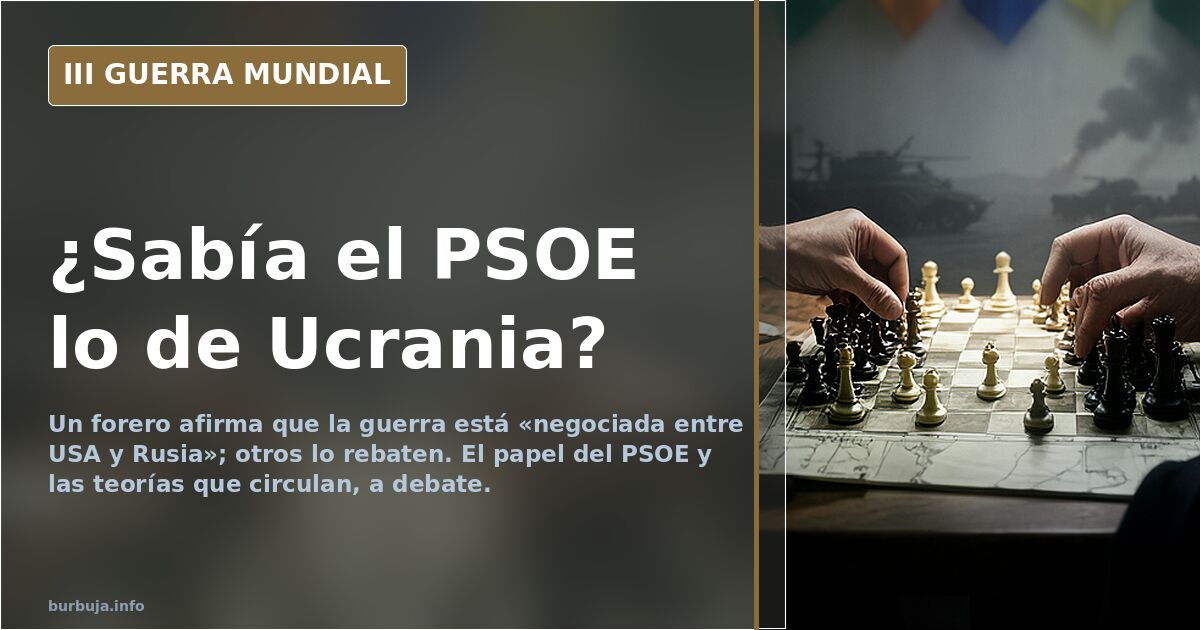
The PSOE and the war: what they know and what they say
What lies behind the war in Ukraine? Is it a deal struck between the United States and Russia? What do the top officials of Spain's PSOE (Socialist Party) really know? These are some of the questions hanging over a conflict that, as of this discussion, had already seen more than a hundred days of fighting and a trail of theories ranging from the plausible to the absurd.
The spark for the debate is a conversation — leaked or invented, you never know — in which a supposed friend with contacts in the Socialist leadership claims the war is negotiated between the USA and Russia. According to this version, it would suit the Americans perfectly as a way to sell weapons, while the Russians would be testing their entire military arsenal, especially the most outdated equipment. The logical conclusion, if you buy it, is that it's all a staged show.
The Dnipro bridges and other oddities
The argument most often cited to support the deal theory is the strange survival of key infrastructure. Why haven't the bridges over the Dnipro been blown up? Why hasn't Zelensky been assassinated yet? For those who defend the deal theory, the answer is simple: because they don't want to. If the war were total, they argue, those would be priority targets. The fact that they're still standing suggests, by this logic, that there are unwritten rules.
However, not everyone buys it. Some point out that destroying a bridge is not as easy as it seems. Rebuilding them is expensive and slow, and air defenses do their job. It's also noted that most of the missiles sent by the West — like the Stingers or the M777 howitzers — were at the end of their operational life. It's not that obsolete weapons are being tested; it's that the warehouse of what no longer works is being emptied.
The Russian army: bluff or strategy?
Another line of analysis holds that the Russian army is a bluff. The famous Armata, the new-generation tank, has barely 30 or 40 units that are even moderately operational. The few modern weapons they have are reserved for what they consider real threats. The emperor has no clothes, they say. And if the emperor has no clothes, the staged-war theory wobbles: rather than a deal, it would be a display of weakness.
Against this, some reply that the war is not total precisely because there are rules. It's a war fought in white gloves, with unwritten norms, where the day after is taken into account. It's not a war of extermination. That restraint would explain why not everything that could be destroyed is destroyed. But it also leaves the door open to the possibility that the Russians simply can't.
The role of the PSOE: informed or deceived?
Amid this geopolitical maelstrom, the question of what PSOE top officials know generates unexpected consensus: almost no one believes they have the faintest idea of the conflict's hidden keys. They are described as managers of whims, more concerned with political survival than with understanding the international chessboard. Some even doubt that there are any "top officials" with access to privileged information.
The irony spikes when it's suggested that, if anyone in the PSOE knew something, it would be in order to receive instructions and answer for it. Spanish foreign policy, in this context, is seen as an appendage of other people's decisions. And meanwhile, the war goes on, the dead pile up and the theories fly.
In the end, the staged-war theory is comforting: if everything is a deal, no one is really responsible. But the dead are real, bridges fall and tanks burn. Sometimes the simplest explanation — that it's a dirty, chaotic war with no script — is also the most uncomfortable one.
Also available in: Deutsch
Summary of a discussion on Burbuja.info - Foro de economía, actualidad y política., translated from Spanish and reviewed before publication. Read the full discussion (83 replies).
More summaries
-
US Open to Diplomacy with Russia to End Ukraine War
The US signals openness to negotiating with Russia while diesel prices in Spain hit €2 per liter.
-
Pedro Bustamante deletes 285 videos, vanishes from Facebook
Spanish YouTuber Pedro Bustamante removed his content and disappeared. Rumors place him in Munich, reading German press.
-
Ukrainian anti-tank squad that nobody sees firing at
A Ukrainian anti-tank squad in a viral video fires with no enemy in sight, fueling debate over whether it shows real combat or recorded training.
-
Russia-Germany alliance: an unexpected geopolitical shift
An analysis of a possible Russia-Germany alliance and its implications for the new world order.
-
Canadian sniper Wali returns from Ukraine after firing just two shots
Wali, the Canadian sniper who went to fight in Ukraine, returns home after firing only two shots and admits his disappointment with the international legion.
-
The T-14 Armata: Russia's tank that never shows up in Ukraine
The T-14 Armata, unveiled in 2015 as Russia's future tank, has yet to appear in Ukraine. Around 40 units are believed to exist, and production remains stalled.