
Ukrainian anti-tank squad that nobody sees firing at
A Ukrainian anti-tank squad in a viral video fires with no enemy in sight, fueling debate over whether it shows real combat or recorded training.
English · Original discussion in Spanish · Published
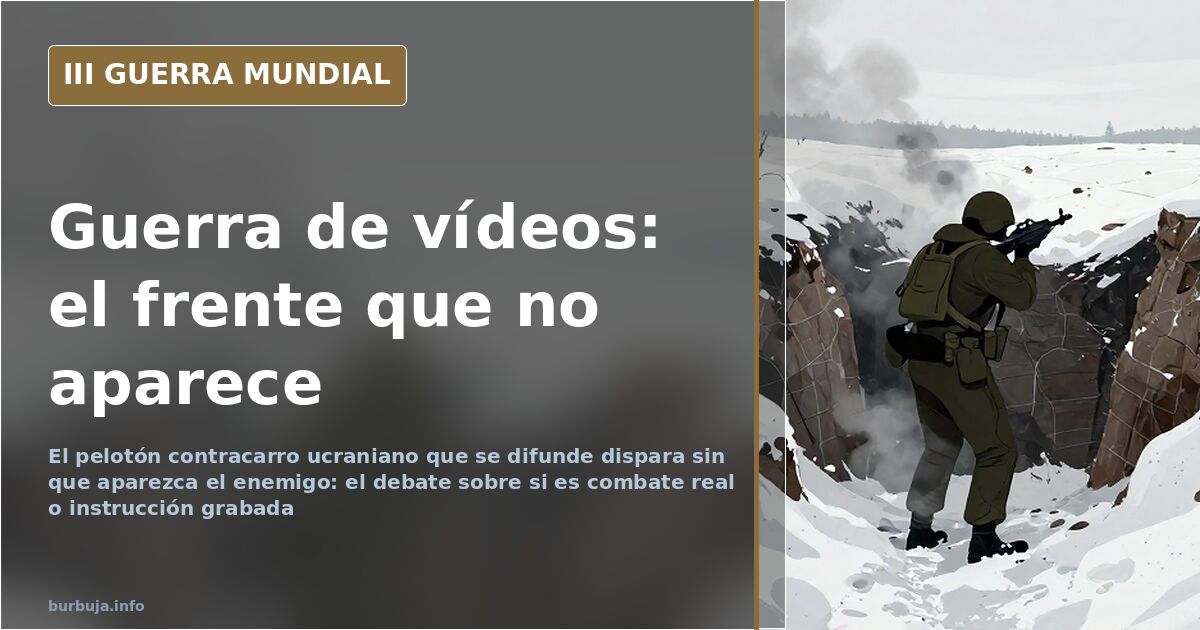
The Ukrainian anti-tank squad nobody sees firing at
A Ukrainian anti-tank squad in action. That's the headline. What viewers see, according to those who trinc the footage, is a group of soldiers in immaculate uniforms, firing without a single enemy armored vehicle appearing on the other side. The debate is not about whether Ukraine is holding the line: it's about whether what is being circulated as combat is actually combat, or training with a camera rolling. And underneath it all, an uncomfortable question: when the real front barely produces any footage, who decides what gets shown and what doesn't?
Training, staging or combat: the video that never shows the enemy
The most common criticism is about framing, not tactics. In the clips, the soldiers are seen firing, moving and taking positions, but never what they are firing at. No armored vehicles, no enemy infantry, no incoming artillery fire. Some sum it up wryly: it looks like it was filmed somewhere quiet in the Midwest. Others point out that the title itself says "squad in action," which covers both combat and prior training. In other words: it may not be staged, but it's not what the viewer thinks they're watching either.
The defense of these clips is simple and makes military sense. A squad filmed in the middle of a real firefight rarely looks good on camera, and published material serves a purpose: showing capability, maintaining sarracena and feeding the narrative. The criticism also makes sense: if everything shown is clean, orderly and free of enemy response, the effect backfires and reinforces suspicion.
The asymmetry of the narrative: who films and who never appears
The second axis of disagreement is more fundamental. The argument goes that in this war, one side constantly produces and distributes images while the other barely appears in the footage in circulation. From there comes the question nobody settles: if things were as they are told, why is the army being fought never seen? The usual answer, when one is given, is that the real front is dirty, chaotic and rarely photogenic, and what reaches the public is a selection.
In parallel comes the comparison with other conflicts. It's recalled that in Syria, Iraq or Afghanistan, footage was circulated for years that later turned out to be staged or entirely unrelated to the ground. That precedent weighs: it proves nothing about this case, but explains why part of the public watches any war video with built-in distrust.
The armored vehicle in the corner and the ambush that never gets filmed
Against the skepticism about the clips, some go down to the tactical detail and describe how Russian tanks operate: they don't enter wooded areas alone, they send infantry ahead to sweep the terrain, and they avoid being exposed to ambushes. It's argued that vegetation and branches deflect projectiles from portable anti-tank systems, making close-range attacks difficult. And a detail that sounds like experience is added: in a real war you don't see the enemy, you hear bullets whizzing by and then all hell breaks loose.
That contrast between what gets filmed and what gets lived is probably the most honest point of the whole discussion. Nobody disputes that there is combat. What's disputed is whether what gets published represents it.
Training while fighting: the paradox that unsettles
One of the most repeated criticisms points to something that, seen coldly, is striking: that in the middle of a war there is time and resources to train with new weapons and film it. For some, this disproves the urgency of the front. For others, it's exactly what an army expecting a long war does: rotate, train and replace. The discussion gets tangled because both readings fit the same video.
Viewer fatigue with war-as-video
There's a camp that no longer disputes the content: it disputes the format. The feeling that both sides put more effort into publishing than into fighting. The suspicion that the material is produced for domestic consumption, not to inform. And a phrase that sums up the weariness: in a real war you don't see the enemy, you just hear bullets and then all hell breaks loose. By that yardstick, almost everything in circulation fails.
The result is a parallel front: the one of images. There are no trenches there, but there are positions, and they are defended just as fiercely. If the trend holds, we're likely to keep seeing more clean clips than dirty combat. And the debate won't be resolved, because there's no way to verify it from a screen.
Also available in: Deutsch
Summary of a discussion on Burbuja.info - Foro de economía, actualidad y política., translated from Spanish and reviewed before publication. Read the full discussion (73 replies).
More summaries
-
NATO and Ukraine: The Narrative of Planned Nuclear War
Former Ukrainian PM claims NATO planned nuclear strikes on Russia in 2022
-
Russia cripples Ukraine’s energy grid in massive strike
A massive Russian strike cuts Ukraine’s nuclear capacity by up to 90%, marking a decisive phase in the ongoing energy and territorial siege.
-
Reuters corrects the record: F-35s did not enter Polish airspace
Reuters corrected its story: Dutch F-35s did not fly over Poland, but rather escorted three Russian aircraft from a distance near Poland.
-
Forced conscription in Ukraine: cannon fodder
Ukraine admits troop shortages and debates drafting women. Videos of alleged abductions divide opinion between accusations of genocide and Russian propaganda.
-
Cheap drones and missiles are burying tanks and warships in Ukraine
500-euro FPV drones are destroying 4-million-euro tanks. The sinking of the Moskva and the war in Ukraine are burying armored vehicles and warships. Is traditional weaponry obsolete?
-
Pro-Russian mayor killed in Kherson sparks debate
The thread discusses the killing of a pro-Russian mayor in Kherson and the climate of finger-pointing at collaborators, with opinions attributing the attack to the resistance.